

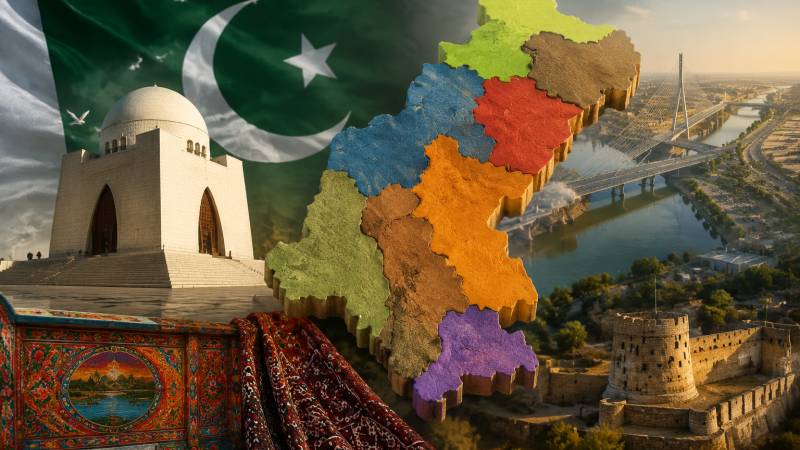
The debate over the creation of new provinces in Pakistan is not a new phenomenon. However, in recent years, this issue has acquired extraordinary political significance. Alongside proposals concerning Punjab, Balochistan, and Khyber Pakhtunkhwa, suggestions to divide Sindh into two or more administrative units have also surfaced from time to time. These proposals have been presented, both officially and unofficially, under various justifications such as administrative reforms, improved governance, and a more equitable distribution of resources. In the specific case of Sindh, however, the debate has extended far beyond the question of administrative efficiency. It has evolved into a fundamental issue concerning Pakistan's federal structure, the national question, the constitutional compact, provincial autonomy, and the role of the state's centres of power.
A significant segment of Sindh's political, academic, and civil society regards such proposals not merely as administrative restructuring but as a fundamental intervention in the federal compact. Their view is that altering the geographical integrity of a historic province without the explicit consent of its people would not only weaken the federal spirit embodied in the Constitution but would also seriously undermine the political trust that exists among Pakistan's diverse nationalities. The central question in this debate is whether the creation of new provinces would genuinely strengthen Pakistan's federation, or whether it would instead deepen national contradictions, intensify political mistrust, and increase tensions between the federation and the provinces. More specifically, if an attempt were made to divide Sindh, what political, constitutional, economic, and national consequences might such a step produce? Would such a measure contribute to greater stability in Pakistan, or would it ultimately weaken the very philosophical and constitutional foundations upon which the federation rests?
The concerns surrounding Sindh are particularly sensitive because Pakistan was not established as a unitary state but rather emerged as a federation formed through the partnership of historically distinct provinces, regions, and nationalities. The Lahore Resolution of 23 March 1940 envisaged autonomous federal units for the Muslim-majority regions of British India. Many constitutional scholars and political historians maintain that Punjab, Sindh, Balochistan, and the North-West Frontier Province (now Khyber Pakhtunkhwa) joined Pakistan while retaining their historical, geographical, and political identities. According to this perspective, the historical integrity of these provinces constituted an essential component of the federal compact and, therefore, cannot be altered merely on the basis of the political preferences of a particular group or considerations of administrative convenience. It is also important to recall that the most serious constitutional crisis in Pakistan's early history emerged when federal principles were subordinated to centralization. The One Unit Scheme of 1955 stands as a clear example of this process, under which all the provinces of West Pakistan were compulsorily merged into a single administrative unit. This experiment not only generated widespread mistrust among the smaller provinces but also became one of the major factors contributing to growing doubts about the federal system in East Pakistan. This historical experience demonstrates that federal issues are more likely to be resolved through political consensus than through administrative decrees.
The central question in this debate is whether the creation of new provinces would genuinely strengthen Pakistan's federation, or whether it would instead deepen national contradictions, intensify political mistrust, and increase tensions between the federation and the provinces.
Supporters of the creation of new provinces argue that rapid population growth, increasing urbanization, administrative complexities, and developmental needs necessitate the establishment of smaller administrative units. In several federal countries, including India, Nigeria, Ethiopia, and others, new states or provinces have been created from time to time. At first glance, this argument appears reasonable. However, adopting such a policy in Pakistan solely on the basis of administrative considerations, while disregarding the country's unique historical, national, and political circumstances, cannot provide a comprehensive solution to the issue. In Pakistan, provinces are not merely administrative units or territorial divisions; they also represent historical nationalities, languages, cultures, and political identities. Consequently, if national identities are weakened in the name of administrative efficiency, such a policy is likely to prove detrimental rather than beneficial to the federation. The principal objection to the proposed division of Sindh is that such a step could further strengthen feelings of deprivation, mistrust, and political insecurity among the Sindhi population. The stability of a federation depends not only upon constitutional arrangements but also upon voluntary political partnership, mutual trust, and a shared sense of justice. When a constituent unit of a federation comes to believe that decisions concerning its historical status, natural resources, or constitutional powers are being made without regard to its political will, the emergence of tensions within the federal relationship becomes a natural consequence.
Another important dimension of the debate concerning Sindh is its economic significance. A substantial proportion of Pakistan's maritime trade, ports, natural gas reserves, coal resources, energy projects, industrial centres, and national revenue is associated with Sindh. Under such circumstances, if the province were to be divided in an atmosphere of political controversy, new and potentially more complex disputes could arise over the distribution of resources, water rights, the administration of ports, ownership of natural resources, the National Finance Commission (NFC) Award, urban and rural representation, and the distribution of administrative powers. Such disputes would not remain confined to Sindh but could have broader implications for the functioning of Pakistan's federal system.
Another highly significant dimension of this debate concerns the structure of state power in Pakistan. Many political analysts argue that the country's central institutions have historically favoured a strong centre rather than a strong federation. According to this perspective, whenever provincial autonomy begins to expand, attempts are made, in one form or another, to reassert administrative or political centralization. Within this context, some political commentators interpret the ongoing debate over the creation of new provinces as being closely linked to the centralized structure of state power. In her influential book Military Inc.: Inside Pakistan's Military Economy, Ayesha Siddiqa argues that Pakistan's military has evolved beyond the role of a purely defensive institution and has gradually become a major economic actor with extensive interests in land, industry, housing, business, and other sectors of the economy. Some political observers contend that if the number of administrative units increases and political power becomes more fragmented, it may become comparatively easier for non-civilian central institutions to preserve and expand their influence. From this perspective, they argue that the issue of creating new provinces in Pakistan has been promoted for precisely this reason.
From a critical perspective, one of the enduring tragedies of Pakistan's political history has been that nearly every constitutional crisis has been approached primarily as an administrative or security issue, whereas at its core lay questions of political representation, federal justice, and trust among the country's constituent nationalities. The emergence of Bangladesh, the recurring crises in Balochistan, the failure of the One Unit Scheme, and the long political struggle that culminated in the Eighteenth Constitutional Amendment all provide compelling evidence that a federation cannot be sustained through coercive power alone. Rather, its stability depends upon political equality, respect for provincial autonomy, and confidence in the constitutional order. Against this backdrop, any attempt to divide Sindh without broad political consensus, public consent, and federal accommodation would not merely constitute an administrative reorganization; it could evolve into a fundamental political crisis concerning the very philosophy of Pakistan's federal system. Such a step could further reinforce the perception among the smaller provinces that the federation is neither willing nor prepared to regard their historical status, national identities, and constitutional rights as permanent and secure. Over the long term, such a loss of confidence could prove even more damaging to the federation than the problems that proposals for new provinces are purportedly intended to address.
Accordingly, if Pakistan is to preserve its political stability, national cohesion, and federal future, any debate over the creation of new provinces should not be confined to the narrow framework of administrative convenience. Instead, it should be examined within the broader context of the Constitution, federalism, the national question, historical realities, and democratic consent. If the state is genuinely committed to strengthening the federation, the appropriate course lies not in weakening the historical provinces which also constitute the historic homelands of Pakistan's different nationalities but in faithfully implementing the federal spirit of the 1973 Constitution, the Eighteenth Constitutional Amendment, provincial autonomy, effective local government institutions, and the equitable distribution of resources. A strong federation emerges from strong provinces, not from weak ones.