

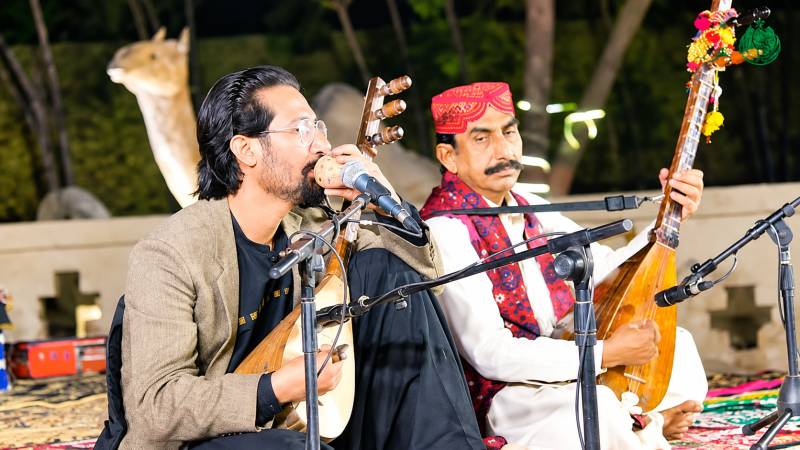
For centuries, Sindh has produced artists who have carried the spirit of the land to the world through their voices, instruments and poetry. Even today, young musicians are working to keep the land’s traditional sounds alive amid the rapid changes in contemporary music. Malhar Junejo, a young folk musician from Badin, is one of them. He has made Sindh’s folk music and its traditional instruments an important part of his life, combining performance with research and documentation.
At a time when music is increasingly shaped by digital platforms, modern instruments and global trends, Junejo has chosen to look towards some of Sindh’s oldest musical traditions not simply as remnants of the past, but as a living part of contemporary culture. Junejo’s relationship with folk music began in childhood. His father was a journalist and social worker and Malhar travelled with him through different towns and villages of Sindh. During these journeys, he encountered a musical landscape in which traditional instruments such as the Nar, Alghoza, Boreendo, Chang, Banjo and Sarangi could still be heard. According to Malhar, two decades ago, these instruments were commonly heard in Badin and surrounding areas. Over time however, many of the older musicians disappeared, while fewer members of the younger generation showed interest in learning the instruments.
A Journey That Began at the Saman Sarkar’s Festival
The annual Saman Sarkar Urs in Badin also played an important role in Junejo’s musical journey. The festival is considered one of the major gatherings in the Laar area, where folk musicians and fakirs perform traditional music outside the shrine. Those sounds left a lasting impression on him. Gradually, Malhar Junejo developed a desire to learn the instruments he had heard during his childhood. He began training with local musician Ustad Haroon Lund in playing the alghoza and boreendo. What began as curiosity eventually became a lifelong journey connected to music, research and cultural preservation. Junejo later pursued formal education in music. In 2014, he joined the National College of Arts (NCA) Lahore, for a master’s degree in musicology, where he focused particularly on the traditional Sindhi instrument. His final research was titled: “The Lost Art of Alghoza: A Brief Study of History, Making, Playing and Understanding of Alghoza.”
The research was later published as a book by the Sindh Culture Department in 2021. It documents not only the instrument itself but also the musicians, craftsmen, melodies, methods of construction and oral traditions associated with it—knowledge that is increasingly at risk of disappearing.
Boreendo: An Ancient Sound at Risk
Among Sindh’s traditional instruments, the “Boreendo” holds a distinctive place. Made from clay, the small and simple-looking instrument produces a unique sound and represents an important part of Sindh’s traditional musical heritage. In 2025, UNESCO inscribed “Boreendo: ancient dying folk musical instrument, its melodies, knowledge and skills” on the List of Intangible Cultural Heritage in Need of Urgent Safeguarding. UNESCO describes the tradition as being closely connected to rural life and the natural environment of Sindh, with the clay instrument traditionally played at weddings, festivals and winter gatherings. The UNESCO recognition also highlights the need to pass the knowledge and skills associated with the instrument on to younger generations. For Junejo, the Boreendo is more than a musical instrument. It is part of Sindh’s cultural memory. He not only plays the boreendo but has also learned how to make it. His interest therefore extends beyond performance to the construction of the instrument and the traditional knowledge associated with it.
Alghoza Two Flute One Voice
The Alghoza is another distinctive instrument of Sindh’s folk music. Made up of two flute-like pipes, it produces a characteristic sound deeply associated with the musical traditions of Sindh’s villages, desert and riverine communities. Malhar Junejo has gone beyond simply playing the instrument. He has researched its history, construction, musicians and traditions. During his research, he interviewed several folk musicians and attempted to document a musical tradition that has largely been passed down orally. For him, folk music is not about returning to the past. It is about carrying the sounds of the past to new audiences.
Junejo says that many of the younger generations of Sindh’s traditional musicians did not continue learning the instruments played by their elders. As a result, an important chain of cultural transmission has gradually weakened. He describes this knowledge as a kind of “father tongue” a cultural language passed from one musician to another not through books, but through listening, observing and playing. During his research and travels, Junejo met several elderly folk musicians who were in the final stages of their lives. Some of them gave their instruments to him as gifts. With those instruments came not only objects but also stories, memories and years of musical knowledge. Junejo’s work demonstrates that folk music does not have to remain confined to elderly musicians or rural festivals. Young people can learn it, research it and introduce it to audiences around the world. Today, Junejo plays several of Sindh’s traditional instruments, including the alghoza, nar and boreendo.
From Shah Jo Raag to Dambura
Junejo’s interest in Sindh’s musical heritage has continued to expand. He is now also learning Shah Jo Raag and dambura. His teacher in this tradition is Kashif Qambarani, who spent twelve years learning and performing Shah Jo Raag at the shrine of Shah Karim. The relationship between teacher and student reflects the very nature of traditional music: it survives through transmissionfrom master to apprentice, from one community to another and from one generation to the next.
Malhar’s work is not limited to performing and making traditional instruments. He is also researching Sindh’s ancient musical heritage and working with the Sindh Culture Department on documenting traditional instruments and understanding their construction. Part of his interest lies in exploring how ancient instruments associated with Sindh’s archaeological heritage might be understood and, where possible, recreated through historical evidence, archaeological findings and surviving musical traditions. His work therefore brings together music, archaeology, history, musicology and living folk traditions.
Junejo now performs the boreendo, nar, alghoza and other traditional instruments at cultural programmes and festivals. His performances are distinctive because he does more than play the instruments he also explains their history and cultural significance to audiences. In this way, a musical performance becomes more than entertainment. It becomes a way of introducing Sindh’s cultural heritage to a wider audience. When an ancient Sindhi instrument is played on a modern stage, it carries with it the history, traditions and musical memory of the region.
Sindh’s cultural heritage is vast, but preserving it requires more than celebrating the past. It needs musicians, researchers, craftspeople and young people willing to give traditional knowledge a place in the present. Malhar Junejo’s story is one such effort. A young man from Badin learning Sindh’s traditional instruments, studying musicology, researching the alghoza, learning to make ancient instruments and presenting their sounds to contemporary audiences represents a journey in which music and cultural preservation come together. Perhaps cultural heritage remains truly alive only when a young generation stops seeing it merely as something inherited from the past and begins making it part of its present and future. In Malhar Junejo’s hands, the sound of the boreendo is more than the sound of an instrument. It is an echo of an ancient memory of Sindha voice born from clay, carrying centuries of history and finding its way back into the world through a new generation.