

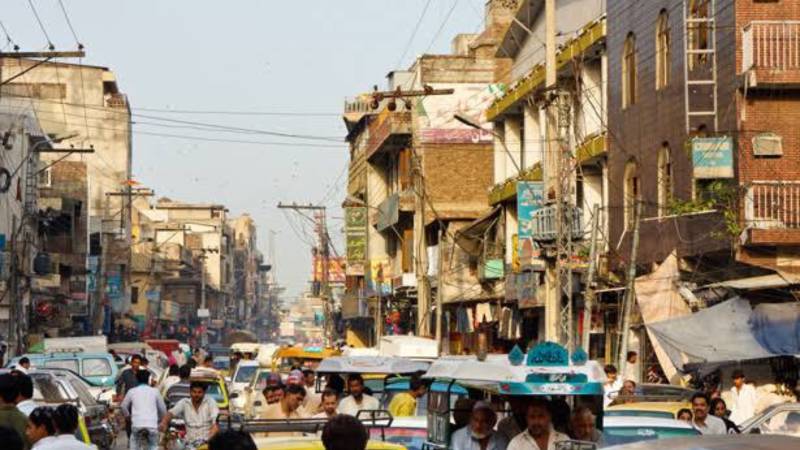
Pakistan is building cities over the very land that feeds them. Each new housing development on the outskirts of Karachi, Lahore, Islamabad, or Peshawar narrates two stories simultaneously: one of urbanization and another of loss of farmland. The problem of crowded cities is no longer the only challenge for Pakistan; it is largely about what those cities are consuming as they grow.
A housing scheme on the outskirts of Lahore may appear to be just another solution to growing demand for housing. The appearance of new settlements outside Islamabad may appear to be development. Yet when such expansions and developments replace fertile land, orchards and green belts, the nation is making a trade that is far more consequential than it looks: exchanging long-term food-producing capacity for low-density urban expansion. That trade is hard to overlook.
Pakistan’s population increased from 132 million in 1998 to 241.5 million in 2023. In six years alone, from 2017 to 2023, the urban population increased from nearly 76 million to 94 million, an increase of more than 18 million people. The annual growth rate of the urban population is around 3.7 per cent, almost twice the rural population's growth rate of 1.9 per cent.
The issue is not urbanisation itself. Cities can boost productivity, generate job opportunities and improve access to services. The issue is the form of urbanisation: low-density, outward expansion supported by weak land-use regulation and governance. As a consequence, some of the most productive parts of agriculture belt are becoming the most convenient ones for real estate development.
Satellite evidence in a recent report by the Planning Commission makes the scale even more visible. From 2005 to 2022, Islamabad's built-up area grew by 104 per cent, Quetta grew by 72 per cent, Lahore by 59 per cent, and Karachi and Peshawar each expanded by 43 per cent. Much of the urban sprawl in cities has been at the cost of agricultural or green spaces.
The issue is not urbanisation itself. Cities can boost productivity, generate job opportunities and improve access to services. The issue is the form of urbanisation: low-density, outward expansion supported by weak land-use regulation and governance.
Lahore is perhaps the most evident warning. Its outward expansion has largely transformed fertile land on its southern and western edges into housing schemes, and there has been a loss of an estimated 10–15 per cent of areas covered in vegetation over two decades. Meanwhile, low-rise housing has taken over the barani agricultural land in Islamabad, and the vegetation cover has declined from 42 to 24 per cent. In addition, significant areas of fertile land have been lost around the outer edges of Peshawar due to unplanned horizontal growth.
This is important because agriculture continues to generate approximately 24 per cent of the GDP and approximately one-third of the national employment. Importantly, Pakistan has increased the farm area in total by approximately 12 per cent since 2010. However, creating new agricultural land elsewhere does not make the loss of productive land irrelevant. A citrus orchard in Sargodha, a mango garden in Multan, or irrigated farmland around Lahore cannot be recreated by cultivating some marginal land elsewhere. Therefore, Pakistan does not have to choose between urbanization and farmland. It needs to change where and how its cities grow.
Three reforms deserve priority.
First, a meaningful legal protection of valuable farmland is needed. The high-value agricultural zones should be identified in provinces and protected as Protected Productive Zones, while establishing agricultural preservation belts around major cities. Housing projects should not be allowed to convert such land simply because agricultural land is easily available and is cheaper to acquire than developed urban land. Second, Pakistan should adopt a vertical expansion model of cities rather than expanding endlessly outward. Provinces should establish minimum-density requirements for new housing schemes and rezone underused inner-city areas for higher-density, mixed-use development. Growth should increasingly be concentrated around mass-transit corridors through transit-oriented development. It is not feasible for Pakistan's cities to react to every growth in population by expanding the periphery of the city and generating additional single-family plots. Land pooling can complement this approach. Rather than acquiring fragmented land through coercion or allowing unplanned subdivision, landowners can pool land for planned redevelopment, receive serviced plots in return, and share in the increase in land value.
Third, land-use planning needs to be made more enforceable. All major cities require a statutory land-use map and updated master plan supported by institutions that enforce the plan. It is also important for provincial governments to be able to identify barren and low-productivity land that can be used for urban expansion instead of the fertile agricultural belts being used for urban expansion by default. Clear coordination among municipalities, development authorities and utilities is important to ensure that one agency’s housing approvals do not affect another’s agricultural or infrastructure plans.
The issue will only become harder. Today, over 50% of Pakistan's urban population resides in only 46 cities, each having more than half a million people. Population is increasing, and people are moving towards the big cities, which means the demand for housing will increase even more. Pakistan will need millions of new homes. But those homes do not have to come at the cost of the land that produces its food. Cities must grow. Farmland does not have to disappear for them to do so. The real choice is between planned urbanization and allowing today’s housing demand to become tomorrow’s food-security problem.