

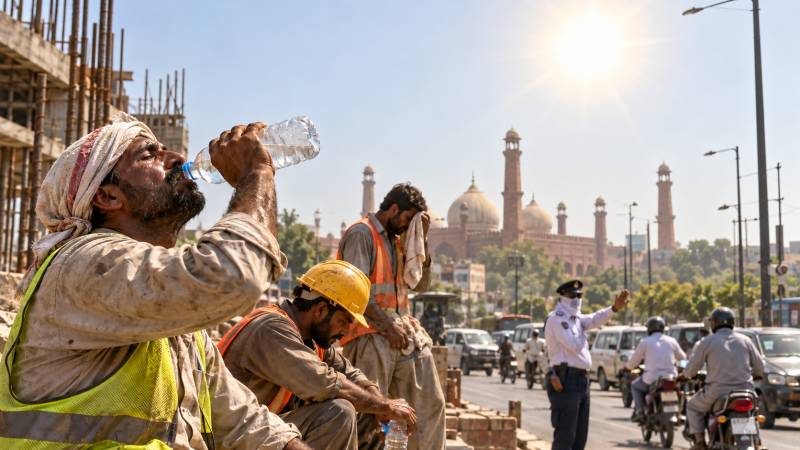
The heat is no longer merely uncomfortable. Across Punjab, it is becoming a public safety threat. For millions of people, a heatwave does not mean staying indoors with an air conditioner. It means working at construction sites, driving through congested streets, tending crops, or spending hours on roads with little shade. For those who depend on daily wages, staying home is rarely an option. The warning signs are already unmistakable. According to the World Meteorological Organization, the years 2015 to 2025 were the 11 hottest years on record, with 2025 ranking among the two or three hottest years globally. Pakistan, despite contributing less than 1 per cent of global greenhouse gas emissions, remains among the countries most vulnerable to the effects of climate change. And Punjab is at the centre of that vulnerability.
Punjab is particularly exposed. Home to more than 127 million people, the province contains some of Pakistan’s largest cities as well as vast agricultural and industrial areas. Lahore shows how urbanisation can intensify the problem. Built-up areas have recorded temperatures as much as 4.1°C higher than surrounding rural areas, while southern divisions including Bahawalpur, Rahim Yar Khan, Dera Ghazi Khan and Multan consistently experience some of the province’s highest land surface temperatures.
The heat is not felt equally. Outdoor labourers, construction workers, farmers, traffic police officers, children, older adults, pregnant women and residents of low-income settlements face some of the greatest risks. During a May 2025 heatwave in Lahore, construction workers told Reuters that they continued working despite the extreme temperatures because they could not afford to stop. One worker, Mohammad Irshad, said workers drank water every 15 to 30 minutes to cope. Their experience exposes a basic problem with conventional heatwave advice. Telling people to stay indoors does little for those whose livelihoods depend on being outside.
The Punjab Heatwave Action Plan 2026 aims to address this gap by creating a province-wide system for preventing, preparing for and responding to extreme heat. The Environment Protection and Climate Change Department will lead the response, working with the Pakistan Meteorological Department, SUPARCO and other monitoring stations to produce district-level heat alerts. A permanent Heatwave Management Cell will coordinate government departments and emergency services as temperatures rise. The plan assigns responsibilities to 27 government departments and introduces a four-level warning system.
Green signals normal conditions. Yellow calls for increased preparedness. Orange indicates dangerous heat and partial emergency measures. Red triggers a full heat emergency, including cooling shelters, restrictions on outdoor work and mobile medical teams. The idea is simple. Government action should begin before hospitals are overwhelmed.
Its success will depend on whether warnings reach workers in time, whether cooling centres actually function, whether employers enforce rest periods and whether medical teams can reach vulnerable communities.
When an alert is issued, district administrations will activate emergency committees, establish cooling centres and track heat-related illnesses and deaths. Health departments will strengthen emergency services and deploy mobile medical units, while Rescue 1122 will prepare teams for high-risk locations such as construction sites, brick kilns and labour markets. The plan also recognises that not everyone receives information in the same way. Heat warnings may be communicated through SMS, community health workers, mosque announcements and door-to-door campaigns, alongside television, radio, print and social media.
For outdoor workers, proposed protections include adjusted working hours, mandatory rest breaks and better workplace safeguards. During severe heatwaves, temporary cooling shelters, mobile health clinics, drinking water and rapid medical treatment are also planned. These measures could be particularly important in low-income communities where access to air conditioning and private cooling spaces is limited.
Extreme heat is also an economic problem. High temperatures reduce labour productivity in sectors such as construction and agriculture while increasing pressure on hospitals and emergency services. Electricity demand can rise sharply as people turn to cooling, placing additional strain on the power system. Agriculture faces its own risks as extreme temperatures reduce crop productivity, stress livestock and worsen water shortages. The cost of doing nothing could therefore extend far beyond the days of a heatwave.
The Action Plan marks a shift in how Punjab approaches extreme heat. Instead of treating it solely as a weather event, it frames heat as a public health, governance and economic challenge. Its proposed digital dashboard will track heat risks and government responses, while seasonal evaluations will identify gaps for future action. But the real test will come when temperatures rise. A plan on paper cannot cool a city. Its success will depend on whether warnings reach workers in time, whether cooling centres actually function, whether employers enforce rest periods and whether medical teams can reach vulnerable communities. Punjab cannot control the global rise in temperatures. It can, however, decide how prepared it will be for the next heatwave. And when the next warning comes, that preparation could determine whether extreme heat becomes another statistic or a crisis that costs lives.