

Immerse my ashes in the Chenab.
Only a lover can appreciate their value,
Ganga, that Brahmin, would not understand.
Mohan Singh
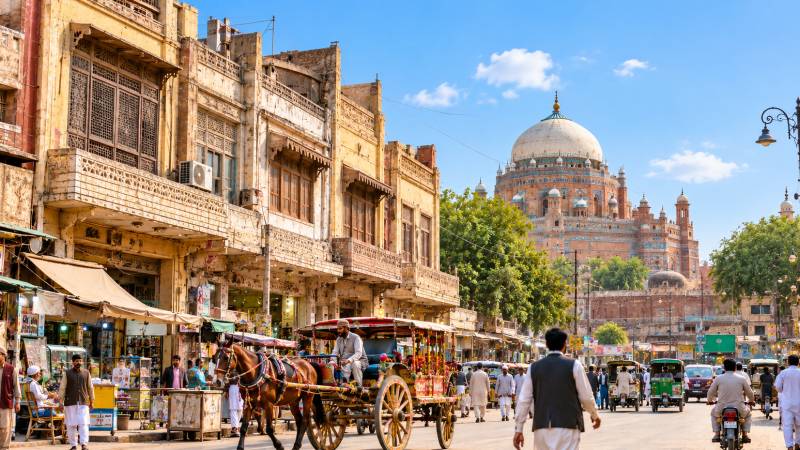
Multan, the city of gates, is a historical city that has been through turbulent periods in history and was the center of excellence once. The prominent saint Ali Hijwari known as Data Gunj Bukhsh writes about Lahore, “ one of cities that is a suburb of Multan.” It is situated at the left bank of river Chenab, a river known for its pinkish water and the rich tradition of folklores. Heer Ranjha and Sohni Mahiwal, the immortal tales of love, have become the archetype of romantic folklore and cultural emblem of the Chenab. These folk tales tell the story of the secular traditions; it refers to cultural traditions that transcend religious identities and belong to the wider community that were deeply rooted in the region’s cultural heritage.
However, historical records indicate that the Sufis of Multan, particularly those belonging to the Suhrawardi order, were not advocates of religious pluralism. In keeping with its doctrinal orientation, the Suhrawardi order aligned itself with the Delhi Sultanate. History abounds with stories to substantiate that the Baha ud Din Zakriya, the founder of Suhrawardi order in Multan, sought the patronage of rulers. The Delhi Sultan needed their support to maintain the crown’s hold over the volatile region. And in return they were granted the role of mediator among different tribes. The Punjab Auqaf and Religious Affairs Department records that Bahauddin Zakariya supported Sultan Iltutmish against Nasiruddin Qabacha in 1228. Following Iltutmish's victory, Zakariya received the title of Shaikh-ul-Islam and official state patronage. In any case, the purpose here is not to give a comprehensive history of Multan as many good books on the subject are already available available.
In my childhood we would have a sojourn at Multan to board a train for Jackabad, Balochistan. Tangas were the only ride, while on wee hours to go to the station the signboards of different films being shown in different cinemas would fascinate me. I had an ardent desire to be in the world of fantasy as the colourful sketches of the actors would captivate me. But my desire remained futile as the father couldn’t afford to take the kids to the cinema. He was a man of meager account.
It was in 1977 that I was acquainted with the city in detail. I got admission in one of the dingy colleges of the city, that had no merit board and was meant for those students who couldn’t be on the merit list of the two prominent colleges of the city. A bitter experience of my life. But luckily I found a friend there who was also a fervent movie goer. I explored every cinema in the city with him. Multan had fascinating cinemas in those days. Capri, Dreamland, Rex, Starlit and Dawn were the prominent cinemas and Capri was known for its moving English movies. Dreamland had a feast of delicious ice cream in the intermission. The taste of that scrumptious ice cream is still with me.It was fun to be in those cinemas.The brutal martial law imposed by Zia-ul-Haq was still in its infancy. My friend had a leaning towards left-wing politics and that led us to the office of daily Imroze.
Whenever I visit Multan, my eyes search for those vanished scenes, but in vain. Even the Caravan Bookstore, once a cultural landmark of the city, has now been reduced to a mere stationery shop.
In those days, Imroze was a hub of progressive journalists, and it was there that our political education began. I remain indebted to Imroze to this day. It was a newspaper of high standards, and its literary page enjoyed a distinguished reputation across the country. It was through Imroze that I was introduced to the great writers of the world, whose short stories appeared in Urdu translation on its literary page every week. Sadly, newspapers have lost the standards they once maintained, and their literary pages have disappeared altogether.
In those days, Multan was considered a stronghold of left-wing politics. The house of the prominent politician Qaswar Gardezi, who belonged to the National Awami Party (NAP), was often crowded with left-wing political activists. There I met Mir Ghus Bukhsh Bizanjo who had a captivating personality and who would be remembered for his principled politics. During one of his visits, I accompanied him to the Carvan Book Centre in the Cantonment Market. Carvan was a centre of intellectual excellence, where one could find some of the finest books published in Europe and America. He bought The Prince by Miachavilli saying “one must read this book to understand the political tactics of Zulfiqar Ali Bhutto.”
The First All-Pakistan Siraiki Literary Conference was held in Multan on 15–16 March 1975. It marked an important turning point in the development of Siraiki linguistic, literary and political identity. The conference was associated with the organisers of Jashn-e-Farid, and Umar Kamal Khan played a prominent role in organising it. Its principal objectives included: recognition of Siraiki as a distinct language, promotion of Siraiki literature and cultural identity, development of a more standardised Siraiki writing system, bringing together Siraiki writers, intellectuals and political activists. Among the participants were Siraiki and Sindhi intellectuals, political figures associated with the Gardezis and Khakwanis, and linguist Christopher Shackle. In short, Multan was once a city vibrant with cultural and political life. But the tyranny of time, as in many other cities of the country, has turned it into a city of housing societies. The city was once surrounded by countless mango orchards, which were cut down to make way for concrete jungles.
The bustling life of Haram Gate, where the sound of ghungroos would fill the air at dusk and young men would make their way to the bazaar, has faded into history. It was from this world that artists like Suraiya Multanikar emerged, and where Zahida Parveen gave a new dimension to the kafis of Khwaja Ghulam Farid. Whenever I visit Multan, my eyes search for those vanished scenes, but in vain. Even the Caravan Bookstore, once a cultural landmark of the city, has now been reduced to a mere stationery shop.