

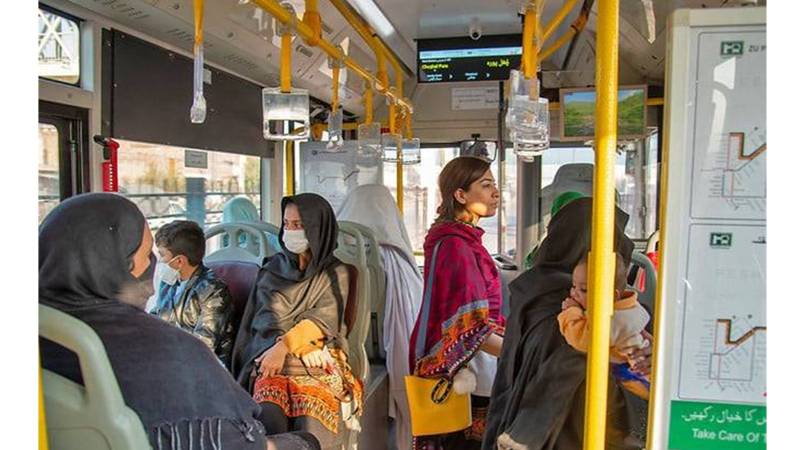
Every morning, a countless number of Pakistanis start their day in the same manner, waiting at a roadside, anticipating a bus, wagon, or rickshaw which might or might not arrive, and might or might not be safe to board. For these individuals, public transport is not simply a lifestyle choice or an environmental statement. It is the singular way to their destinations. However, the system they rely on is often overcrowded, underfunded, and under-regulated.
It is undisputed that Pakistan is essentially a lower-middle-income country with a per capita income of roughly $1,825, and the squeeze on households has been tightening. Under the World Bank's revised poverty line of $4.20 a day for lower-middle-income countries, 44.7 per cent of Pakistanis are poor, roughly 108 million people. About 16.5 per cent, around 40 million, fall below the $3-a-day extreme poverty line.
In such a country where numerous people struggle to cover food and shelter, a private vehicle is out of reach for almost everyone. The Pakistan Social and Living Standards Measurement Survey for 2019–20 found that about 94 per cent of households do not own a single car. Fewer than two million of roughly 32 million households have one, and even in urban areas, the figure is well below 10 per cent.
Even those who can afford wheels opt for the less costly option of motorcycles, which make up around 77 per cent of registered vehicles, according to the Pakistan Economic Survey 2022–23. Between 2007 and early 2025, more than 20.4 million motorcycles were sold against just 2.6 million cars. The motorbike has become the family vehicle, carrying parents and children through traffic with no protection. Everyone else, which is to say the majority, relies on buses, vans, wagons, and rickshaws.
A Severe Shortage of Vehicles
There is not nearly enough public transportation to meet that demand. Karachi, for example, needs about 15,000 buses, but there are only about a thousand in use, the majority of which are outdated private cars, according to a World Bank assessment that was extensively reported in the local media. As a result, every Karachiite is familiar with the scenario: people crammed into cars without functional emergency exits, sitting on roofs, and hanging onto doors.
Owners and drivers chase margins rather than schedules or safety, and no single operator is accountable for routes, fares, frequency, or maintenance
The issue is not confined to a single city. The same pattern is described in letters from readers and local reports from all throughout the nation. Commuters in Sukkur lament the misuse of route permits, the uncontrolled fluctuation of tariffs, and the continued operation of unsafe vehicles. Residents of Rawalpindi claim that although Metrobus and Orange Line services are welcome, they only serve a small portion of the city.
Strikes and Standstills
The precariousness of the system once again showed in 2026. In April, after the government sharply raised fuel prices amid the Iran war, state-run public transport in Islamabad and Punjab was made free of charge for a month to cushion the blow. In June, Karachi came to a standstill when the Karachi Transport Alliance began a wheel-jam strike over the Sindh government's digital challan system. Operators argued that fines often exceed their daily earnings, while office workers, factory employees, students, and daily-wage earners were left stranded. When talks failed, the strike continued, and the people who suffered most were the ones with no alternative.
The Deadly Cost of Neglect
The most tragic consequence of a neglected system is the body count. On the 3rd of July 2026, a speeding, overcrowded bus plunged into a ravine in the Dana Sar area of Balochistan's Zhob district, killing 40 people. It had left Quetta bound for Peshawar and, according to officials, picked up passengers from another bus that had broken down, pushing it beyond capacity. A survivor said some passengers protested before the driver lost control.
It was not an isolated event. In May 2026, a minibus rammed into a parked bus on a motorway in the northwest, killing 17 people. In August 2025, more than 34 people died in two separate bus crashes within two hours. International wire reports routinely attribute such accidents to weak enforcement of traffic laws, speeding, poor road safety standards, and reckless driving—a diagnosis that has barely changed in years.
Misdirected Investment and Fragmented Authority
It is not unprecedented for the question to arise as to why Pakistan’s public transport system is broken. Reasons behind this include the flowing of investment to private vehicles rather than public ones. A recent study by the Pakistan Institute of Development Economics found that the country’s vehicle count rose from 4.47 million in 1990 to over 39 million in 2025, with private vehicles growing from 1.42 million to 35.87 million, while public transport vehicles, including buses, vans, and rickshaws, stayed roughly flat at three to four million.
Easier auto financing fuelled the private boom, and nothing comparable existed to support public fleets. The little public transport that does exist is also fragmented and informal. In Karachi, services are dominated by privately owned buses, taxis, and rickshaws represented by the Karachi Transport Ittehad, where owners and drivers chase margins rather than schedules or safety, and no single operator is accountable for routes, fares, frequency, or maintenance.
The question of responsibility for road safety in Pakistan’s public transport sector admits no single answer, since authority is distributed across several parties and, in practice, accountability rests with none. Transport is largely a provincial matter, so provincial transport departments and regulatory authorities are responsible for permits, fitness checks, and route planning, while traffic police are responsible for enforcement on the road. Local governments are responsible for city planning and terminals, and operators are responsible for maintaining their vehicles and refusing to overload them.
This overlapping division of responsibility allows each actor to deflect blame onto the others, particularly in the aftermath of a serious accident. When a bus goes over a cliff, the response follows a familiar sequence of condolences and an inquiry order, followed by silence. This pattern rarely produces systemic change, as the fragmentation of authority ensures that no institution is compelled to bear responsibility for the underlying failures.
A Necessity, Not a Luxury
Public transport in Pakistan is not a luxury to be improved when budgets allow. It is the daily lifeline of a population too poor to drive, and the failure to provide it safely is a failure to protect people who have no other choice. Fixing it requires clear accountability for a single authority in each city, enforced safety standards, financing for fleet renewal, and a commitment to treat buses as essential infrastructure rather than an afterthought. Until then, ordinary Pakistanis will keep paying for that neglect in lost hours, lost wages, and, far too often, lost lives.