

How could someone be stranded in paradise? Paradise is a place with unlimited pleasures. Being stranded implies something horrible. How could the two emotions go together?
Well, I would have said the same thing until last week. The events of that week made me realise that one could experience both good and bad emotions at the same time.
Two Sundays ago, we landed on the lovely island of Kauai, the smallest of the four major islands of Hawaii, intending to spend a week there. It’s lush green and is aptly called The Garden Isle. Our first trip there was in April 1992. It was a case of love at first sight. We would return there several times over the decades that have elapsed since then and do something different every time. For example, we would ride on a Zodiac boat to explore the Napili coast in the north. Get in a helicopter and fly over the areas where the first Jurassic Park movie was filmed. Drive to a mountain top to view the steep canyon that lay underneath, check out the lighthouse on the north shore, and visit the “blow horn” on the south shore where water spouts out of the ocean at regular intervals. Tour the famed Allerton Gardens. Walk on the innumerable beaches and feel the sand in between the toes and the tropical breeze on the face. Watch the incredible sunrises and the awesome sunsets, which would be preceded by the most colourful twilights. Enjoy the diverse cuisines that are offered on the island and interact with people from several parts of the globe.
On this visit, we decided to skip all the sightseeing that we had done on prior visits. We were going to focus simply on rejuvenating the body and the mind. We would begin the day by meditating on the beach, leave our footprints on the sand, and then go eat breakfast. Later, we would relax on the beach chairs by the pool and watch the waves strike the beach. Afterwards, we would walk to nearby restaurants for lunch, return to our room to relax, and then head out for dinner.
In between, we would visit the neighbouring gardens where so much was in bloom, from flowers to fruits. We saw orchids, water lilies, and lotus in striking bloom, along with ginger plants and fruit trees.
We did not rent a car but drove around in shared rides, such as Uber. Many of the drivers were native Hawaiians or Filipinos, and by talking with them, I learnt a lot about what it was like to live in Hawaii. The climate was incredible and the people were friendly, but it was one expensive place to live in. Many people worked two jobs, in addition to driving Uber or Lyft, the ride-share companies.
The power went out – all we had going for us was an uninterrupted view of the swirling waves of an angry ocean
The same sentiments about Kauai came from those in the hospitality industry, such as waiters or hotel staff. I also interacted a fair bit with fellow tourists, some of whom had come from Japan and other Asian countries, and some from Europe. Several had been here before, and all agreed that prices had really shot up since the pandemic.
The week went fast. Before we knew it, it was Friday, our last full day in Kauai. We were scheduled to fly home on Saturday in the early afternoon. While we were enjoying lunch, a text came from United Airlines to check into our flight. We checked in. Less than two hours later, one of our daughters texted us from San Francisco that our flight had been cancelled. We thought it was a joke until I received a text from United saying the flight had been cancelled because of a pending tropical storm.
Hurricane Lala was nearing the Big Island, which is the most eastern of the Hawaiian Islands. Kauai is the most western of the Hawaiian Islands. There was no sign of an imminent storm in Kauai.
I called United, and they said they must book us on another flight, but that there was no space available on any non-cancelled flight until the following Friday. That shocked the daylights out of me. Working with one of my daughters and United, we found a flight that would take us home on Monday. It was on Hawaiian Airlines, but United not only gave us credit for the cancelled flight but also did the booking for us.
At the hotel, we had to check out of our room, since it was booked for someone else. We got a room in another building, and this one had an incredible view of the ocean. The prior room was facing the other way and gave us a gorgeous view of the sunrise over the mountains.
My wife noticed the new room was adjacent to a corner room where we had stayed several years ago for Valentine’s Day. During that stay, a cold storm had blown in from Japan, shutting down all activities at the beach. To deal with the sudden drop in temperature, we had to drive to a shopping plaza and buy some woollens.
On this trip, Friday concluded with an uneventful but somewhat tense dinner. When was the storm going to arrive? What havoc would it cause?
As Saturday dawned, I looked out through the patio door. The ocean was calm. Not much wind was blowing. People were walking on the beach and swimming in the ocean, like they had done in the past seven days. There was plenty of sunshine everywhere. Where was the storm?
They had cancelled our flight prematurely. That thought kept on irritating me. We could easily have flown out yesterday, before the tropical storm arrived. Why did we have to go through all the hassles associated with booking a new flight and a new hotel room? Why did we have to incur all the additional meal and lodging expenses? Why did we have to cancel the activities we had planned back home on Monday?
As I was struggling with these "what-if" questions, the weather began to change. As the evening approached, I noticed there was no twilight at all. The sky was thick with dark clouds. Where was the sunset? Its time had come and gone.
We went back to our room wondering what would happen next and remained glued to the weather channels on TV for the next couple of hours. The Big Island was being hit hard. The intense rainfall on the mountains had created rivers which were flowing downhill. The roads had disappeared and bridges had broken. Downed trees blocked roads which were otherwise fine. Traffic ground to a standstill. Then the inevitable happened. The power went out. Similar scenes were being shown from the most populated island, Oahu, where the capital Honolulu is located, and from Maui, which is located just west of Kauai. And then we fell asleep.
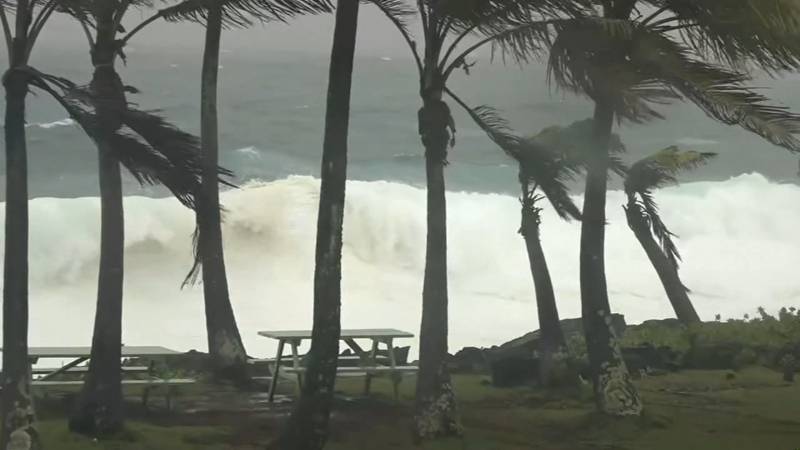
When we woke up on Sunday, the view through the glass patio door had changed dramatically. I opened it and stood out on the balcony. The tropical storm had arrived. The wind was howling and blowing fiercely, stirring up the ocean waves. They were getting closer to the end of the beach. I wondered if they would go over the beach and enter the hotel’s grounds and maybe seep into the rooms on the ground floor.
Despite being told to stay away from the ocean, several surfers were making the most of a bad situation by riding the waves on their surfboards. The tall coconut palm trees were swinging in both directions, and some were losing branches, a few of which were a dozen feet long. I wondered whether the trees themselves would break and fall.
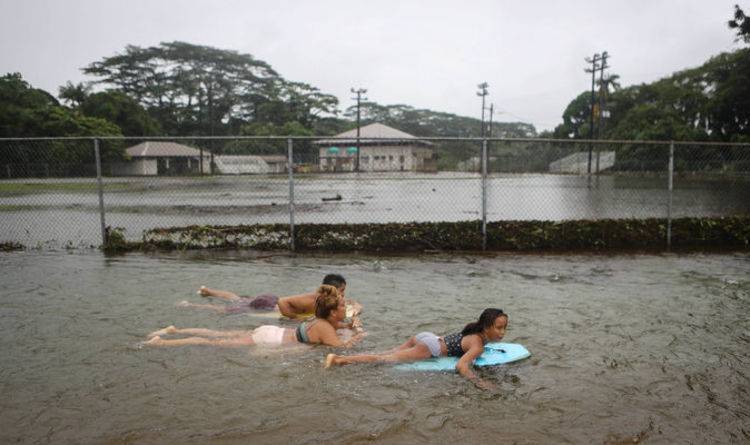
This was no trivial storm. Later, I would learn that somewhere between 10 to 15 inches of rain had drenched the Garden Isle in less than 24 hours.
But we had to eat. We walked over to the hotel’s restaurant. Everyone else had the same idea. It took us a long time to get seated and get served. At some point, the lights began to flicker. I asked the waiter if the hotel had backup power, either through diesel generators or solar panels paired with battery storage. He said backup power was very little, only enough to keep the lights on in the hallway and a few other items.
When we returned to our room, what I had feared finally happened. The power went out. First, the lights went out, then the TV stopped working, and then the Wi-Fi went dead. Our mobile phones stopped working. Even the landline phone in the room which connected with the hotel’s operator and guest services stopped working. Then the elevators shut down. All we had going for us was an uninterrupted view of the swirling waves of an angry ocean.