

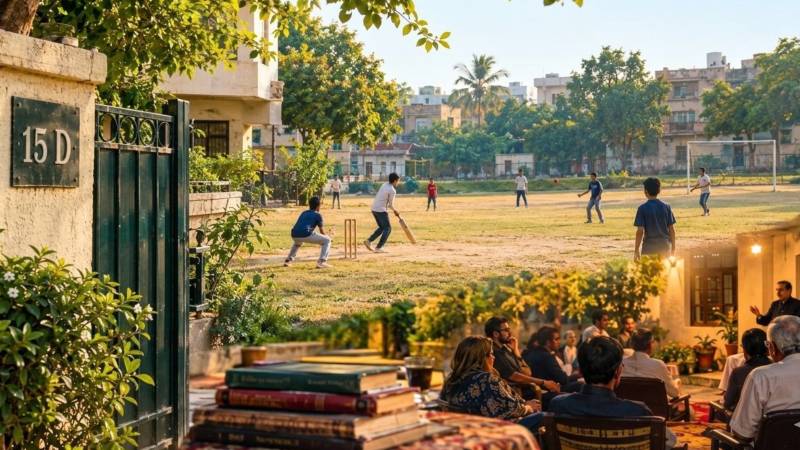
There are some places we leave behind in life, but they never really leave us. They remain quietly stayed in our memories, waiting for a familiar smell, a name, a sound or a passing thought to bring them back. For me, one such place is 15 D Garden Road, Karachi.
It was more than just the house where I grew up. It was the centre of my childhood, the place where I first learnt about friendship, community, books, sport, laughter and the simple happiness of being together. Looking back now, I realise that I was fortunate to grow up in a government officials' colony where life was not confined to the four walls of a home. The whole neighbourhood felt like an extended family.
Garden Road had its own rhythm. There was a sense of familiarity among the people who lived there. Doors opened easily, neighbours knew one another, children moved freely from one house to another, and evenings seemed longer than they do today. Life was not measured by mobile phones, social media notifications or the constant rush that has become so common. We had time for one another.
Our house at 15 D Garden Road stood opposite a large open ground. To me, that ground was almost as important as our house. It was our playground, our meeting place and, in many ways, our little world. Whenever I think of my childhood, I can almost see that ground again.
As children, we did not need much to keep ourselves busy. A ball, a bat, a hockey stick or simply a group of friends was enough. We played cricket, basketball and hockey, often until we were tired and the light began to fade. There was no need to arrange anything in advance. We simply came out of our houses, looked around, called out to one another and started playing.
Cricket was, of course, one of our great passions. The ground became a proper cricket field in our imagination. Every boy wanted to bat, every bowler believed he could bowl the perfect delivery, and every catch became a matter of great importance. Arguments were common too. Was it out? Was the ball a no-ball? Had it crossed the boundary? We would debate these matters with the seriousness of international cricket officials, only to forget the argument a few minutes later.
Basketball and hockey gave us another kind of excitement. We ran, shouted, fell, got up and carried on. There were no coaches standing on the sidelines and no carefully designed training programmes. We learnt by watching each other and by playing. More importantly, we learnt how to win and lose, how to share, how to wait for our turn and how to forgive an argument before the next game began.
15 D Garden Road was more than just the house where I grew up; it was the centre of my childhood, where friendship, community, books, sport, laughter and the simple happiness of being together shaped my earliest memories.
The ground also taught us something that we did not understand at the time; how to live with people. Children from different families came together there. We had different personalities, different interests and different ideas, but on the playing field we were simply children. The rules of the game were more important than anything else.
Yet Garden Road was not only about sport. It had another side, one that shaped my imagination in a different way. I grew up seeing literary sittings, discussions and mushairas taking place at our house. Poetry and literature were not distant things belonging only to books or classrooms. They were part of everyday life.
I remember the atmosphere of those gatherings, people sitting together, listening carefully, talking about poetry, literature and ideas. There was something special about watching adults become completely absorbed in words. A poem could change the mood of a room. A discussion could continue late into the evening. A verse could be repeated, appreciated and remembered.
As a child, I may not have understood everything that was being discussed. But children absorb more than they realise. The sounds of poetry, the seriousness of conversation and the presence of people who valued ideas all became part of the background of my childhood. Perhaps that is how a love of literature begins, not always through lessons or instructions, but simply by growing up around people who respect words.
Those literary gatherings gave the neighbourhood a special character. The same place where we children ran after a cricket ball could also become a place where people gathered to listen to poetry. It was a beautiful contrast. During the day, the ground belonged to children and games. At other times, homes and gathering places became spaces for discussions and family gatherings.
There was also a strong sense of togetherness in the way we celebrated occasions. We enjoyed celebrations as families, and those moments brought people even closer. A celebration was rarely limited to one household. Neighbours and friends became part of it. There was food, conversation, laughter and the movement of people coming and going.
The joy of those celebrations was not necessarily in how grand they were. It was in the feeling of sharing them. People had time to visit one another. Children looked forward to the excitement. Adults sat together and talked. Someone would arrive carrying something to eat, another would bring news, and before long the house would be full of voices.
When I think about those days now, I realise how much happiness existed in ordinary things. We did not need expensive entertainment. We had the open ground, our friends, our families and the people around us. We made our own entertainment. We created our own adventures. A simple afternoon could become a story that stayed with us for years.
The most precious thing about 15 D Garden Road was perhaps the sense of belonging. It was not just an address. It was a community in which childhood seemed safe, open and shared. The walls of our home marked the beginning of our world, but they did not define it. Outside those walls was a neighbourhood full of people, stories and possibilities.
As children, we naturally believed that such a life would continue forever. We assumed the ground would always be there, our friends would always be nearby, and the evenings would always stretch endlessly ahead of us. We did not understand that childhood is temporary. We only knew that tomorrow would bring another game, another gathering and another day.
Years have passed since those days. Life has taken us in different directions. People have moved, children have grown up, and the city itself has changed. Yet memory has a strange way of keeping places alive. Sometimes I close my eyes and find myself back at 15 D Garden Road. I can see the house, the open ground opposite it and the children gathering for a game. I can almost hear the noise of a ball being hit, the shouting of friends and the conversations drifting from a nearby gathering.
What stays with me most is not one particular match, one particular mushaira or one particular celebration. It is the feeling of those years. It was a time when sport and literature, family and friendship, play and conversation all existed side by side.
Perhaps that is why Garden Road remains so special to me. It gave me more than a childhood address. It gave me memories that have travelled with me through life. It taught me that a community can shape a child just as much as a school or a family can.
When I look back on those days now, I do not see just a house. I see a whole chapter of my life. I see a young boy running across a large open ground with his friends, playing cricket, basketball and hockey, without a care in the world and without thinking about what tomorrow might bring.
Perhaps that is the greatest gift childhood gives us. It does not stay forever, but it leaves something behind. A little place inside us that we can return to whenever we want, a place filled with familiar faces, happy memories and the feeling of being at home. For me, that place will always be 15 D Garden Road, Karachi.