

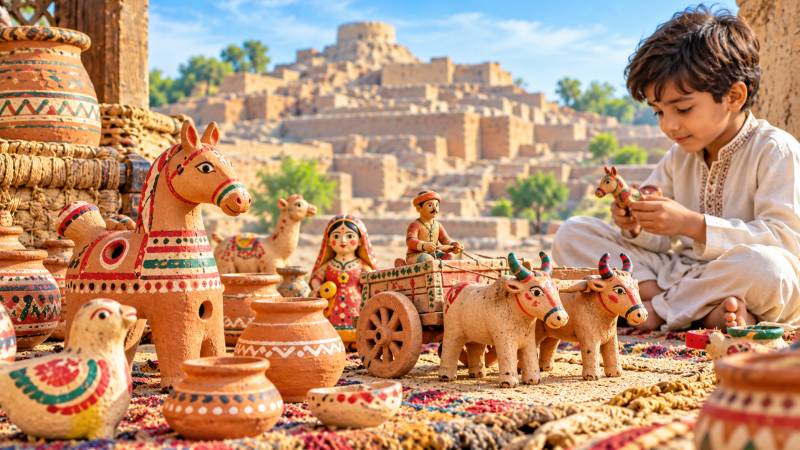
In a child’s world, a toy is not something trivial. A toy serves as a primary teacher, introducing children to colours, shapes and imagination long before they learn to read or think formally. Through play, a child learns how to connect, grasp, imagine and identify their surroundings. Toys have long performed this quiet work, connecting play with cultural roots and transforming artefacts into stories long before schools or digital screens entered children’s lives. For centuries, clay toys have helped sustain the art of storytelling in the subcontinent.
For centuries, children across the subcontinent grew up playing with toys made from one of the earth’s most basic materials: clay. These toys were moulded by hand and dried in the sun or fired in kilns, long before silicon-based technologies or battery-powered toys were invented. Archaeological excavations of the ancient Indus Valley Civilisation, which flourished across the Indus plains thousands of years ago, revealed clay animal figurines, miniature carts and other toys that reflected the everyday life of the people who created them. Some miniature bull toys had movable necks and were designed to be pulled in small bullock carts. These were tiny mechanical marvels, designed to fit into a child’s palm long before anyone thought of inventing batteries. A toy was never merely a toy; it preserved the memory of the environment that had created it.
This land never entirely lost its tradition of creating meaning out of clay. Generations of artisans preserved the craft in the rural areas and towns of Punjab and Sindh, shaping animals, birds, dolls and miniature household objects from locally sourced clay and painting them in the colours available to them. Some names of these traditional toys have survived, even as the artefacts themselves have become increasingly rare. The Ghughu Ghora are small clay horses, often shaped like whistles and glazed in simple, vibrant colours. Tiny Handis are miniature clay cooking pots, no larger than a child’s hand, modelled on the everyday vessels found in traditional kitchens. Then there are miniature bullock carts, pulled by two bullocks and complete with a tiny driver. These toys transformed the routines of domestic life into a child’s own imaginative theatre.
It reminds us that somewhere between plastic and digital screens we have lost the artefacts that kept our children connected to heritage, told stories and fostered the imagination quietly.
Clay toys were exceptional not because of their price but because of their close association with the soil, a shared element of our collective identity. Every toy bears the imprint of the hand that made it. The hump of a camel was never perfectly symmetrical. The shape of a Ghughu Ghora whistle varied slightly from one horse to another. No mould could replicate the subtle irregularities of a doll’s smiling face. Long before the phrase “sensory play” was coined, clay toys were already providing children with valuable opportunities for early learning. A toddler discovered texture by touching a coarse, sun-dried clay toy. Children learnt to recognise differences by observing that no two Handis were exactly the same size or shape.
A child developed their imagination by turning a clay bird over in their hands and inventing a story about its flight. No screen has ever fully replaced these sensory and visual experiences. Moreover, these toys were rarely silent in the hands of children. A clay bullock cart could become part of a bridal procession, with tiny Handis placed inside as dowry. Depending on the game being played, a clay doll could become a mother, a queen or a bride. This was a civilisation that introduced its young to their cultural identities through the very artefacts they played with. Storytelling was woven into the fabric of everyday life. Grandparents did not need to explain their heritage explicitly; they simply handed a child a clay toy, and a story emerged.
This memory has not entirely faded from Pakistani literature. Hamza Hassan Sheikh frequently revisits scenes of dimly remembered rural and urban life in his collection of Urdu short stories, Kaghaz, which features old shops, narrow lanes, paper boats and, most importantly, clay toys. He places these seemingly insignificant objects alongside larger themes of insecurity, loss and the exploration of identity. Urdu fiction, therefore, offers glimpses of a gentler, almost forgotten world through the humble clay toy.
Eventually, over time and without any single defining moment, these connections began to break. Plastic toys appeared first. They were cheaper, more colourful and considerably more durable than fired clay, making it increasingly difficult for small workshops to survive. Parents naturally gravitated towards toys that cost less and lasted longer. Then came battery-powered toys, followed by digital screens. These replaced not only clay as a medium of play but also the creative possibilities that came with it, substituting a child’s imagination with pre-programmed movements and sounds. A toy that once encouraged a child to invent their own story was gradually displaced by toys and devices that told the story for them.
This transformation cost us more than the village pottery industry. We also lost an art of storytelling that relied on colour, shape and size rather than code or dialogue. Nowadays, when a child looks at a screen, they encounter something fascinating, too. Yet it is not an experience passed down through generations, nor is it something that necessarily calls upon their imagination in the same way. This is neither an argument against technology nor a suggestion that children should abandon their devices in favour of clay toys. Rather, it is a reminder that somewhere between plastic toys and digital screens, we have lost the artefacts that once connected children to their heritage, inspired stories and quietly nurtured their imaginations.