

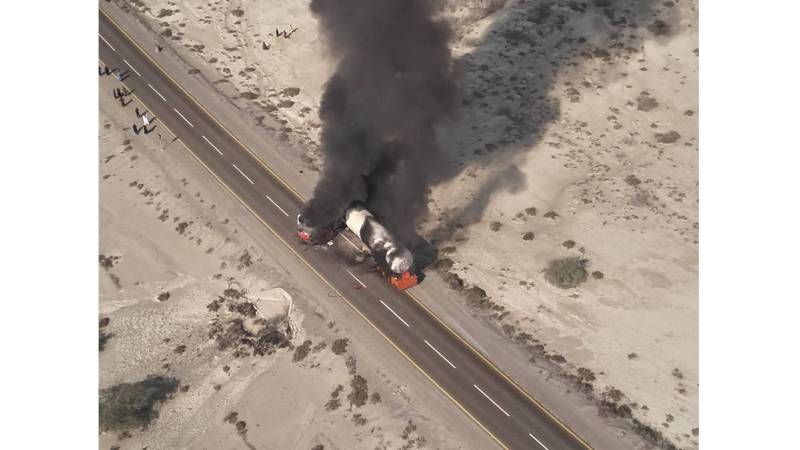
A passenger bus embarked on an ill-fated journey from Turbat to Karachi on the sunny morning of the 19th of November 2026, carrying 48 passengers. Around noon, as it reached the Basol area near Ormara, the coach collided head-on with an LPG bowser on the Makran Coastal Highway and caught fire.
Within seconds, flames began spreading through the bus, leaving the 48 passengers, including women and children, with a slim chance of escape and a sliver of hope amid an otherwise grim scene.
Inside the overcrowded coach, passengers were trapped, screaming and wailing in shock.
However, some managed to jump through the rear window of the bus with severe burns, while others suffered even more serious injuries requiring urgent stitches and quick medical braces. They stumbled around in pain, like wounded and sobbing survivors, with burns on their knees, elbows, waists, and faces. The tragedy claimed around a dozen lives and left more than two dozen people critically injured. Many of them suffered severe burns. Worse still, the injured were stranded in the middle of nowhere, without access to emergency medical help.
CCTV footage shows the LPG bowser overtaking two trucks near the entrance to a bend. The bus also appears to be travelling from the opposite direction at considerable speed despite the sharp curve.
The footage suggests possible negligence on the part of both the bus driver and the bowser driver.
A widely held view is that the gas bowser alone did not necessarily cause the bus to burst into flames and burn to ashes, especially since the bowser itself did not explode.
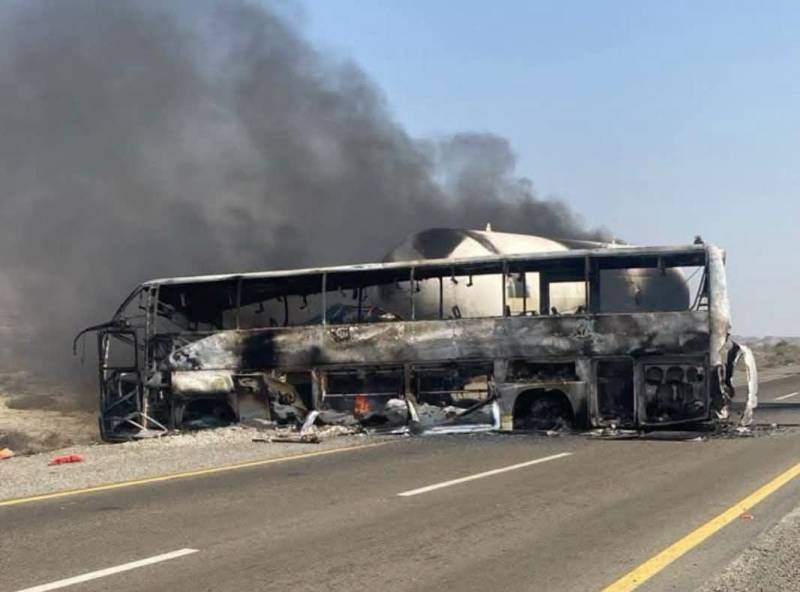
Passengers travelling along this route complain that the bus owners often heavily load smuggled Iranian diesel and petrol into the luggage compartments of the passenger coaches along routes connecting coastal and southern areas—such as Gwadar, Turbat, and Panjgur—to Karachi. This dangerous practice could be a possible cause of such fires.
A Pattern of Fatalities on the N-10
However, this was not an isolated incident.
On the 19th of August 2026, a family’s journey home ended in tragedy at the steep, narrow, and winding 780-foot Buzi Pass, also known as Buzi Top, in Hingol National Park near Ormara. Six members of the family, including children, were horrifically burnt to death when their car caught fire after colliding head-on with a heavy gas bowser, which overturned in the crash. They were returning to Turbat after a shopping trip to Karachi for a wedding.
In most countries, maximum highway speed limits for buses are strictly regulated and typically range between 80 km/h and 110 km/h, whereas bus drivers in Balochistan often reach speeds of 140 km/h
The 653-kilometre Makran Coastal Highway (N-10), a single-carriageway road, was completed in just two years, between 2002 and 2004, during the Musharraf era. In its early years, the highway passed through areas rich in wildlife, where deer, camels, donkeys, desert-adapted foxes, and other wild animals often wandered onto the highway and rested in the middle of the road. At night, the headlights of speeding coaches and other vehicles can startle them, sometimes causing fatal accidents. Such incidents were common when traffic first began using the highway in 2004–05.
Although no centralised public database records the total number of road accidents and fatalities on the Makran Coastal Highway since its opening, the loss of human life has been considerable. Yet many of these incidents have gone without proper investigation or accountability.
Ancient Routes and Captivating Landscapes
The Makran coastal route has a long history. In 325 BCE, Alexander the Great travelled through the Makran region and its coastal areas, which were then known to Greek writers as Gedrosia.
Throughout ancient and modern history, the mountainous Makran coast has been home to small fishing settlements. Greek writers described their inhabitants as Ichthyophagi, meaning ‘fish-eaters’. The region is also home to ancient trade routes and pilgrimage sites, including the Hinglaj Mata Temple, locally known as Nani Mandir, in Balochistan’s Hingol National Park.
Before the paved coastal highway was built, travelling along this route was difficult and uncommon, and the route was rarely used and poorly accessible. The journey often involved multi-day trips, with travellers navigating rough dirt tracks in 1960s-era Toyota jeeps and single-cab pickups.
Even until the mid-twentieth century and some later years, much of Balochistan still retained a medieval outlook. Particularly in the coastal belt, people travelled to Karachi by land or sea. Those travelling by land relied on horses, donkeys, and camels as their main means of transport.
The natural beauty that unfolds along the Makran Coastal Highway, particularly around Buzi Top and Kund Malir, is truly captivating. Ormara Beach and its local resorts continue to attract domestic tourists—especially weekend travellers from Karachi—despite broader security concerns in Balochistan.
The breathtaking scenery is a feast for the eyes, where majestic mountains and desert cliffs meet the sea. The magnificent highway winds its way between them, creating a truly mesmerising view.
One of the most striking features is a tall, naturally formed rock formation rising between the sedimentary rock mountains of Hingol National Park. It resembles a woman wearing a flowing robe or crown, standing tall in silence and gazing towards the horizon. Hollywood actress Angelina Jolie named it the “Princess of Hope” during her visit to the Makran coast in August 2001. At the time, she was serving as a UNHCR Goodwill Ambassador. Her visit came during the peak of her global fame shortly after the release of Lara Croft: Tomb Raider.
Speed, Moral Responsibility, and Institutional Accountability
Coming back to the bus tragedy on the 19th of November, human error cannot be set aside. In most countries, maximum highway speed limits for buses are strictly regulated and typically range between 80 km/h and 110 km/h, whereas bus drivers in Balochistan often reach speeds of 140 km/h. Their speeds should be restricted by traffic authorities.
Unfortunately, the authorities have so far done little to satisfy public concerns. There has been no comprehensive investigation or clear accountability for such a tragic loss of human life.
Especially when discussing administrative negligence, unsafe transport, and preventable deaths, Ivan Karamazov, a character in Fyodor Dostoevsky’s The Brothers Karamazov, comes to mind. His character reminds us that human suffering should never be dismissed as fate when negligence and injustice are involved. Dostoevsky’s profound moral insight in the novel offers a sobering reminder that the loss of innocent lives is not merely a matter of fate; it also raises questions about collective responsibility, negligence, and the failure to protect human life.
Converting the single-carriageway coastal highway into a dual carriageway would significantly reduce fatal accidents and lethal mishaps.
On the Makran Coastal Highway, recurring fatal road accidents demand immediate institutional accountability. Traffic management must be overhauled, safety standards strictly enforced, and human lives protected from entirely preventable tragedies.