

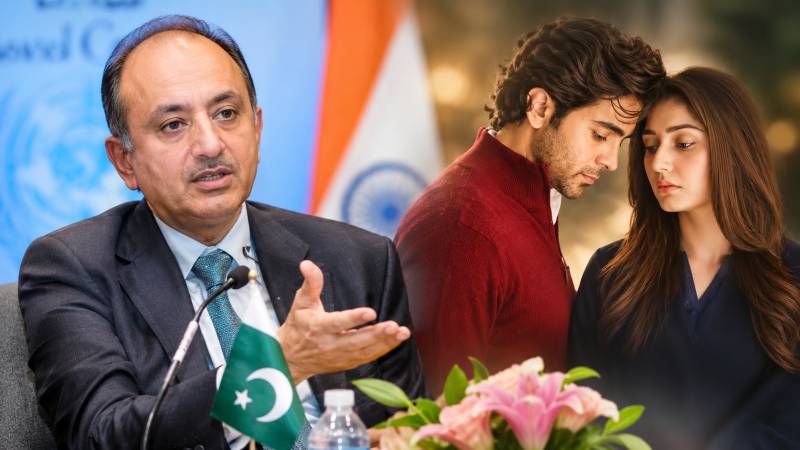
There are moments in the troubled history of Pakistan-India relations when a seemingly modest development offers a glimpse of what might be possible if the two countries were prepared to look beyond their differences. The visit of Pakistan's Federal Minister for Climate Change, Dr Musadik Malik, to New Delhi from November 20 to 22 for the Shanghai Cooperation Organisation's Civilisational Dialogue Forum was one such moment. Another, unfolding simultaneously, is the remarkable popularity of the Pakistani television drama Dar-e-Nijat among young Indians.
At first glance, the two developments might appear unrelated. One involves a senior government minister representing Pakistan at a multilateral gathering, while the other concerns a television serial capturing the imagination of young viewers across the border. Yet both demonstrate something important: despite decades of hostility, political confrontation and mutual suspicion, there remains considerable space for engagement between the people of Pakistan and India.
Malik's visit was particularly significant because it marked the first visit by a Pakistani federal minister to India since Bilawal Bhutto Zardari attended an SCO meeting in Goa in May 2023. It also came against the backdrop of the military confrontation between the two countries in May 2025, which pushed bilateral relations to another dangerous low.
In such circumstances, merely travelling to New Delhi was significant. But Malik went considerably further. He represented Pakistan with intelligence, composure and an understanding of the larger issues confronting South Asia. His remarks were thoughtful, measured and refreshingly free of the confrontational rhetoric that has too often characterised exchanges between representatives of the two countries.
Speaking about the importance of civilisational dialogue, Malik emphasised that cultures and civilisations transcend political boundaries. He also expressed hope that changing geopolitical circumstances would encourage countries in the region to take a broader view of their relationships, including the political, social and economic challenges they collectively face. These were sensible observations, particularly coming from a Pakistani minister speaking on Indian soil.
What made Malik's contribution especially effective was his ability to draw upon the region's shared cultural and historical inheritance. Addressing the gathering in Urdu, he invoked the great poet Mirza Ghalib and spoke about Delhi's history as a meeting place of different civilisations. He referred to the city's Purana Qila, associated with both Humayun and Sher Shah Suri, as an example of how different rulers and traditions had contributed to a common historical landscape. This was diplomacy conducted through history, literature and cultural understanding rather than political point-scoring.
Malik also demonstrated that acknowledging shared cultural traditions does not require either country to compromise its national identity or legitimate interests. Indeed, recognising differences while remaining willing to engage is precisely what meaningful dialogue should involve. In doing so, he proved himself a worthy ambassador for Pakistan. His performance was a reminder that the country possesses articulate, capable representatives who can present its perspective confidently without resorting to unnecessary hostility.
At a time when political discourse in both countries can be dominated by suspicion and hostility, young Indians are enthusiastically consuming Pakistani cultural content and identifying with its characters.
That is especially important at a time when Pakistan's international image is frequently shaped by political instability, economic difficulties and security challenges. A thoughtful and confident Pakistani voice on an international platform can help challenge simplistic perceptions of the country. There is, however, another form of Pakistani diplomacy taking place across the border, one that does not involve ministers, official delegations or conference halls. It is happening on television screens and smartphones.
The Pakistani drama Dar-e-Nijat, written by Umera Ahmed and directed by Saqib Khan, has attracted considerable attention among India's younger generation. Its characters, particularly Abu Bakar and Zaryab, have become popular subjects of Instagram reels and social media conversations. What is especially interesting is why young Indian viewers appear to be responding so positively.
Reports featuring Indian Generation Z viewers suggest that many admire the character of Abu Bakar for his kindness, emotional maturity, loyalty and respectful treatment of women. Some have described him as a positive example of masculinity, contrasting his behaviour with the aggressive or controlling male characters frequently portrayed in television dramas. The appeal clearly extends beyond religious or national identities. Young Hindu viewers have also reportedly embraced the serial, responding to its portrayal of compassion, patience and human decency. There is something profoundly encouraging about this.
At a time when political discourse in both countries can be dominated by suspicion and hostility, young Indians are enthusiastically consuming Pakistani cultural content and identifying with its characters. They are not necessarily watching it as a Pakistani production. They are watching because the stories resonate with their own experiences, aspirations and understanding of relationships. This is the extraordinary power of culture. It can establish connections that political rhetoric struggles to destroy.
Pakistani television dramas have enjoyed popularity in India for years, just as Indian films and music have long attracted audiences in Pakistan. These cultural exchanges demonstrate that the people of the two countries have far more in common than their political disagreements might suggest. The tragedy is that official policies have often sought to restrict precisely the exchanges that could encourage greater understanding.
None of this means that the serious disputes between Pakistan and India can simply be wished away. Kashmir, terrorism, water-sharing arrangements and longstanding security concerns remain formidable obstacles. The military confrontation of 2025 demonstrated how quickly tensions can escalate and how dangerous the consequences could be. Nor should anyone imagine that a ministerial visit or a popular television drama will suddenly transform bilateral relations. But diplomacy does not always begin with grand agreements or dramatic breakthroughs. Sometimes it begins with a conversation, a cultural exchange or the recognition that people on the other side of a border share similar hopes and concerns.
Pakistan and India are neighbours by geography and history. Neither can change that reality. Both face enormous challenges involving poverty, employment, climate change, education and human development. Their populations would benefit considerably from a relationship that allowed greater cooperation without requiring either country to abandon its fundamental positions.
The encouraging aspect of Malik's visit is that it showed how Pakistan can engage with India constructively while maintaining its dignity and independence. The success of Dar-e-Nijat demonstrates that younger generations are capable of appreciating each other's cultures despite the political environment. Together, these developments offer a modest but meaningful reason for optimism.
Perhaps the future of Pakistan-India relations will not be transformed by politicians alone. Perhaps it will also be shaped by writers, artists, television producers, students and young people who refuse to allow political boundaries to determine whom they admire or whose stories they enjoy. Musadik Malik's visit showed that dialogue remains possible. Dar-e-Nijat shows that cultural connections remain alive. For two countries whose relationship has been defined by conflict for far too long, both are reminders that another future is possible.