

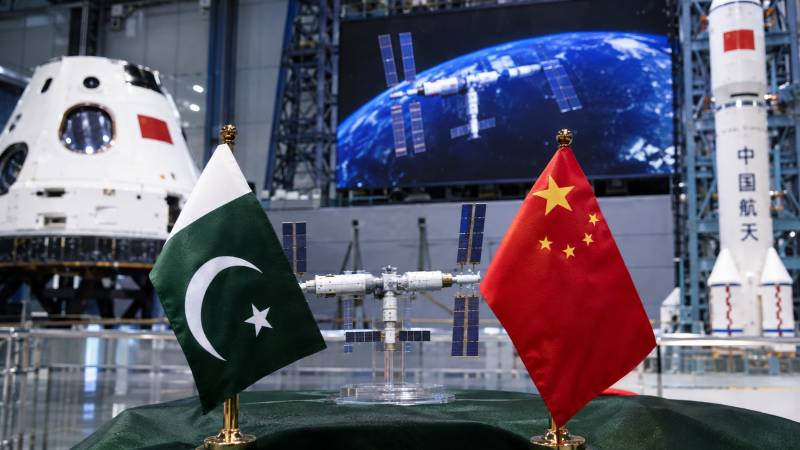
When the China Manned Space Agency announced on November 7 that a Pakistani payload specialist would fly to the Tiangong space station aboard Shenzhou-24 and return on Shenzhou-23, it did far more than give Pakistan its first human spaceflight. China will now open its national space station to a foreign astronaut for the first time, and it chose to extend that honour to a developing partner rather than to a wealthy ally. The brevity of the visit and the narrow remit of a payload specialist matter far less than the precedent itself, because every partnership in human spaceflight, including the early years of the International Space Station, began with short visits before maturing into longer and more ambitious missions.
China earned the standing to make this offer through decades of patient and self-reliant engineering. Shut out of the International Space Station and barred since 2011 by the Wolf Amendment from bilateral cooperation with NASA, Beijing refused to accept permanent exclusion and instead assembled its own three-module station between 2021 and 2022 with remarkable speed and precision. Its lunar programme achieved the first soft landing on the far side of the Moon and, with Chang'e-6 in 2024, the first return of samples from that hidden hemisphere. Its Tianwen-1 mission orbited, landed and roved on Mars at the very first attempt, while its BeiDou system now provides global navigation free from dependence on any foreign power.
What sets China apart, however, is not only what it has built but how willingly it shares the fruits of that effort with its partners. According to Quwa, Pakistan has launched seven satellites on Chinese rockets since May 2024, beginning with the lunar cubesat ICUBE-Q aboard Chang'e-6 and followed by the communications satellite PakSat-MM1. Five more reached orbit between January 2025 and April 2026, including PRSC-EO3, the largest satellite Pakistan has ever developed at home. Under a February 2025 agreement, a Pakistani rover will travel to the lunar south pole on China's Chang'e-8 mission in 2028, and according to a Stimson Center analysis, Pakistan remains the only country granted access to the restricted, encrypted service of BeiDou. Few space powers have placed such trust in a partner, and fewer still have done so for a nation with such limited means.
The contrast with the older Western model of space cooperation is instructive. For decades, smaller nations could reach orbit only by purchasing commercial seats priced far beyond their budgets or by accepting political conditions attached to cooperation. Pakistan absorbed this lesson after the 1999 Kargil war, which left lasting fears that Washington could restrict GPS access during a crisis with India, and its military moved to BeiDou in 2014 to remove that vulnerability. China, by contrast, has built its space policy around international partnership, opening Tiangong to experiments from United Nations member states through its programme with the UN Office for Outer Space Affairs and inviting a growing roster of countries and institutions into the International Lunar Research Station. Beijing treats space as a shared frontier for the Global South rather than an exclusive club reserved for the wealthy.
When Pakistan's first astronaut enters Tiangong, the moment will belong not only to Pakistan but also to a broader vision of space as a shared frontier rather than an exclusive club.
India's Department of Space received Rs13,705 crore in the 2026-27 budget, and its astronaut Shubhanshu Shukla reached the International Space Station in 2025, yet a closer look at how he got there strengthens the case for the Chinese model. Shukla travelled on a commercial American mission, whereas Pakistan's astronaut will fly as the invited guest of a government that trained its candidates alongside its own crews and integrated Pakistani experiments into its national station. With SUPARCO's development allocation cut by more than 90 percent in 2025-26, according to Quwa, China's partnership is delivering capabilities that Pakistan could not otherwise afford for decades.
The benefits of this partnership already reach ordinary Pakistanis on the ground. PRSS-1 and PakTES-1A, launched from China in 2018, along with the newer PRSC series, give Pakistan its own satellite imagery for defence planning and for monitoring floods, crops and melting glaciers in one of the world's most climate-vulnerable countries. A partner who has consistently delivered launches, astronaut training and encrypted navigation has given Pakistan more dependable access to space than any alternative has ever offered.
None of this absolves Islamabad of its own responsibilities toward a national space programme. Pakistan still needs a formal space policy, sustained and adequate funding, and universities working alongside SUPARCO to build engineering talent at home, so that China's generosity becomes a ladder for indigenous growth rather than a substitute for it. Pakistan can also keep its doors open to the European Union, the United States and other partners, and it should pursue space-related confidence-building measures with India, modelled on the 2005 agreement on pre-notification of ballistic missile tests.
When the Pakistani astronaut floats into Tiangong aboard Shenzhou-24, the moment will rightly belong to Pakistan, but it will also stand as proof of China's conviction that space should not remain the preserve of a privileged few. By opening its station, its rockets and its navigation network to a developing partner, Beijing has offered the world a more inclusive model of space exploration, and nations across the Global South will be watching closely to see how wide that door can open.