

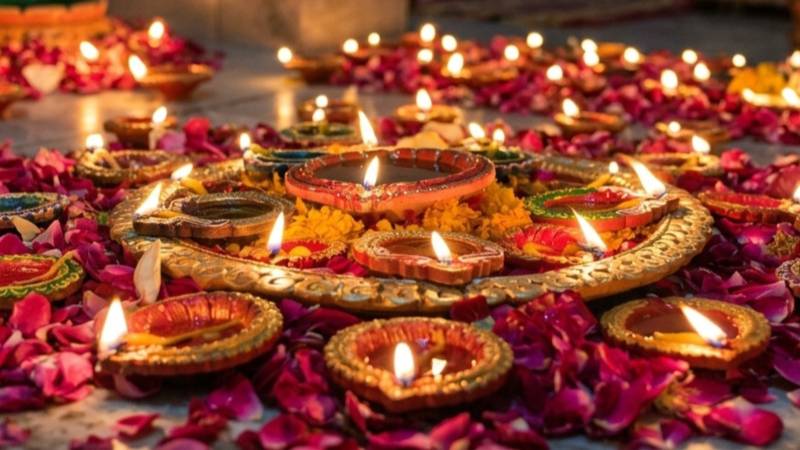
Festivals have a curious ability to bring together people who may otherwise inhabit different worlds. They interrupt the ordinary rhythm of life, revive memories, strengthen relationships and remind us that happiness acquires a special meaning when shared. Diwali, the festival of lights, offers a particularly beautiful expression of this human experience. Its illuminated homes, colourful decorations, family gatherings and traditional sweets form part of a religious and cultural heritage that has survived centuries of political change, migration and social transformation. Yet beyond its familiar celebrations lies a larger question: how do people belonging to different traditions learn to live together without surrendering what makes them different?
The answer is not necessarily found in elaborate declarations of interfaith harmony. Sometimes it emerges through the simplest exchanges of everyday life. During my years of teaching at the University of Karachi and the Institute of Business Administration (IBA), Karachi, whenever Hindu students requested leave for Diwali, I would occasionally remind them, with exaggerated seriousness, that their return should be accompanied by sweets for their teacher. The response was invariably cheerful. The students would smile, sometimes laugh, and promise not to forget. It was a small exchange, yet it reflected a form of companionship in which religious differences presented no obstacle to sharing another person's happiness.
Such encounters reveal something that formal discussions about tolerance occasionally overlook. A society does not become welcoming merely because its members agree to coexist. Its character is reflected in whether individuals can participate naturally in one another's happiness, acknowledge unfamiliar customs without discomfort and recognise that cultural differences need not create emotional distance.
Diwali occupies a cherished place in Hindu religious and cultural life. Its observances vary across regions and communities, but prayers, decorated homes, family gatherings, gifts and the lighting of earthen lamps, or diyas, remain among its most recognisable features. For many Hindus, the festival commemorates the return of Lord Rama to Ayodhya after exile, while other traditions emphasise the worship of Lakshmi, prosperity and renewal. Jain communities associate the occasion with the liberation of Mahavira, while Sikhs observe Bandi Chhor Divas, commemorating the release of Guru Hargobind. These traditions demonstrate how a festive season can carry different religious meanings while remaining part of a wider cultural landscape.
The symbolism of light is especially evocative. A small earthen lamp placed on a doorstep or beside a window appears almost insignificant against the surrounding darkness. Yet hundreds of such lamps can transform an entire neighbourhood. Their appeal lies not merely in illumination but in the memories they carry: childhood evenings, a mother's preparations, the anticipation of visitors and the reassuring familiarity of a family home.
Modern technology has transformed the way people celebrate festivals. Electric decorations accompany earthen lamps, digital greetings replace handwritten messages, and family photographs travel instantly across continents. Yet the desire to gather with loved ones, preserve familiar rituals and acknowledge significant moments remains remarkably resilient. Human beings may change the instruments of celebration without abandoning the emotions that sustain it.
South Asian societies have developed an extraordinary talent for expressing affection through food. Births, weddings, religious festivals and academic achievements are marked by culinary generosity. Eid brings sheer khurma and other traditional delicacies, Diwali its colourful assortments of mithai, and Christmas its cakes and festive meals. One could almost write a social history of the subcontinent by tracing the dishes exchanged between neighbouring households. Food crosses boundaries with an ease that formal arguments rarely achieve. It requires no lengthy introduction, only a willingness to accept another person's hospitality.
The language of interfaith harmony, however, has become increasingly formal. Conferences and seminars routinely reaffirm the importance of tolerance, mutual respect and peaceful coexistence. These efforts have value, particularly where religious prejudice threatens social relationships. Nevertheless, harmony cannot be created through resolutions alone. It must find expression in everyday interactions.
There is an important difference between tolerance and genuine social acceptance. Tolerance may suggest that differences are endured rather than appreciated. When applied to religious diversity, it can unintentionally imply that acceptance is a reluctant concession. A more mature understanding of society recognises that people need not share identical beliefs to enjoy equal dignity, meaningful friendships and a common civic life.
A Hindu student celebrating Diwali, a Christian colleague preparing for Christmas or a Muslim family observing Eid should not have to treat their religious identity as an obstacle to ordinary human relationships. Respecting another person's festival does not require participation in its religious practices. The purpose is not to erase distinctions but to recognise that religious conviction and social companionship can coexist without contradiction.
This distinction becomes particularly meaningful in Pakistan, where religious identity has frequently shaped public debate. The country's cultural history, however, is considerably more diverse than simplified accounts sometimes suggest. Its languages, traditions, architecture, music, cuisine and regional customs have developed through centuries of interaction among communities with different religious and cultural backgrounds.
Sindh provides a particularly revealing example. For generations, Hindu and Muslim communities contributed to the province's commercial, intellectual and artistic life. Their shared linguistic environment encouraged cultural exchanges reflected in literature, music, folklore, craftsmanship and everyday customs. Sindhi poetry and traditional music preserve evidence of relationships that developed across communal boundaries. The cultural inheritance of a region is rarely confined within the boundaries that later political narratives attempt to construct. Language and artistic expression often preserve connections that survive profound historical disruption.
It would nevertheless be misleading to romanticise this inheritance as an uninterrupted history of peaceful coexistence. Communities experienced inequalities, rivalries and political tensions. The Partition of 1947 profoundly changed Sindh's demographic and social landscape, particularly through the migration of large numbers of Sindhi Hindus. Families were uprooted, professional relationships disrupted and established cultural networks permanently altered.
Many who migrated carried Sindhi language, memories and cultural traditions into new environments. Their descendants inherited stories of neighbourhoods, schools, markets and family homes that remained deeply connected to Sindh. Such experiences reveal how cultural identity can survive geographical separation, even as the circumstances in which it developed disappear.
Within contemporary Pakistan, Hindu communities remain an important part of Sindh's social landscape. For families celebrating Diwali in Karachi, Hyderabad, Tharparkar, Umerkot and other districts, the festival is neither an imported cultural curiosity nor a borrowed celebration. It belongs to their religious inheritance and to the history of the places they call home.
A society does not become welcoming merely because its members agree to coexist. Its character is also reflected in whether individuals can participate naturally in one another's happiness, acknowledge unfamiliar customs without discomfort and recognise that cultural differences need not create emotional distance
This recognition has implications beyond festive greetings. Religious minorities are not guests whose presence depends upon the generosity of the majority. They are citizens whose rights deserve equal protection. Freedom of religion, access to education, fair employment opportunities and protection against discrimination should not depend upon personal goodwill or social influence. A friendly greeting may create warmth, but it cannot substitute for justice. A society's commitment to equality is tested by the opportunities and protections its institutions provide throughout the year.
Educational institutions have a particularly important role in cultivating this understanding. A university is not simply a place where information is transmitted and degrees awarded. It is an environment in which young people encounter beliefs, experiences and social circumstances different from their own. Students may speak different languages, observe different traditions and approach the world through different cultural experiences. Yet they share academic ambitions and anxieties. A difficult examination can unsettle students regardless of religious identity, while success brings a remarkably similar sense of relief. The common pursuit of knowledge creates opportunities for relationships that might otherwise never develop.
Knowledge alone does not guarantee wisdom. Intellectual achievement becomes socially valuable when accompanied by curiosity, humility and the ability to recognise the dignity of others. An educated person should be capable of encountering unfamiliar traditions without immediately regarding them as threats. Such openness does not demand the abandonment of personal convictions. On the contrary, confidence in one's beliefs should make it easier to respect the sincerity with which others hold theirs.
Festivals also connect generations through experiences that remain recognisable even as social circumstances change. A child awaiting Diwali celebrations, a student travelling home for the holidays and an elderly family member remembering festivals of earlier decades participate in traditions that link personal memory with collective identity. For communities that have experienced migration or displacement, familiar prayers, traditional foods and household rituals help preserve connections with places and people separated by distance or history.
At the same time, cultural appreciation should avoid turning religious festivals into vague celebrations of universal values stripped of their particular meanings. Diwali is not merely a convenient metaphor for light defeating darkness. It is a living religious occasion with distinct rituals, beliefs and associations for the people who observe it. Respect begins with recognising that specificity rather than claiming that every tradition ultimately means the same thing. A mature society should be able to appreciate difference without demanding sameness. Shared citizenship does not require identical histories, and national identity need not erase regional or religious inheritance.
Pakistan's challenges in this regard remain substantial. Religious prejudice, social inequality and the difficulties experienced by minority communities cannot be dismissed through optimistic descriptions of cultural harmony. They require serious institutional attention, effective legal protections and consistent application of the principles of equal citizenship. Occasional festive greetings should not become a substitute for examining the everyday experiences of those whose rights may be vulnerable. Symbolic gestures acquire credibility when accompanied by practical fairness.
Human relationships cannot flourish through legislation alone. Laws provide essential safeguards, but trust and mutual respect grow through everyday experiences, particularly in educational institutions, where students learn far more than their prescribed subjects. Sometimes a conversation, a shared celebration or a simple festive greeting leaves a deeper impression than a formal lecture.
Diwali offers an occasion to appreciate this human connection without reducing the festival to a moral lesson. For Pakistan, particularly Sindh, such understanding draws upon a rich, though sometimes troubled, history of shared languages, neighbourhoods and cultural traditions. That inheritance deserves both historical honesty and a commitment to equal citizenship.
As Hindu families, students, colleagues and friends celebrate Diwali, may the occasion bring them happiness and cherished moments with their loved ones. Beyond the festivities lies a simple but essential principle: everyone should be free to celebrate their traditions with dignity, without ever feeling like a stranger in their own country.