

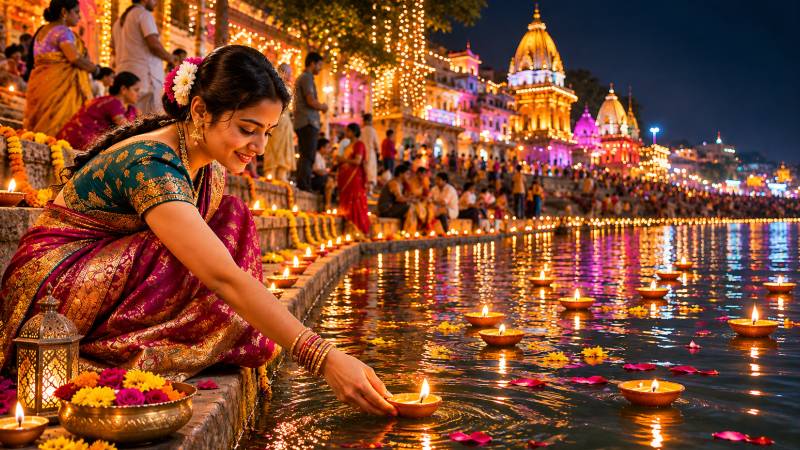
Today, Diwali is being celebrated with joy across the world. Lamps illuminate homes, fireworks light up the night sky, sweets are shared, and an atmosphere of happiness prevails everywhere. Diwali is generally associated with the worship of Goddess Lakshmi and the return of Lord Ram Chandra to Ayodhya. But is the story of Diwali limited to these traditions alone? Have we ever tried to explore its roots in the earliest journey of human civilisation, the emergence of agriculture, the settlements established along riverbanks, and humanity’s ancient relationship with nature? Perhaps the history of Diwali is far older and broader than our conventional understanding.
From the Formation of Mountains to Human Civilisation:
Approximately 200 million years ago, the Indian landmass was part of an ancient southern supercontinent known as Gondwana, which also included Africa, Antarctica, Australia and Madagascar. Over time, the Indian tectonic plate separated from Gondwana and began moving northwards across the ancient Tethys Ocean. Around 50 to 60 million years ago, it collided with the Eurasian Plate. This immense collision gave rise to the great mountain systems, including the Himalayas, Karakoram and Hindu Kush. The Indian Plate continues to move northwards by a few centimetres every year, keeping these mountain ranges geologically active and contributing to their continuing uplift.
These mountains, glaciers and rainfall systems gave rise to the great rivers of the subcontinent, which have continued to flow through the region. These include, in particular, the Indus, Jhelum, Chenab, Ravi, Beas, Sutlej, Ganges, Yamuna and Brahmaputra. Their waters, fertile soils and seasonal flows made the region suitable for human settlements and agriculture. Approximately 12,000 years ago, during the Neolithic Revolution, human beings gradually moved away from nomadic lifestyles based on hunting and food gathering towards cultivating land, practising agriculture and establishing permanent settlements. The valleys of the Indus, Ganges, Yamuna, Saraswati and Brahmaputra offered favourable conditions for the development of agriculture and ancient civilisations. For human beings, harvesting crops was not merely a means of obtaining food. It also symbolised prosperity, survival and hope for the coming season. After harvesting, communities expressed gratitude for nature's blessings and celebrated before the arrival of winter. In this way, seasonal celebrations emerged from the close relationship between agriculture, nature and human life. This is where the early origins of Diwali may be traced.
From Agricultural Prosperity to the Worship of Goddess Lakshmi:
As agriculture gradually became the foundation of prosperity in human society, wealth, livelihood and abundance became increasingly associated with religious beliefs. In Hindu traditions, Goddess Lakshmi emerged as a symbol of wealth, good fortune and prosperity. Lakshmi is mentioned in ancient Vedic literature, particularly in the Shri Sukta, which is associated with the Rigvedic tradition, although it is generally regarded as a later addition to the Rigveda. This suggests that traditions associated with the worship of Lakshmi predate even the traditionally accepted era of Ram.
The brightest lamp of Diwali is the one that illuminates the human heart and mind with knowledge, awareness, gratitude, love, compassion and wisdom.
The concepts of Lakshmi, Durga, Saraswati and other goddesses also encourage us to reflect on the position of women in ancient societies. Women played important roles in economic, social and political affairs. There were traditions of female authority and leadership in ancient societies, and throughout the histories of Africa, Asia, Europe and the Americas, women have occupied positions of governance and leadership. Female figurines, seals and other artefacts discovered in the Indus Valley Civilisation also offer important clues about the position and representation of women in ancient society. By this stage, Diwali had also evolved into a festival associated with the worship of Lakshmi and the prosperity of the harvest, as religious traditions had gradually taken a more organised form.
The Story of the Ramayana and the Royal Tradition of Diwali:
According to the Hindu religious concept of time, this story belongs to the Treta Yuga, the second of the four Yugas. It is associated with the Raghuvanshi dynasty of Ayodhya, whose traditions placed great importance on keeping promises and fulfilling family obligations. These traditions have been preserved in literary works such as the Ramayana of Sage Valmiki and the Ramcharitmanas of Tulsidas. King Dasharatha of Ayodhya had three queens. His youngest and favourite queen, Kaikeyi, invoked two promises previously granted to her and demanded the throne for her son, Bharata, and fourteen years of exile for her eldest stepson, Ram Chandra. Bound by his promises, King Dasharatha felt compelled to accept her demands. Ram also submitted to his father's decision and departed for the dense forests of Dandakaranya, accompanied by his wife Sita and younger brother Lakshman. These forests extended across areas of present-day Chhattisgarh, Odisha, Maharashtra, Telangana and Andhra Pradesh. In essence, this episode was rooted in family politics and royal succession.
During this exile, a war broke out between Ram and Ravana, the powerful Dravidian king of Lanka, following Ravana's abduction of Sita. With Hanuman's assistance and through political strategy, Ram Chandra secured the support of Ravana's brother, Vibhishana, who turned against Ravana. Ram eventually won the war, recovered Sita and handed over the kingdom of Lanka to Vibhishana. This victory is commemorated as Dussehra, fifteen days before Diwali. Some modern historical estimates have also suggested 5635 BCE as the possible period of this war. According to the renowned contemporary thinker Osho, the roots of the hostility between Ravana and Ram can be traced back to Sita's Swayamvara ceremony. King Janaka had announced that whoever could lift and break the mighty bow of Lord Shiva would win the hand of his beautiful daughter, Sita. According to Osho's interpretation, fearing Ravana's extraordinary and seemingly invincible strength, Ram's family spread false news that Lanka had been set on fire to prevent Ravana from attending the ceremony. Ravana later abducted Sita as an act of revenge. This interpretation offers a different perspective on the origins of the conflict between Ram and Ravana.
Nevertheless, after completing fourteen years of exile, Ram Chandra returned to Ayodhya on the day that had already been associated with the celebration of Diwali. During Ram's exile, the people of Ayodhya had observed the occasion in a relatively subdued manner. However, when Ram, Sita and Lakshman finally returned, the people of the city celebrated their homecoming with great enthusiasm, illuminating their homes and streets with lamps. Over time, this event became one of the most important religious traditions associated with Diwali.
The Message of Diwali Beyond Religion:
When Diwali is viewed against the broader historical and civilisational background, several stages of humanity's journey appear interconnected: the formation of the Earth and its mountains, the emergence of rivers, the beginning of agriculture, agricultural prosperity, the worship of Goddess Lakshmi, the social position of women in ancient societies, and the religious traditions of the Ramayana. It is possible that all these traditions did not originate at the same time or in the same geographical location. However, over centuries and generations, they became interconnected. In this way, Diwali evolved into a living cultural heritage, with each era contributing its own beliefs, ideas and experiences.
Rivers existed before temples, human communities dependent on nature existed before organised religions, and long before wealth was associated with a goddess, human beings were cultivating land, sowing seeds and struggling for survival. In my view, the true significance of Diwali is not confined to the return of Ram to Ayodhya, the worship of Goddess Lakshmi or Ram's victory over Ravana. It also symbolises humanity's long journey from the lap of nature to the creation of civilisation, from hunting to agriculture, from the struggle for survival to prosperity, and from ignorance to knowledge and awareness. The brightest lamp of Diwali is the one that illuminates the human heart and mind with knowledge, awareness, gratitude, love, compassion and wisdom. For light is not merely about illuminating homes and streets; it is also about dispelling the darkness within human minds.