

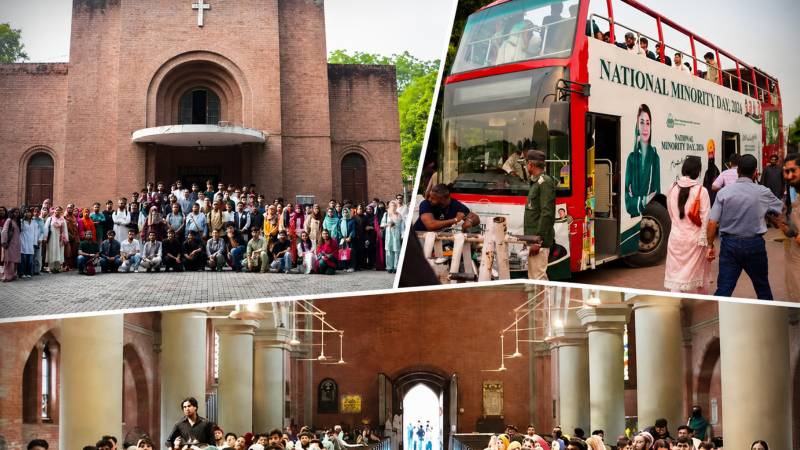
Minority Week from August 7 to August 11 has been celebrated in Punjab under the directives of Chief Minister Maryam Nawaz Sharif and led by the Human Rights and Minorities Affairs Department, led by the Minister for Human Rights and Minority Affairs Punjab, Sardar Ramesh Singh Arora. The week-long program promotes interfaith harmony, religious tolerance, and social inclusion, culminating in National Minorities Day on August 11.
For this purpose, a heritage photo walk was organized in Lahore on Sunday, August 9. Around one hundred and twenty students, photographers, and people from different backgrounds participated in it. The photo walk provided us with an opportunity to visit important religious and historical places in Lahore. We visited churches, a Hindu temple, and a Sikh gurdwara. These visits were not only about historical buildings. They were also an opportunity to understand the religious traditions and cultural heritage of different communities living in Pakistan.
The first important message of the activity was that minorities are an important part of Pakistan's history and society. The historic churches of Lahore showed the contribution of the Christian community to the cultural and educational development of the city. Churches such as the Sacred Heart Cathedral, the Cathedral Church of the Resurrection, and Naulakha Church are important examples of Lahore's religious and architectural heritage.
The visit to Naulakha Church also highlighted the contribution of Christian missionaries to education and health. Institutions such as Forman Christian College and Rang Mahal School have played an important role in the educational development of Lahore. This shows that religious minorities have contributed greatly to the progress of Punjab. The visit to Shri Krishna Temple provided an opportunity to learn about the Hindu community and its religious traditions. The temple is an important religious and cultural centre for Lahore's Hindu community. Festivals such as Diwali, Holi, and Janmashtami are celebrated there. Such visits help remove misconceptions about other religions and create a sense of mutual respect.
Hatred based on religion divides society. It creates fear and weakens national unity.
The visit to Gurdwara Dera Sahib was another important part of the photo walk. The Sikh community welcomed us warmly and served us langar with delicious dal chawal and potato rice. We sat together and shared the same food irrespective of any religious or racial discrimination. This simple tradition gave a powerful message of equality, brotherhood, and humanity. We also observed Sikh prayers respectfully. We did not criticize or judge another religion. Instead, we listened and tried to understand the religious practices of the Sikh community. This is the true spirit of interfaith harmony. The visit to Maharaja Ranjit Singh's Samadhi also reminded us of the historical contribution of the Sikh community. Such historical places are part of the common heritage of Lahore and Pakistan. They should be protected and respected by everyone.
The Constitution of Pakistan also provides protection to religious minorities. Article 20 guarantees freedom to profess, practise, and propagate religion, subject to law and public order. Article 25 guarantees equality of citizens before the law. Therefore, religious harmony is not only a social need but also a constitutional responsibility. Religious intolerance and extremism are serious threats to social peace. Hatred based on religion divides society. It creates fear and weakens national unity. No person should be hated because of his or her religion, sect, or belief.
The role of the government is important in this regard. It should protect places of worship and ensure equal rights for all citizens. Political leaders, religious scholars, teachers, media, and civil society should also promote tolerance and peaceful coexistence. Educational activities such as this photo walk can play an important role. When young people visit churches, temples, and gurdwaras, they learn about other communities directly. Such interaction reduces prejudice. It replaces misunderstanding with knowledge and fear with familiarity.
The Lahore photo walk gave a practical message of religious harmony. It showed that people from different faiths can visit each other's religious places, share food, learn about each other's traditions, and live together peacefully. The diversity of Pakistan should be treated as a strength rather than a weakness. Pakistan can achieve lasting peace only when its citizens respect one another regardless of religion, sect, or belief. The state must protect minority rights, while society must reject extremism and hatred. This is the only way forward for a prosperous and peaceful Pakistan.