

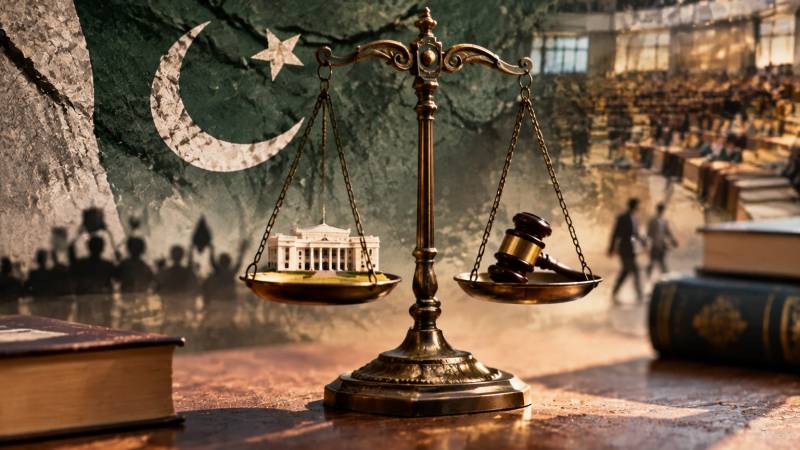
A constitution isn’t just another law it’s the ground everything else rests on. This is where a state draws its authority, figures out who gets to do what, and sets the rules for how government and ordinary people interact. Political tides change all the time. Governments swap out, coalitions shift, the majority in Parliament rises and falls. Through all that, the Constitution is supposed to hold steady, well above the ambitions of whoever happens to be in charge right now. The danger of oligarchy begins when a handful of powerful interests start treating the Constitution as their private instrument rather than the people's supreme covenant. The fox does not become the guardian of the henhouse simply because Parliament gives it the keys. Right now, Pakistan’s constitutional conversation feels a bit like a tug-of-war over institutional power. Every political camp says the right things respect for democracy, accountability, upholding the Constitution. Yet, when those principles start to threaten their own interests, you find out pretty quickly who’s serious and who’s not.
Look at how the 26th and 27th Amendments played out. Supporters called them necessary reforms, steps toward fixing the system. Even, Maulana Fazal Ur Rehman supported government in 26th amendment but Mohsin Naqvi clears that there won’t be any share for him any further. Critics worried that these changes were undermining judicial independence, shaking up the institutional balance, and piling too much power in the hands of a few. These aren’t just talking points they’re real issues that deserve an honest debate, not just finger-pointing and political slogans. The 26th Amendment, passed in October 2024, changed how the Chief Justice of Pakistan gets appointed, set a three-year term, and tweaked the process for judicial appointments and how constitutional cases are handled. It brought in constitutional benches and drew new lines around judicial power. The government argued the changes were about making Parliament supreme, demanding more accountability in the system, and clearing up delays that were keeping people from getting justice. And yes, there have been real frustrations slow courts, barriers to justice, and uneasy relations between lawmakers and judges.
Still, you can’t just take the government’s word for it. When politicians get a bigger say in picking judges, you need solid guardrails to stop politics from seeping into the bench. Both Parliament and the courts play essential roles neither should be used as a blunt instrument against the other. The 27th Amendment, passed in November 2025, took things further. It set up the Federal Constitutional Court and shifted big constitutional cases there. It even changed how top judges and military leaders are picked. Again, the government said it was making the system more rational. But skeptics saw dangers diluted judicial independence, weakened checks and balances, and more power flowing to the center.
So here’s the real test: Never mind how grand the amendment sounds or how many votes it gets—does it actually help restrain power, protect rights, and settle disputes fairly? If a reform makes people trust the system less, it’s probably made everything worse, no matter how good it sounded in Parliament. If you look back, the Eighteenth Amendment of 2010 stands out. Major political parties agreed Pakistani democracy couldn’t breathe under a government that hoarded all the power in Islamabad. The Eighteenth shifted real authority to the provinces, scrapped the Concurrent List, and put more responsibility in local hands. Article 140A demanded provinces set up real local governments. Article 160(3A) guaranteed provinces wouldn’t get a smaller share of national funds than before. These weren’t small tweaks. They showed a willingness to give up power and trust the federation, not just the capital. And yet, devolution hasn’t worked as people hoped. Basic needs quality schools, health care, clean water, working city services are still out of reach for many. Local governments get pushed around, elections are often delayed, and they hardly ever control real money.
Planning Minister Ahsan Iqbal said in late October that the government wasn’t planning to create new provinces via a 28th Amendment, but he did push hard for empowering local governments. That’s a key point admin reform and constitutional overhaul are not always the same thing. Pakistan badly needs stronger local institutions, but these can only be built through open debate where everyone at the table—the center, provinces, and proper local reps—gets a say. There’s nothing wrong with fixing constitutional arrangements that don’t work. But these debates can’t just be about dividing up political spoils. The only reforms worth passing are those that actually make government more open and institutions more effective for ordinary people. If every shift in power looks like a threat, nothing works; but if provinces use their autonomy only to dodge responsibility, people lose out there too.
Look abroad and the contrasts are sharp. The US has changed its Constitution only 27 times in almost 250 years. The first ten amendments, the Bill of Rights, go back to 1791. The last, the 27th, was ratified in 1992. That doesn’t mean the US hasn’t had major crises or that Pakistan should copy America’s model. But it does show something: US amendments are purposely hard to pass. You need a supermajority in both houses of Congress and three-quarters of the states to agree. That means big changes only happen with real broad support, not just a fleeting parliamentary majority.
A parliamentary majority isn’t a blank cheque to bypass consultation. The opposition, in turn, should use committees and negotiation—not just treat every issue as a reason for total confrontation.
Pakistan needs to keep its Constitution flexible enough to fix real problems, but not let it become a tool for short-term political wins. Local governments, fair courts, accountable leaders these are all reforms worth fighting for, but every amendment has to serve public interest, not just whoever’s holding the reins. An amendment can’t just move titles, reward insiders, or settle political scores. The Constitution isn’t a private contract or a market stall where parties haggle over the spoils. Real reform should make the whole system stronger not just hand out perks to whoever’s in power.
Pakistan’s own political anxieties make all of this urgent. Just look at the standoff between the federal government and Maulana Fazlur Rehman’s JUI-F over what’s happening in Khyber Pakhtunkhwa. He’s pushing back against the possibility of emergency powers or governor’s rule, saying you can’t just toss out elected officials with extraordinary measures. The government argues back security threats and militancy are real, and the state has to act. Both sides raise points worth considering. But nobody should treat security concerns as a green light to trample constitutional boundaries.
Khyber Pakhtunkhwa has suffered terribly lives lost, people displaced, the economy battered. The state must defend its citizens, but it should do so under the law, respectful of institutional oversights. Security, no matter how urgent, doesn’t mean you can ignore the rules. The political fight is getting nastier, too. Interior Minister Mohsin Naqvi claimed in the Senate that JUI-F had privately asked for governor’s rule. The party denies it. These things should be cleared up transparently but mud-slinging and personal accusations have no place in what should be a serious parliamentary discussion.
Maulana Fazlur Rehman, for his part, says he’s tried to mediate between the government and the PTI, but that hasn’t led anywhere. The core problem is obvious: if everyone treats anyone talking to the other side as a traitor, real political dialogue doesn’t stand a chance. That’s why there’s so much hope riding on the idea of a new Charter of Democracy. When Benazir Bhutto and Nawaz Sharif signed the first one in 2006, they managed, despite deep rivalries, to agree on some ground rules and set the stage for the big reforms that followed, like the Eighteenth Amendment.
But any new agreement has to go further. It needs to put real limits on executive power, protect the right to debate in Parliament, reassure provinces about their autonomy, and block the manipulation of constitutional loopholes for political gain. And above all, it should make clear that political problems should be solved by Parliament, courts, and public debate not by threats or backroom deals. Both government and opposition have responsibilities here. A parliamentary majority isn’t a blank check to bypass consultation. The opposition, in turn, should use committees and negotiation—not just treat every issue as a reason for total confrontation.
The recent story involving Asad Mahmood, Maulana Fazlur Rehman’s son, ups the temperature even more. Questions about the rising costs of road projects in Dera Ismail Khan demand answers. Big jumps from the initial estimates to final contracts need transparency. But an increase in project costs can’t be taken as proof of corruption without proper, independent examination of the records. Public money has to be audited, and the law should apply to everyone. Yet, allegations alone don’t make someone guilty. The review process must be fair and based on evidence, not just political convenience. How the state goes about accountability matters a lot, too. Investigations shouldn’t be used to score points or crush rivals just because of timing. Evidence, not politics, should drive inquiries. And while the state must hold people to account for corruption or terror, it doesn’t need to humiliate anyone or slam doors on conversation.
Democracy is more than just tallying up seats and passing amendments with a supermajority. Just meeting the legal requirements doesn’t mean you’ve earned real legitimacy. Trust, restraint, and respect for differences are the glue that holds any long-lasting Constitution together. Pakistan has already paid a steep price for letting unchecked ambition tear at its institutions. Banking the country’s future on the “next strongman” showing a bit more restraint than the last is not a plan. At the end of the day, a Constitution belongs to the people not the current government, not the opposition, not anyone angling for their turn at the top. It belongs to everyone, including future generations who haven’t even been born. They deserve more than just another headline about a “historic” amendment. They deserve a country where the rules stand taller than the rulers.