

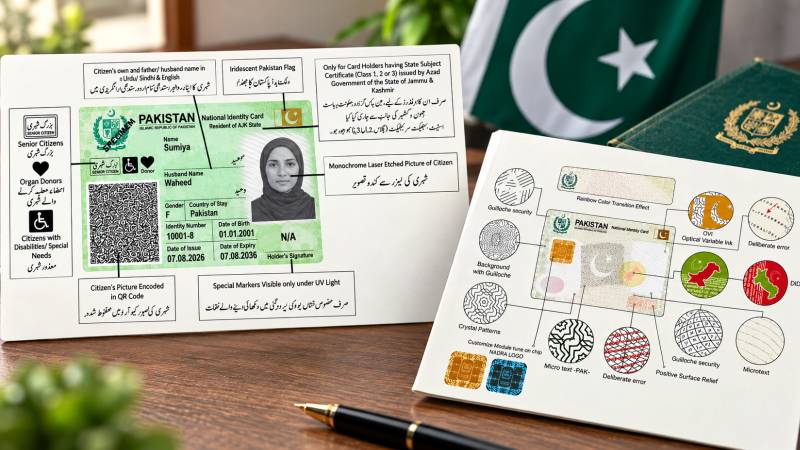
On Independence Day, NADRA announced that Pakistan's national identity card would no longer carry a microprocessor chip. In its place sit two QR codes, printed on a locally made polycarbonate card and readable by any smartphone through the Pak-ID app, that was launched in 2021. The change replaces a card that stored and verified identity data on an embedded microprocessor with one that instead prints two scannable codes. NADRA frames the shift as cheaper to produce, easier to read at scale, and less dependent on imported components. It also, by design, trades away a set of security properties the chip provided. Both halves of that trade deserve dispassionate examination rather than a verdict taken on faith.
NADRA introduced Pakistan's first Smart National Identity Card in 2012, built around a secure microprocessor capable of matching fingerprints and digital photo against data stored on the chip itself, so the biometrics never had to leave the card. The card also carried the architecture for digital certificates, PINs and tokens, developed by NADRA's own engineers. The underlying ambition was a reusable trust platform: one credential a citizen could use to open a bank account, draw a pension or receive a cash transfer without re-enrolling at every counter. Another goal was to have world best card, the unforgeable one, with maximum security features to showcase the world to win international business for NADRA.
NADRA's stated rationale for removing the chip is that readers and supporting infrastructure never spread widely enough to make full use of it. There is evidence for this. There is also reason to examine it further. Banks ran chip cards for years. The Army fielded its own biometric smart cards. Several government departments commissioned smart cards of their own. Readers, in other words, were not obviously the scarce resource. What appears not to have been built is the procurement rule, business model and institutional architecture needed to make one national credential reusable across every service, a narrower gap than an infrastructure shortfall alone would suggest. It is also worth noting that the 2012 Smart NIC already carried a QR code alongside the chip and biometrics, with both online and offline verification paths. The design matched the method of proof to the stakes of the transaction rather than betting everything on one piece of plastic. A QR code and a secure chip are not interchangeable, and a fact-based assessment of this transition has to say so plainly.
Pakistan is moving from the global majority standard to a minority one. More than 100 countries in the world are using chip-based cards as their national IDs. Some countries like India (Aadhaar), Singapore (SingPass), Indonesia (KPT), Malaysia, Brazil (CIN) and some others rely on a QR code. Some use QR code with chip. In leaving that majority, Pakistan's new card in fact joins Panama as one of the only two countries known to place two QR codes on a single national identity card, though the two designs differ in what they separate. Pakistan's CNIC, according to specimen images NADRA published on its official X account, @nadrapak, carries one QR on the front, encoding the cardholder's photograph, and a second on the back, encoding identity data.
NADRA maintains that this design protects citizens' privacy and security. Officials describe the QR code as intended primarily to enable secure verification of the document itself: the payload includes the CNIC number, and the data is bound by a cryptographic signature that lets an authorized verification system determine whether the record has been altered or tampered with. On that narrow claim, tamper detection, NADRA is on solid technical ground. A signed payload genuinely lets a verifier tell a forged code from a genuine one. Worldwide experience with similar QR-based identity systems tells a more complicated story once the code leaves the issuing authority's hands.
A microprocessor chip holds a private key inside tamper resistant hardware and performs its cryptographic check without that material ever leaving the card. A QR code, however securely signed, is something you can see: an image any smartphone can capture from across a counter, off a photocopy, or from a scan left on someone else's phone. It carries no proof it was not simply lifted from an earlier photograph, and cloning one takes nothing more than a camera. In Pakistan, where every bank, hotel and property registry has trained citizens for two decades to hand over a CNIC photocopy, a QR code carrying full identity data functions, in effect, as a walking photocopy that anyone who ever collected one can now scan and reuse. A signature confirms who issued the code. It does nothing to restrict who can read it.
That is why the real test has little to do with what sits on the card. It is whether Pakistan finally builds what the chip was meant to enable: one authoritative identity every ministry and program can verify against, instead of each inventing its own.
Consider again. QR-based IDs can use strong cryptography, but their data usually is static, copyable, and anchored to a state-controlled database. Chip-based IDs shift trust to the citizen: cryptographic operations happen in tamper-resistant hardware, enabling offline, holder-verifiable authentication that resists silent, remote alteration (including by the issuing state). If a government quietly erases a dissenting citizen’s identity in its registry, a chip still carries the original signed attestation. This is a check, not sovereignty: the state controls revocation and the trust root. But still, chips raise the cost of undetected tampering and decentralize verification; QR-database models concentrate both authority and vulnerability in state hands.
India's experience is instructive. Aadhaar adopted a UIDAI-signed secure QR code in 2018 so citizens would not have to hand over their raw number. Security researchers, and a Supreme Court advocate quoted at the time, warned that anyone with an ordinary scanning app could pull a person's name, address, photograph and date of birth off the code, with no consent step and no way for the cardholder to know. India has since introduced consent requirements for parties relying on Aadhaar-based verification, a meaningful correction. Even so, the fraud that preceded it was not theoretical. In 2023, police in Uttar Pradesh broke up a ring using forged Aadhaar and PAN cards, with recreated QR codes convincing enough to open more than 300 bank accounts. A Delhi gang sold altered Aadhaar records online for under fifty rupees apiece. In 2026, Ahmedabad's Cyber Crime Branch uncovered an operation using AI-generated deepfakes to clear Aadhaar verification and take out loans in victims' names. India's own regulator has since steered citizens away from handing out Aadhaar photocopies, for exactly this reason.
None of this is unique to South Asia. QR-based fraud, unrelated to any single country's ID card, is one of the fastest growing categories of online crime worldwide. Industry trackers recorded QR phishing rising several fold between 2023 and 2025, with QR codes now present in roughly one in eight phishing attempts, and Britain's national fraud reporting center logging a comparable surge. A QR code can still anchor a secure identity system. One that simply displays personal data, however well signed, inherits weaknesses a chip was specifically built to avoid.
For countries like Pakistan, as mentioned above, there is also the question of verification without a live connection. A chip completes its check offline, inside a village clinic or a border post with no signal. A QR code, in most deployments, depends on a smartphone, an app and a network for anything beyond what is printed on its face. NADRA says banks, hospitals, telecom operators, Railways and police will get scanning software, a real step forward from needing specialized readers. It also means assurance quietly degrades exactly where connectivity is weakest, in the rural districts already furthest from formal services.
None of this argues for keeping the chip as it was. A QR code any ordinary smartphone can read removes a genuine barrier, since specialized readers were never going to reach every counter in the country. What deserves equal weight is that cost and reach are not the only numbers that matter. A chip-embedded card required imported microprocessors and specialized personalization equipment that a printed QR code does not. NADRA should publish what the old card cost, what the new one costs, and how much of that saving reaches citizens through lower fees, since the public is not just buying a cheaper card but giving up a security capability. That is a fair exchange to ask citizens to make. It is not a fair exchange to leave unexplained.
Digital identity systems elsewhere have often become politically contentious at exactly the point they begin working as intended: when they remove an intermediary, or surface irregularities such as ghost employees or duplicate benefit claims that some stakeholders would prefer remained unexamined. Institutional resistance in such cases rarely centers on the specific technology involved. It centers on what a well-implemented credential, chip or QR code, makes harder to conceal.
That is why the real test has little to do with what sits on the card. It is whether Pakistan finally builds what the chip was meant to enable: one authoritative identity every ministry and program can verify against, instead of each inventing its own. This has been done before. BISP's own Benazir Card was retired once biometric authentication against the national database matured, with a beneficiary's CNIC and fingerprint replacing the separate card at the point of payment. The Sehat Sahulat health insurance program followed the same path in 2021, when Prime Minister was persuaded that a citizen's CNIC could itself serve as the health card, retiring the standalone Insaf Card.
In Punjab alone, the past two years have added a Kissan Card for farmers, a Sehat Card for health, an Asaan Karobar Card for small business credit, a Smart Ration Card, a Rehmat Card for widows and orphans, a Khidmat Card for low-income households, a Minority Card for religious minorities, and a Parwaaz Card for skilled workers seeking overseas jobs. Eight credentials already in place, with a Himmat Card for persons with disabilities on the way. Eight portals, eight verification systems, each built on the CNIC yet each re-identifying a citizen NADRA had already identified, even though the same national ecosystem that absorbed BISP and Sehat Sahulat remains available. A QR code genuinely reused as shared infrastructure, with common standards, verifiable signatures, consent management and a rule against duplicating what the national system already provides, would be a real advance regardless of what sits on the plastic.
Pakistan's identity card did not fall short over fourteen years because the chip was too ambitious. It fell short because the country kept building projects instead of infrastructure. A QR code can carry that unfinished promise forward, but only if the ecosystem around it—the standards, safeguards, and shared architecture is built and protected long enough to matter. The plastic, chip, or QR code was never the point. The point was and remains a state that Pakistanis can deal with directly, securely, and on equal terms.