

If you had to describe life in one sentence, what would it be? Imagine you are not an artist, a writer, or a creative thinker. What would your answer be? Your answer would reveal a great deal about how you see life and, perhaps, determine the story you tell about it.
I am excited to share something with you today. This is exactly why I read books: they shape my views and help me understand life from different angles. Today, I am happy to share a book written by my friend, corporate expert, and leadership coach, Mustafa Kamal.
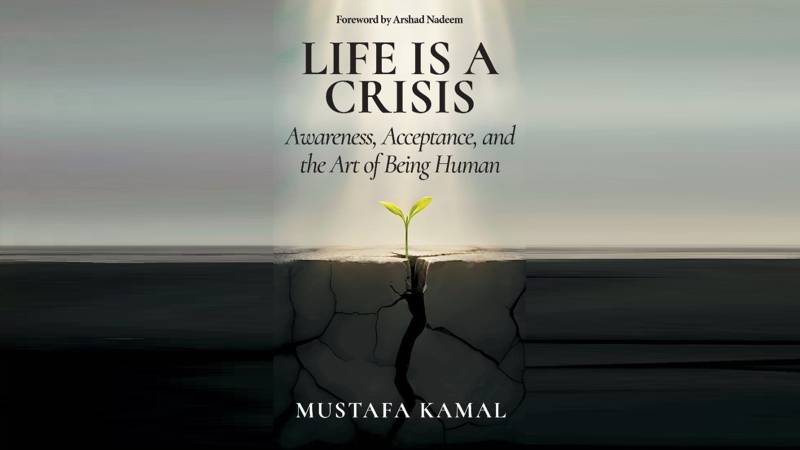
Life Is a Crisis: Awareness, Acceptance and the Art of Being Human is a beautiful book.
First, I must acknowledge that although I have known Mustafa Kamal for several years, I never knew he was such an exceptional writer. Let me congratulate him on his first book, a 240-page hardbound edition with a dust jacket, quality paper, and an excellent, reader-friendly font. The presentation is excellent.
The foreword is written by Olympic gold medallist Arshad Nadeem (Paris 2024), alongside contributions and endorsements from other accomplished leaders and authors known in Pakistan and internationally.
Dr Franco Gandolfi writes, “The book offers a profound reflection on how adversity shapes our identity, purpose, and personal growth. . .”
Muhammad Saad Faridi writes, “The style of Life Is a Crisis reminds me of Malcolm Gladwell and Nassim Nicholas Taleb. Well researched, natural flow with real-life stories placed at just the right moments.”
Beyond Conventional Self-Help
Pakistan’s self-development and corporate training industry has produced many books. Many, however, rest primarily on the author’s personal experiences or on future possibilities, with limited practical application to everyday life.
What makes this book particularly beautiful is the depth Mustafa Kamal brings to the subject. He does not approach it merely as a motivational speaker. Instead, he explores the meaning of life through different experiences, challenges, and stages of human existence. Although written by a Pakistani author, the book carries an international flair.
Other books on crisis tend to focus on one point in the journey, usually midlife or a single transition. Mustafa Kamal has taken on the whole journey. He maps a human life from the birth bed to late life, showing how each crisis prepares us for the next.
The word crisis is easy to misread. In this book, it carries a precise meaning. As the author puts it, a real crisis is “disruption so deep that the old ways of thinking, coping, or being simply stop working.” It is the moment the framework we used to make sense of life becomes inadequate. Seen this way, crisis is not life’s interruption. It is life’s rhythm, and every stage of growth begins with one.
The book also reaches beyond personal turning points. It separates external crises such as war, climate change, and economic collapse from internal ones such as identity and faith, and shows how the two meet: the same event can break one person and build another, depending on the meaning we make of it.
The author dedicates this book to his children, Ayesha and Hasan, writing:
“For Ayesha and Hasan, whose arrival made my life begin again, and for everyone who keeps going when giving up would be easier.”
This dedication itself carries a beautiful message about life, love, new beginnings, and resilience.
Throughout the book, you will find a logical sequence of ideas, thoughtfully articulated examples, and real-life stories supported by research and references. Mustafa does not use the book to boast about his achievements or seek sympathy by highlighting his struggles. He shares his strengths with humility and acknowledges his vulnerabilities with gratitude and honesty, which is rare and courageous.
In my opinion, this makes the book a valuable addition to Pakistan’s personal development and literary landscape.
The book begins with an introduction and is divided into three major parts, comprising twelve chapters, followed by an epilogue and four appendices:
- Part One: Understanding Crisis (Chapters 1 to 3)
- Part Two: The Journey Through Life Crises (Chapters 4 to 7)
- Part Three: Mastering Crisis (Chapters 8 to 12)
The book concludes with an epilogue titled “Life Is A Series of Rebirths.” It is enriched with thought-provoking quotations, research studies, meaningful phrases, and practical recommendations.
The TIDE Framework: Understanding Life’s Crises
One particularly interesting aspect is an original framework for dealing with life’s challenges. Mustafa Kamal explains that he calls it the TIDE framework not because a crisis is gentle like a tide, but because, like a tide, it is governed by forces larger than our preferences. We cannot stop it, but we can learn to navigate it.
TIDE stands for:
- T – Threshold
- I – Immersion
- D – Discovery
- E – Emergence
Through this framework, the author draws an analogy between life’s challenges and the movement of tides. The model encourages us to recognise the moment a crisis begins, understand its impact, discover what it teaches us, and eventually emerge with a new perspective.
Another thought-provoking concept is finding meaning in the breaking. Crisis does not ask whether we are happy; it asks whether we are truly alive to what matters. It reminds us that life’s most difficult experiences force us to reconsider our priorities, relationships, ambitions, and purpose.
On page 145, the author presents an important reflection on control, effort, and outcomes.
We can control our effort, our skills, and our choices. We cannot always control whether these translate into the outcomes we desire.
Accepting what is within our control and what lies beyond it is both humbling and liberating. It reminds us that while we are responsible for our actions, we are not in complete control of life’s results.
The real wisdom lies in giving your best without becoming attached to controlling every result.
Spiritual Intelligence, Resilience, and the Power of Relationships
In Chapter 9, the author explores emotional and spiritual intelligence. On page 157, he refers to research suggesting that people with strong spiritual or philosophical frameworks are often better equipped to navigate crises.
Faith is handled with breadth rather than allegiance. The author does not push any single tradition; he offers a broader context on how different faiths and philosophies help people bear suffering, so readers of any belief can find themselves in these pages.
Chapter 10, ‘Building Resilience and Adapting’, explores how people respond to adversity. On page 171, the author discusses the safety net that people need to survive difficult circumstances. Research on resilience among children repeatedly highlights the importance of at least one stable and caring adult in a child’s life. It could be a teacher, neighbour, grandparent, coach, or someone who recognises their potential and helps them see their own worth.
This observation is meaningful because it reminds us that human development is not an individual journey alone. Sometimes, a single person who believes in us can make a lasting difference in our lives.
Lessons for Life
A strength of the book is its use of real-life examples and stories. The author refers to well-known personalities, including Abdul Sattar Edhi and Malala Yousafzai, alongside other remarkable individuals, some familiar and others less widely recognised.
What I appreciate most about Life Is a Crisis is that it does not promote forced positivity or suggest that everything will eventually work out exactly as we wish.
Sometimes suffering is simply painful, and not every crisis brings an immediate lesson or a rewarding outcome. The first challenge may simply be to survive, accept reality, and find the strength to move forward.
Yet the book remains hopeful. Not because everything always works out, but because human beings possess a remarkable ability to adapt, endure, and find meaning even in difficult circumstances.
As someone associated with corporate training, leadership development, and storytelling, I believe books like Life Is a Crisis are important additions to our reading culture.
I would recommend this book to young people who are trying to discover their direction, professionals navigating career challenges, parents raising children, trainers, leadership coaches, and anyone who wants to understand life from a different perspective.
Perhaps the most important lesson is that life is not always about avoiding crises. It is about understanding them, learning from them, and finding the courage to continue. And sometimes, a crisis is not the end of a story. It is the beginning of a new chapter.