

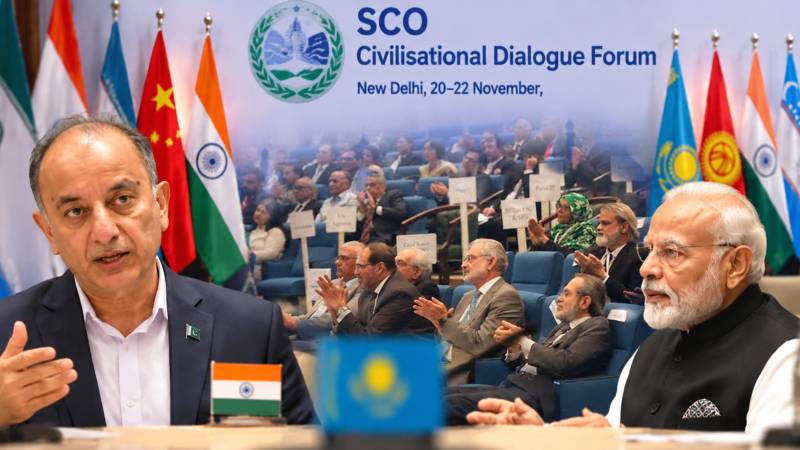
The Shanghai Cooperation Organisation's (SCO) Civilisational Dialogue Forum in New Delhi on Nov. 20–22 was meant to celebrate the shared cultural heritage of Eurasia. Instead, Pakistan's participation provoked extraordinary hostility in sections of the Indian media, political establishment and social media. Rather than focusing on the forum, Indian journalists confronted Pakistan's visiting climate minister, Dr Musadik Malik, with familiar accusations of terrorism. Prominent commentators went further, questioning Pakistan's history, culture and even its legitimacy as a nation.
The controversy exposed a striking contradiction. India aspires to global leadership on the strength of its economic power and civilisational greatness, yet remains remarkably obsessed with Pakistan. Even a multilateral cultural gathering became another occasion for Pakistan-bashing. Pakistan and India joined the SCO as full members in 2017. Their participation in its activities should not be held hostage to bilateral disputes. Yet India's opposition Congress Party accused Prime Minister Narendra Modi of betraying the country by welcoming a Pakistani minister. Pakistan-bashing has become so deeply embedded in India's domestic politics that even the opposition competes with the ruling Bharatiya Janata Party (BJP) in displaying hostility towards its neighbour.
Dr Malik, meanwhile, displayed diplomatic composure. Responding to aggressive questions, he emphasised diversity and shared civilisational traditions. His observation that dialogue requires distinct identities, rather than a single voice, was particularly appropriate. Speaking in Urdu at the forum, he recalled Delhi's historical connections with Central Asia and the wider Muslim world. The contrast between his courteous engagement and the hostile reception was striking.
Modi himself spoke about the importance of cultural connections for world peace. But how can India preach civilisational dialogue internationally while discouraging cultural engagement with Pakistan? Artists, journalists and ordinary citizens face severe restrictions on cross-border visits, while SAARC has remained paralysed for more than a decade. Even the minister’s proposed visit to the shrine of Hazrat Nizamuddin and Taj Mahal was reportedly denied permission. Civilisational dialogue should begin with the immediate neighbourhood.
The X posts of Brahma Chellaney and ANI citing M. J. Akbar’s remarks—both known Pakistan bashers were particularly revealing. Chellaney criticised India's decision to receive Dr Malik, recalling his earlier warning of a forceful Pakistani response to interference with the Indus waters. But India had unilaterally placed the Indus Waters Treaty in abeyance following the April 2025 Pahalgam attack, threatening Pakistan's vital water interests. The treaty contains no provision allowing one party simply to suspend its obligations unilaterally. Pakistan's strong objections were therefore understandable.
Akbar went further, describing Pakistan as an artificial state without a genuine civilisational identity. He even questioned Pakistan's claim to Urdu. Such arguments disregard history. Most modern nation-states are relatively recent political creations, including India in its present constitutional form. Pakistan's independence in 1947 did not erase the ancient civilisation of the land it occupies.
The geographical heartland of the Indus Valley Civilisation lies in Pakistan, including Mohenjo-daro, Harappa and Ganeriwala. Pakistan also inherits Gandhara, Buddhist and Hindu sacred sites, Sikh religious landmarks and centuries of Indo-Islamic culture. Its Islamic identity and ancient civilisational inheritance are complementary, not contradictory. Urdu is likewise a shared South Asian language that Pakistan adopted as its national language without denying its regional languages.
There is another irony in Akbar's position. Much of India's celebrated cultural heritage, including the Taj Mahal and Red Fort, owes its existence to Muslim rulers. India's civilisational greatness emerged from cultural synthesis, not religious exclusivism. Yet Hindutva increasingly seeks to reinterpret this plural inheritance through Hindu majoritarianism. For Muslim public figures, this political environment can also create pressure to demonstrate nationalist credentials through particularly strong positions against Pakistan.
The terrorism narrative deserves equal scrutiny. Pakistan has suffered tens of thousands of casualties from terrorism over the past two decades. India repeatedly accuses Pakistan of supporting cross-border terrorism, while Islamabad alleges Indian RAW’s involvement with terrorist groups like BLA and TTP operating against Pakistan. Both countries should submit their evidence to credible independent scrutiny rather than exploit terrorism for political purposes.
India’s ambition to emerge as a global civilisational power is undermined by its inability to engage with Pakistan as an equal neighbour, turning platforms for cultural dialogue into arenas for political hostility, despite the shared history, heritage and regional interests that bind the two countries.
India's own international record has also attracted serious questions. Canadian authorities have alleged Indian government links to violent criminal activity, which New Delhi denies. In the United States, Nikhil Gupta pleaded guilty in February 2026 to participating in a plot to assassinate a US citizen at the alleged direction of an Indian government employee. No country can claim a monopoly on victimhood or moral authority in combating terrorism. But India's Pakistan obsession has a deeper explanation. The political and strategic assumptions underlying Modi's regional ambitions have suffered significant setbacks since May 2025.
For years, India projected itself as an overwhelmingly superior military power capable of imposing its will on Pakistan. The May 2025 confrontation challenged that assumption. Pakistan demonstrated credible conventional deterrence despite India's enormous advantages in economic resources and military expenditure. India acknowledged aircraft losses, although their extent remains disputed. FlightGlobal's latest World Air Forces directory lists 32 active Indian Rafales, compared with 35 in its previous edition and 36 originally delivered. The figures do not establish the causes of the reduction, but raise further questions about India's military claims.
The diplomatic reversal has been equally significant. India spent years attempting to isolate Pakistan through the terrorism narrative. Yet during the 2026 Iran conflict, Pakistan emerged as an important intermediary between Washington and Tehran. Its strategic partnership with China, close relations with Saudi Arabia and Türkiye, and working relationships with Iran and the United States gave Islamabad unusual diplomatic relevance.
India, meanwhile, encountered the limitations of its strategic expectations. Three decades of expanding engagement with Washington, particularly as a counterweight to China, did not guarantee privileged treatment under President Donald Trump. American policy became increasingly transactional, while India's influence over the West Asian crisis remained limited. India retains considerable economic strength and international partnerships, but the assumption that these would automatically translate into regional dominance has been challenged.
Pakistan's geography places it between China, Central Asia, Iran and the Arabian Gulf. Its military capabilities and diplomatic relationships provide access across competing regional alignments. With the Iran–US conflict still unsettled, Pakistan remains relevant to efforts to restore regional stability. India's attempts to diminish Pakistan's international standing have failed to achieve their intended result.
These developments help explain the frustration reflected in India's political discourse. Hindutva has combined legitimate pride in an ancient civilisation with exaggerated claims of cultural superiority and regional dominance. When military and diplomatic realities challenge these expectations, hostility towards Pakistan becomes a convenient political response. But denying Pakistan's achievements cannot reverse India's setbacks.
The SCO summit in Islamabad in September 2027 offers India an opportunity to adopt a more constructive approach. During India's SCO presidency in 2023, Pakistan's then foreign minister Bilawal Bhutto Zardari attended the foreign ministers' meeting in Goa despite strained relations. India can demonstrate similar diplomatic maturity by facilitating Modi's participation in Islamabad without necessarily holding bilateral negotiations.
Chellaney and other Indian critics should recognise the wider strategic implications. The SCO emerged under Chinese leadership, with China and Russia remaining its principal powers. India has strong reasons to maintain engagement with this important Eurasian organisation, particularly amid uncertainty in its relations with Washington. New Delhi has already demonstrated pragmatism towards Beijing through renewed diplomatic contacts and progress in managing their disputed border. Why should similar pragmatism be impossible in its multilateral dealings with Pakistan?
Pakistan has little reason to make Modi's attendance a condition for the summit's success. It can extend the invitation with customary diplomatic courtesy and proceed with its wider SCO agenda. Its growing international relevance should be sustained through economic recovery, institutional strength and constructive diplomacy rather than triumphalist rhetoric.
The New Delhi controversy ultimately revealed more about India's political insecurities than Pakistan's civilisational standing. A confident nation does not need to deny its neighbour's history or turn every diplomatic encounter into a confrontation. India's real challenge is not Pakistan's growing confidence, but its own difficulty in reconciling civilisational ambition with geopolitical reality. Unless that changes, its Pakistan obsession will continue to undermine the regional and global leadership it seeks.