

I remember turning forty. My highly educated younger brother, who was visiting Pakistan briefly, made a rather interesting observation: “Aab kya? Chalees ke baad apni kya zindagi? Auron ke liye, aulaad ke liye jeena hai!” (What is left of one's own life after forty? One must live for others, for one's children!)
He probably meant it affectionately, as a familiar observation about the responsibilities of middle age. I did not argue. But some words, even when spoken casually, leave an echo. His were to find their answer in an unexpected encounter with the geography of gender. We both went shopping in Blue Area. Afterwards, he announced that he wanted to have sajji at his favourite place. We went there. Every customer seemed to be a man (perhaps culinary preferences are gendered too!). The young men quickly arranged a “ba-purdah corner” for me. Noticing my hesitation, my brother reassured me: “Aab tou aap yahan baith jaain” (Now you can sit here).
I am not making my brother an antagonist here. That would miss the point. He is an educated man, and his remarks were not necessarily expressions of any conscious desire to restrict me. It is the cultural conditioning, selective biases and assumptions we inherit, often without examining them, that interest me. Many of our men enjoy remarkably unrestricted public lives, particularly those settled in the West. They are perfectly at home with individual freedom, socialising and personal choices. Yet the cultural rulebook governing women in their families back home can remain rather traditional. Apparently, liberalism too can have different geographical and familial applications!
Luckily, no man controls me. I have my own resources, including what I like to call the power of the purse. I have earned this independence, though not without a price. I no longer need permission to make my choices, but financial independence and family acceptance are two different things. I am not necessarily the most popular or socially endorsed female in my khandaan. Being outspoken, questioning conventions and, above all, being feminist can make one something of an inconvenient relative.
Feminism is also the right to pleasure, visibility and participation without judgement. But claiming public space must mean making it accessible to all women, not just those with the resources and freedom to enjoy it.
There are highly celebrated women around me in the family. According to some other revered women, including my mother, “Voh sab bhi tou hain tumhari tarah, zuban nahi chalateen, ghar nahi tora.” (Look at all those other women; they are like you, but they don't talk back or break up their homes.) So, the fault lies with me! Now, I can laugh at some of life's tragedies without turning every recollection into a drama. Humour does not diminish their seriousness or the perks of patriarchy; it simply gives me another way of looking at them.
Has anything changed in 2026? Certainly. Women are more visible in Islamabad and other urban centres. They are eating out, travelling, working, performing and organising. But visibility should not be confused with equality. Economic necessity, too, has pushed women into public life, without necessarily transforming the collective mindset. Perhaps one sign of change is the growing number of informal cultural spaces where women can gather, share an interest and enjoy themselves without having to explain their presence. Singing circles are one such example. The Singing Circle of Islamabad, an initiative by the talented K-TV anchor Rida Imran, is worth celebrating. She happens to be the daughter of Aftab Ahmad Israr, a distinguished producer from PTV's golden era and one of my respected mentors when I worked as a PTV anchor.
The circle has its own character. It is not an exclusively women's space in the sense of excluding men. Sometimes the spouses and parents of these vibrant women join in too. Men are welcome. Claiming public space need not mean creating another set of walls. It means creating environments where women can participate freely, without having to seek permission or justify their presence. The initiative also gives visibility to local musicians and bands who are often sidelined or struggling to find platforms. It doubles as a networking space for women entrepreneurs, allowing friendships, professional connections and collaborations to develop organically.
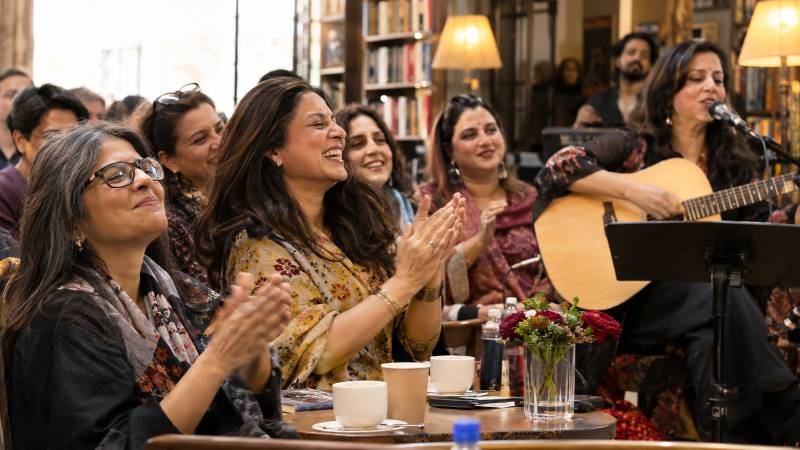
Karachi has its own lovely initiative, Sing Along Karachi, led by singer Afshan Ahmed, whom those in their fifties and older may remember from her childhood appearances in Suhail Rana's Hum Hi Hum and a toothpaste advertisement. Inspired by her mother's lifelong association with music, the circle brings women together once a month to sing, unwind and enjoy some much-needed me-time. And then there was my own little experience of fairytale feminism at Café Mudz, tucked inside the old Vanguard Bookstore, in Islamabad's nostalgic Super Market of our generation.
We sang, we clapped, we swayed. For a little while, we were not someone's mother, wife, daughter or professional colleague. We were simply people enjoying music in a public space. We were the ageless women, refusing to be defined by the numbers attached to our lives; women beyond classism, at least for those precious moments, connected by music rather than social standing, professional titles or economic differences. Perhaps that is the little miracle of such spaces: the opportunity to meet one another beyond the hierarchies society has constructed.
Feminism is also the right to pleasure, visibility and participation without judgement. But claiming public space must mean making it accessible to all women, not just those with the resources and freedom to enjoy it. Every gathering, reading circle, walking group or shared song challenges the assumption that public space belongs more naturally to men. Perhaps feminism needs no manifesto. Sometimes it arrives with a song, a cup of coffee, a few claps and the freedom to sway. And sometimes, after all these years, it is simply about sitting down at a table and knowing that you belong there. May all women have the courage to claim their space, the freedom to enjoy their coffee and conversations, and the confidence to be as strong, outspoken and unapologetic as they wish. That, too, is claiming our public space and breaking the cultural curfew.