

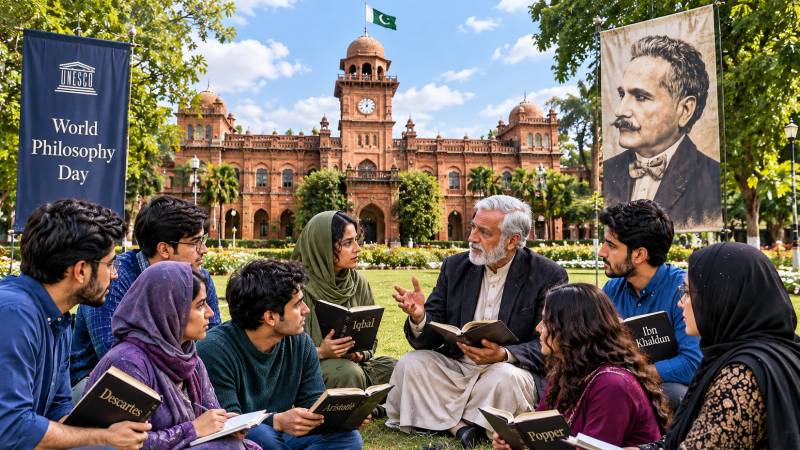
UNESCO celebrates World Philosophy Day every year in November to highlight the significance of philosophy in reflecting on national and global challenges. The key theme for 2026 is achieving coexistence in a world in crisis. Migration, climate change, the ethical implications of artificial intelligence, violence, terrorism and war are crucial global challenges. Philosophy helps us understand our common humanity, our shared challenges, and the need for collective thinking and action to address them.
Learning to live together in a world in crisis requires recognising that humanity is sacred and deserves reverence rather than contempt, as it represents the only dependable unity among human beings that no one can deny. Learning to be human means learning to live together by recognising our limitations, fallibility, interdependence and common humanity. This understanding helps us realise that our lives depend on one another and that there is no other option: we must either survive together or perish together in a world in crisis. Learning to live together means embracing the ethics of mutual reverence.
However, the entire human world is in crisis. It seems that the world has become a Hobbesian state of nature. In his magnum opus, Leviathan, Thomas Hobbes, the father of modern Western political philosophy, explained the concept of the 'state of nature'. Hobbes argued that, in the state of nature, there is no authority, law, morality or tradition. In this state, people have no sense of common humanity, shared challenges or collective thinking and action. They pursue their own interests, and in doing so, each is at war with all others, engaging in a zero-sum game. In the state of nature, human life is "solitary, poor, nasty, brutish, and short". In this global state of nature, humanity stands at a crossroads between the common good and the common bad, echoing Garrett Hardin's idea of the 'tragedy of the commons': self-interest destroys shared resources, leading to collective harm. In the age of nuclear weapons, the question of human survival becomes even more pressing for everyone.
All developed nations are alike; each developing nation has problems of its own. Pakistan is a developing nation. Overpopulation, socio-political unfreedom, authoritarianism, intolerance, ecological unsustainability, disease, poverty, illiteracy, lawlessness, distributive injustice, lack of accountability, corruption, low levels of human development and human rights violations are among the country's crucial problems. These problems are created by none other than human beings themselves. Overpopulation is the root cause of all problems in Pakistan.
Why does philosophy matter? Philosophy fosters rationality, helping us find alternative solutions to problems and promote a culture of dialogue in society. It not only helps us understand the world but also change it. Philosophers are intellectuals who transform the world through the tools of logic and ethics. In his Prison Notebooks, Antonio Gramsci, an Italian intellectual and political activist, defines the role of intellectuals. Gramsci states, "All [hu]men are intellectuals... but not all [hu]men have in society the function of intellectuals." If the world is in crisis, it means that intellectuals have not adequately fulfilled their function in society.
Following Gramsci, Julien Benda, a French thinker, argues in his work The Treason of the Intellectuals that many modern intellectuals have betrayed their primary function of fostering universal, objective truth and justice by propagating political passions, nationalism, racial hatred and class interests. In line with the thinking of Gramsci and Benda, Edward Said, Eqbal Ahmad and Noam Chomsky also advocate an active role for intellectuals and condemn their tendency to remain detached observers of political and social realities. They argue that intellectuals have a moral, political and social responsibility to question the causes of injustice and ideological manipulation and to protect human dignity.
Learning to be human is learning to live together by realising human limitations, fallibility, interdependence, and common humanity. Our lives depend upon each other, and there is no other option: either we survive together or perish together in a world in crisis.
In Pakistan, we celebrate two significant occasions in November: World Philosophy Day and Iqbal Day. Sir Muhammad Iqbal, a philosopher, created political consciousness among the Muslims of the subcontinent through his powerful philosophical ideas, inspiring them to safeguard their socio-political, economic and religious rights. This ultimately contributed to the creation of a separate homeland. Pakistan has decided to celebrate Iqbal's philosophy throughout the year in observance of his 150th birth anniversary. This is a great tribute to a philosopher. Iqbal's philosophy, which possesses both national and cosmopolitan characteristics, urges people to become creative, productive and moral members of society. His philosophy promotes human development, creativity, and a rational and scientific approach to life as a means of achieving a good life. Iqbal played an active role as an intellectual in transforming society and shaping a better future. Certainly, his work represents a valuable intellectual heritage that can inspire young people to become genuine agents of transformation in Pakistan.
On the occasion of World Philosophy Day, the key question is: how can we achieve peaceful coexistence in Pakistan? There is an urgent need to promote philosophy in Pakistan to reduce intolerance, foster rational dialogue, and promote a vibrant democracy and freedom of thought. There are several ways to achieve this. Schools could introduce curricula that incorporate philosophy for children to develop critical and moral thinking. Philosophy courses should also be taught at colleges and universities. AI ethics, environmental ethics, logic and critical thinking are essential subjects in the present era. New teaching positions should be created, and philosophy teachers recruited at colleges. New departments should also be established at universities to promote a culture of questioning, independent thought and critical thinking for the country's social, political and economic progress. To make Pakistani society more progressive, greater emphasis on the works of essential philosophers, including René Descartes, Immanuel Kant, Karl Popper, John Dewey, Muhammad Iqbal and Fazlur Rahman, could be promising.
In the 21st century, several unprecedented challenges have emerged, including migration, ecological deterioration, disease, AI-related challenges and terrorism.
Migration is a global challenge. Due to limited resources and a lack of opportunities, people migrate from one place to another, creating various social, political and cultural challenges. In Pakistan, many people migrate to developed countries, contributing to brain drain. To address migration and brain drain, people must have access to social justice, employment opportunities and equal opportunities within the country.
Climate change is one of the most pressing challenges facing the contemporary world. It causes environmental unsustainability, posing serious threats to humanity today and to future generations. Creating a sustainable environment is a matter of environmental ethics, which urges people to adopt nature-friendly practices. Ecological sustainability depends on collective thinking and collective action.
Artificial intelligence has intervened extensively in human affairs. Indeed, AI is assisting human thinking in ways that no previous technology has. However, it also raises ethical challenges relating to privacy, transparency and fairness. There is an urgent need to develop a universal ethical framework to regulate AI for the betterment of humanity.
Health is also a global challenge. Pandemic diseases, pollution and deforestation are creating various health problems. Collective thinking and collective action can promote good health and help prevent the factors that undermine it.
Thus, on World Philosophy Day, we need to recognise the significance of philosophy in both academia and the public sphere to promote a vibrant intellectual culture in which people can enjoy freedom of thought, a democratic spirit and peaceful coexistence. By expanding our mental horizons through philosophy, we can learn to live together with an ethic of reverence for humanity, despite our differences in race, culture, creed and language.