

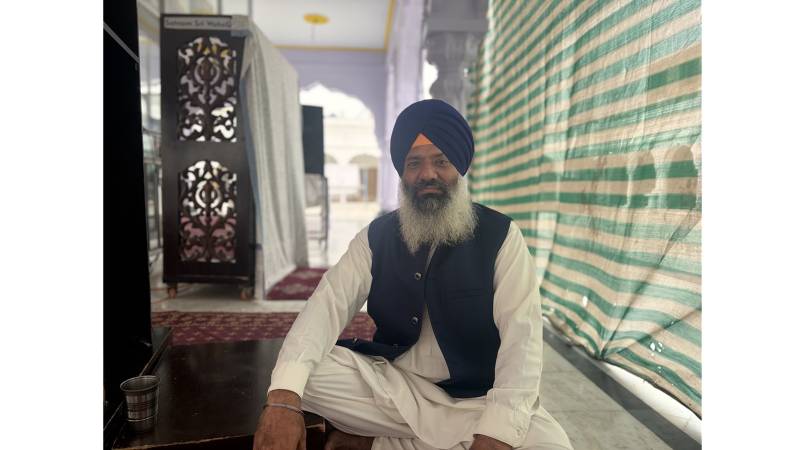
Giyani Daya Singh shakes every hand that reaches him, whether it belongs to a passing pedestrian or the president of the district council. His demeanour holds respect for everyone, irrespective of their socio-economic status.
Before we began, he asked whether I understood Punjabi. When I said yes, he lit up and slid into his comfort zone. As we settled near the prayer area, staff members called him over to join them for chai. He told them he had company and led me to the courtyard instead. Two cups of chai were brought in for us as we started talking.
Around us, construction crews hammered and drilled, setting the anticipatory mood of the shrine for the Gurupurab on the 24th of November. The renovations and extensions were preparing the shrine for the crowds next week would bring. Daya Singh had to raise his voice to be heard above the construction noise. He had a gentle smile on his face, with no sign that he was being disturbed by the commotion around us. Nearby, his brother moved among the pilgrims, handing out slices of apple and pear.
He warned me we would be interrupted, and we were, at least three times: pilgrims, visitors, and a staff member who needed his guidance.
On Tuesday, the gurdwara that marks the birthplace of Guru Nanak, the founder of Sikhism, will celebrate his 557th birth anniversary, with the recitation of the Akhand Path Sahib and a nagar kirtan procession.
Daya Singh had expected an Indian jatha of close to 3,000, and that is about what has come. He put attendance at more than 6,000 in 2024 and close to 2,000 in 2025, mostly from Europe, Canada, and the United States. Gurpurab marks the birth of the founder of Sikhism, he said, so whoever shows up, the celebrations will go on.
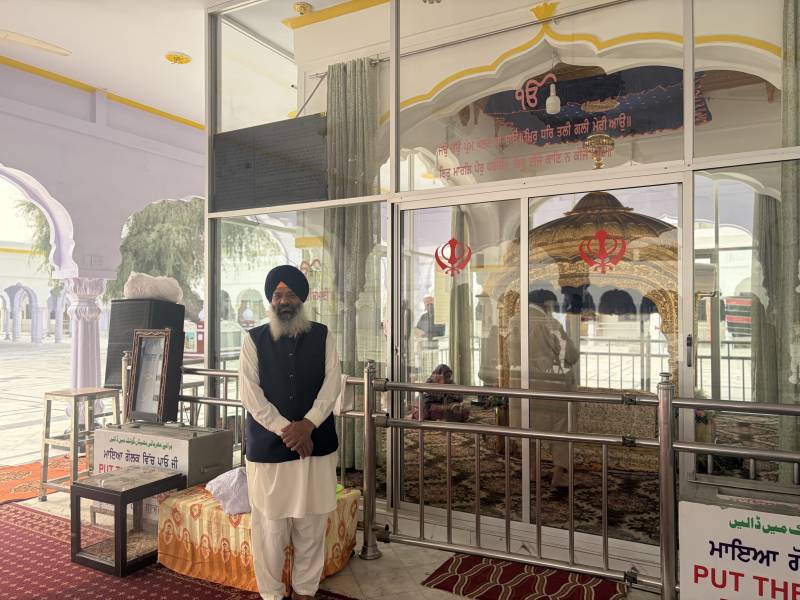
I asked him who looks after the shrine day to day and how he prepares for large gatherings. Between 200 and 250 volunteers keep the shrine running, he said, many of them Sikhs from Peshawar and Lahore. The wider sangat, or congregation, matters most in the days around Gurpurab.
The granthi, the caretaker and reader of the Guru Granth Sahib, has kept this shrine for 27 years. He was born to the work: his parents were caretakers here before him. His day runs for 17 hours, from 2:30 am to 7:30 pm. It starts with a bath and his own prayers, before anyone else arrives. The gurdwara opens at 3:30 am, and the first hours go to nit nem, the daily prayers, and the ceremonial opening of the Guru Granth Sahib. Pilgrims arrive all day, he said. Some offer prayers; some recite the divine names. When I visited, two women sat outside the prayer area, absorbed in prayer and meditation. Inside, two others read scripture and bowed their foreheads to the floor, the gesture known as matha tekna. Nothing about the scene was unusual for a gurdwara, and yet it felt deeply personal. No two prayers are alike, it seemed, and no two people ask for the same thing in the same way.
The 1921 Memorial
He also took me to a low memorial in the courtyard, built around the base of a large tree. A painted panel shows the attack of 1921, and a plaque beside it tells the story.
After the British took over Punjab, it says, Hindu mahants took possession of Sikh gurdwaras and violated their sanctity. On the 20th of February 1921, Sardar Lachhman Singh came to Gurdwara Janam Asthan with about 200 Sikhs to take it back. The custodian, Mahant Narayan Das, refused, it says, and he and his men killed them. Lachhman Singh was burned alive after being hung from the tree that stands over the memorial. The killings intensified the Sikh reform movement, and the British handed control of the gurdwara to the reformers on the 3rd of March.
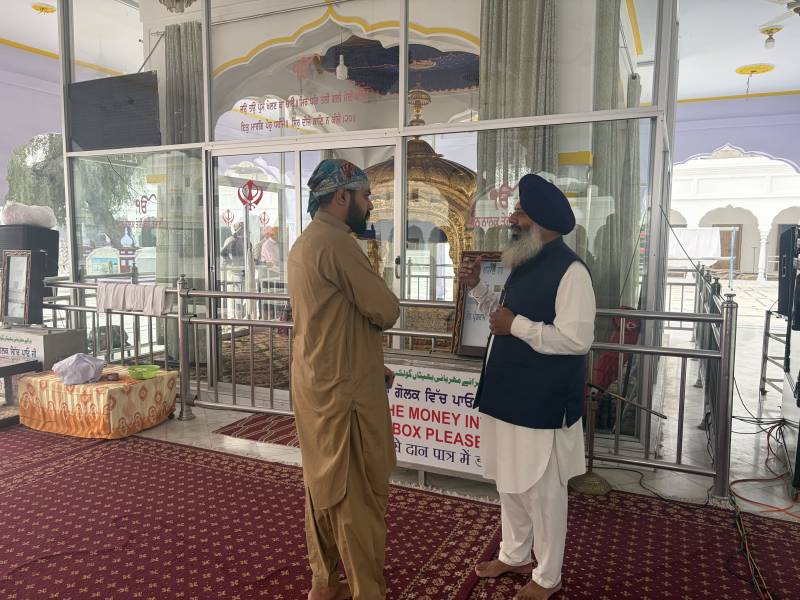
The plaque gives no death toll, and Daya Singh said no number has been agreed. The figure most often quoted, he said, is about 200. Eighty-six names are recorded, and 86 turbans were recovered, which would mean 86 bodies. But some of the dead were burned alive and others, he said, were thrown into a well, so those unaccounted for come to 384. Published estimates run from 140 to 260.
Asked about Kartarpur, he called it a wonderful initiative by the Pakistani government, then turned to what he believes the country is missing. In his view, Nankana Sahib is the most important Sikh shrine in the world. Religious tourism could help the economy, he said, but the infrastructure to host visitors needs to be magnified.
He called for “sincere people” to take charge of the shortcomings and pointed to Saudi Arabia’s arrangements for hajj and umrah as a model. Religious tourism is no easy feat, and he doesn’t want decision-makers who chase power and popularity to be in charge. He doesn’t want seasoned politicians for optical representation leading the cause, but real, wholesome change.
Seekers and Service
Everyone who comes, he said, is a seeker. Some want peace, some want a child, and some come to give thanks. He has seen miracles on a daily basis. When I asked for the most memorable one, he told me about two women who came to the shrine after seven and eight years of marriage, respectively, praying for children. About 20 years later, they came back to give thanks: one with two children, the other with three. That same day, two other women were in the room, there to pray for children. Their marriages, too, were seven and eight years old. He said it felt as though past, present, and future had merged in that one meeting, and that the women still seeking were meeting their future selves.
The interview had a deadline. A district councillor was waiting, and the granthi had a new gate to inaugurate, so he knew our time would run short. He had warned me, and the day proved him right.
When I left, the work of the shrine was still going on around us. Fruit passed from hand to hand, the hammering carried on, and someone was already calling the granthi away again.
To live, it seemed, is to be of service.