

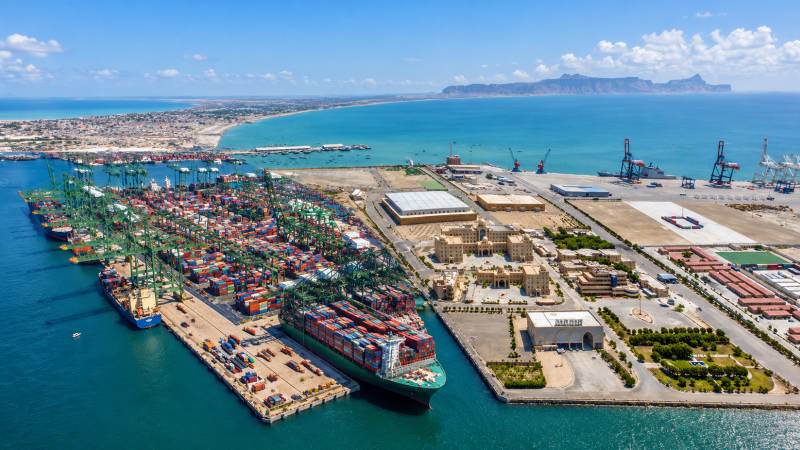
For decades, Gwadar has featured prominently in Pakistan's plans to become a regional trade and transit hub. Its location on the Arabian Sea, near the Strait of Hormuz, places it close to important international shipping routes. Through the China-Pakistan Economic Corridor (CPEC), the port has also been positioned as a potential gateway connecting western China with the Arabian Sea. But the commercial activity envisioned for Gwadar has yet to match the scale of these ambitions. The port has not developed into a major international transshipment centre, and the surrounding city continues to face challenges involving water, electricity, transport and employment.
Thousands of kilometres to the east, Singapore offers an example of how a port can become the foundation of a much wider economy. Despite having limited natural resources and a small domestic market, the Southeast Asian country has developed one of the world's busiest maritime centres, supported by international shipping, logistics, finance and trade. Singapore handled a record 44.66 million twenty-foot equivalent units (TEUs) of containers in 2025. It also recorded 3.22 billion gross tonnes of vessel arrivals and 56.77 million tonnes of marine fuel sales. Its port is connected to more than 600 ports worldwide and serves as a major global transshipment hub.
The contrast raises a question for Pakistan: could Gwadar adapt elements of Singapore's port model to become a commercially viable trade centre for the Gulf, South Asia and Central Asia? The answer may not lie in building larger terminals or pursuing the same volume of shipping as Singapore. Rather, it may depend on how Pakistan develops the businesses, infrastructure and institutions needed to make Gwadar attractive to traders and shipping companies.
Singapore's rise as a maritime centre was the result of decades of investment and institutional planning, rather than geography alone. The country began developing its modern container port in the 1970s, as containerisation transformed international shipping. Over time, it invested in port infrastructure, efficient customs procedures, skilled workers and a business environment that attracted international shipping companies.
An important change came in the 1990s, when Singapore separated port regulation from commercial operations. The Maritime and Port Authority of Singapore was established in 1996, while the Port of Singapore Authority was corporatised as PSA Corporation in 1997. The arrangement allowed the government to oversee regulation, maritime safety and industry development while commercial operators focused on port operations and investment.
Singapore also attracted businesses that provide services beyond cargo handling. More than 200 international shipping groups have offices in the country, including companies involved in ship management, maritime insurance, finance, brokerage, arbitration and technology. In 2025, Singapore's Maritime and Port Authority reported that 35 maritime companies had opened or expanded operations in the country. Key maritime companies collectively contributed an estimated S$5 billion in annual business spending to the economy. These services have helped Singapore develop an extensive maritime ecosystem. Shipping companies can arrange financing, insurance, fuel, vessel management and logistics from a single commercial centre, generating economic activity beyond the handling of containers.
For Gwadar, this is an important distinction. A port's commercial value is not determined only by the number of ships entering its harbour. It also depends on the businesses, jobs and services that develop around maritime trade. Developed with Chinese investment and operated by China Overseas Ports Holding Company, Gwadar is a central component of CPEC. Its port and free zone were planned to facilitate international shipping, regional connectivity, logistics and industrial development.
Its location offers potential access to maritime routes linking the Gulf, East Africa, South Asia and other international markets. However, proximity to major shipping lanes does not guarantee commercial activity. Shipping companies choose ports based on cargo volumes, operating costs, turnaround times, reliable transport links and access to established shipping networks. They also consider whether adding a port to their routes makes commercial sense. Singapore has an established network of regular shipping services and handles a large share of its containers through transshipment. Around 85 per cent of the containers handled at PSA Singapore's terminals are transferred to other destinations, allowing cargo from regional ports to connect with larger international vessels.
Gwadar does not yet have a comparable network of regular feeder and mainline shipping services. Without consistent cargo volumes and reliable connections, attracting international shipping lines remains difficult. This creates a commercial challenge. Shipping companies need sufficient demand to justify regular calls, while exporters and importers need reliable shipping services before they commit to using a port.
For Gwadar, overcoming this cycle will require identifying cargo markets that can generate consistent demand. Expanding port capacity without securing that demand risks leaving infrastructure underused. Rather than attempting to compete immediately with established transshipment centres, Gwadar could focus on specific trade routes and commodities where it may offer a practical advantage. These could include agricultural produce, seafood, minerals, construction materials and industrial goods moving between Pakistan, the Gulf and selected regional markets.
Balochistan's agricultural and mineral resources offer potential opportunities for export-oriented businesses. However, the development of these markets would require reliable storage, packaging, quality control, cold-chain facilities and access to international buyers. The port's potential role in connecting western China to the Arabian Sea also requires a realistic assessment. Although CPEC provides a strategic transport link, moving goods over long distances from China's inland regions to Gwadar involves transport costs that may make established routes through China's eastern ports more economical for some shipments.
Central Asian markets present another potential opportunity, but they are already connected to other trade corridors through Iran and the Caspian region. Gwadar would need to demonstrate a clear advantage in cost, transit time or reliability to attract significant cargo from these countries. Pakistan could explore regional trade agreements, simplified customs procedures and better transit arrangements to make the port more accessible to businesses. Such measures would need to be supported by actual demand from exporters, importers and shipping operators.
The objective should be to establish commercially viable routes first and expand them as trade grows, rather than relying solely on projections of future regional connectivity. One of the most relevant lessons from Singapore is the development of industries and services around maritime operations. Gwadar's free zone could provide space for warehousing, food processing, packaging, cold storage, distribution and selected manufacturing activities. These businesses could add value to goods before they are exported or distributed to other markets.
Seafood processing and cold-chain logistics, for example, could create opportunities for businesses linked to Balochistan's fishing industry. Agricultural storage and packaging could help producers reduce post-harvest losses and meet export requirements. Mineral-related businesses could also explore processing and logistics facilities, provided that reliable energy, water, transport and commercially viable supply chains are available. However, tax incentives and access to land alone are unlikely to sustain industrial investment. Businesses need dependable utilities, access to finance, skilled workers, efficient transport and predictable regulations.
However, tax incentives and access to land alone are unlikely to sustain industrial investment. Businesses need dependable utilities, access to finance, skilled workers, efficient transport and predictable regulations.
Singapore's maritime economy is supported by an extensive network of shipping, insurance, financial, legal and technology companies. Developing a similar ecosystem in Gwadar would take time and would need to begin with services for which there is identifiable demand. Attracting a small number of businesses that can operate successfully using existing infrastructure may be more sustainable than announcing large industrial projects without confirmed investors or markets.
The competitiveness of a port depends on the efficiency of the entire supply chain, from the point where goods are produced to the point where they reach their final destination. Gwadar is connected to coastal Balochistan and Karachi through the Makran Coastal Highway, while CPEC-related road infrastructure is intended to improve links with other parts of Pakistan and western China. But the commercial value of these connections depends on travel times, maintenance, transport costs, border procedures and the availability of logistics services.
Rail connectivity could eventually support the movement of large volumes of cargo over long distances. However, railway infrastructure requires substantial investment and a sufficient volume of freight to justify its construction and operation. Its development should therefore be linked to realistic assessments of future cargo demand. Energy and water are equally important. Port operations, cold storage, warehouses and processing facilities require affordable and reliable electricity. Water shortages in Gwadar and the wider coastal region also present a significant constraint for industrial development. Without these basic services, businesses may face additional operating costs that reduce their ability to compete with established regional ports.
Singapore's experience in digital port management also offers a practical lesson. Its maritime authorities have introduced systems to improve documentation, coordination and operational efficiency. In 2025, digital bunkering was adopted by all bunker suppliers in Singapore, with the Maritime and Port Authority estimating annual savings of up to 40,000 person-days in business process efforts. Gwadar could benefit from an integrated digital system connecting customs, port operators, shipping agents, transport companies and relevant government departments. Cargo tracking, electronic documentation and coordinated inspections could reduce delays and make operations more transparent. Such reforms, however, would need to be accompanied by consistent regulations, predictable tariffs and clear commercial procedures. Digital systems cannot compensate for administrative uncertainty or inadequate infrastructure.
Gwadar is not the only port seeking to serve trade between South Asia, the Gulf and Central Asia. Karachi and Port Qasim already have established shipping networks, cargo-handling facilities and connections to Pakistan's major industrial and consumer markets. In the wider region, Dubai's Jebel Ali port benefits from extensive logistics, financial and industrial services, while Iran's Chabahar port offers another potential route towards Afghanistan and Central Asia. These ports have established commercial relationships and transport networks that Gwadar would need to compete with or complement.
Gwadar's development should therefore be based on identifying trade that it can attract on commercial grounds, rather than assuming that cargo will shift from existing ports simply because of its geographical location. There may also be opportunities for cooperation between ports, particularly in logistics, feeder shipping, cargo distribution and regional supply chains. An integrated maritime strategy could help Pakistan develop different roles for Karachi, Port Qasim and Gwadar while avoiding unnecessary duplication of infrastructure.
The development of port services could create jobs in cargo handling, equipment maintenance, transport, warehousing, logistics and maritime administration. But local residents will need access to relevant technical training and opportunities to participate in the growing economy. Singapore's maritime industry is supported by training programmes developed through cooperation between the government, industry, educational institutions and labour organisations. A similar approach in Gwadar could include vocational training in port operations, customs documentation, logistics, digital trade systems and equipment maintenance. Local businesses could also be supported to compete for contracts involving transport, catering, repairs and other services. These opportunities will require transparent recruitment and procurement procedures, as well as clear mechanisms for local businesses and workers to access training and employment.
The provision of water, electricity, healthcare and other public services must also remain part of development planning. Industrial expansion that does not address the needs of the city and its residents may struggle to generate broad-based economic benefits. Singapore's experience cannot be transferred directly to Gwadar. The two ports operate in different economic, institutional and geographical environments. Singapore has decades of established shipping connections, a highly developed business ecosystem and extensive infrastructure, while Gwadar is still developing its commercial networks and supporting services.
The practical lesson is not that Gwadar should attempt to match Singapore's container volumes or infrastructure. It is that a port's success depends on the wider economy built around it. For Pakistan, this could mean prioritising reliable port operations, improving customs procedures, strengthening road connections, ensuring affordable utilities and attracting businesses that can use Gwadar's existing infrastructure. The next stage could involve developing targeted trade corridors, attracting regular shipping services and expanding logistics and processing activities as demand increases.
The government and port authorities would also need to publish consistent data on cargo volumes, vessel calls, port revenue, investment, employment and shipping connections. Such information would help businesses assess the port's commercial potential and allow the public to evaluate whether development targets are being met. Regional partnerships could support this process, but proposed trade corridors would need to demonstrate actual cost and time advantages over competing routes.
Gwadar's strategic location provides an opportunity, but its commercial future will depend on how effectively Pakistan addresses the practical challenges of trade, infrastructure and governance. Singapore shows how maritime infrastructure can support a wider economy of shipping, finance, logistics and services. Gwadar's task is to develop an approach suited to its own circumstances, with commercial demand and local economic needs at its centre. The question is no longer simply how much cargo Gwadar could handle in the future. It is whether the port can attract regular trade, support viable businesses and create lasting economic opportunities for the people who live along its coast.