

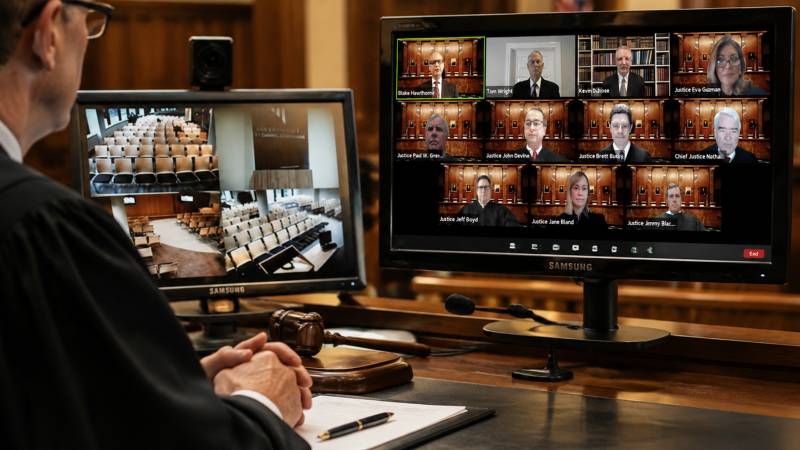
One of the most significant changes in the administration of justice post covid in Canada and particularly in Ontario has been the efficient use of technology in court proceedings. Today, majority if not all of the civil litigation in Ontario is conducted online; Judges, lawyers and litigants attend ‘online’ courtrooms, through video-conferencing platforms such as Zoom. Pakistani courts did adopt the online system briefly in response to covid, however, we have by and large reverted back to the in-person system of litigation, which, respectfully, was a grave injustice to all sides, due to the following factors.
Every litigation lawyer in Pakistan is familiar with the sheer frustration of attending courthouse early morning at 9 am and waiting hours for their case to be heard, only for the matter to be adjourned for lack of time due to the long cause list. Similarly, some litigants travel from another city or district just to attend his/her case hearing. When finally his case is called, he discovers that the opposing counsel is seeking an adjournment due to unavailability, sickness or another (valid) reason. Judges normally grant such adjournments, however, imagine the state of the poor litigant who may have paid for transportation, accommodation, meals, loss of wages and, in many cases, the cost of accompanying family members or representatives just for that single hearing. His/her trust and respect for our legal system would surely have been tarnished.
The irony is that in many such hearings, there is no genuine reason why the parties need to be physically present. If the purpose of the hearing is simply to seek an adjournment, confirm the next date, address a procedural matter or inform the court about the status of the case, why should the lawyers or litigants have to be present in the courthouse if such tasks can be completed online?
And the benefits of online courts extend beyond the litigants. A lawyer's time is one of the most valuable resources he has in his practice. Presently, a lawyer in Lahore or Karachi may spend hours sitting in court, waiting for a matter to be called and then travelling back to offices in rush hour. A virtual hearing can transform that entire process: the lawyer can log into court from the office, make submissions, receive directions from the judge and, once the matter is concluded, immediately return to other legal work. So instead of losing half a day in court to a fifteen-minute appearance, the lawyer can use that time in his office to perform substantive legal work, such as review files, draft pleadings, conduct legal research, prepare for next day’s hearings or meet a new client. For a justice system already struggling with enormous delays in the administration of justice, this efficiency should not be underestimated.
Every litigation lawyer in Pakistan is familiar with the sheer frustration of attending courthouse early morning at 9 am and waiting hours for their case to be heard, only for the matter to be adjourned for lack of time due to the long cause list.
Virtual hearings also help ease the financial burden of the litigants. Under the current model, when the lawyer has to travel for a case to another city, the client pays for the lawyer's transportation, accommodation and other incidental expenses. With online zoom hearing, those additional expenses go out of the window. A regular case may involve dozens of appearances (including for adjournments) before it reaches a final hearing. If even a portion of those appearances can be conducted virtually, the savings for clients can be substantial, which would lead to a more accessible justice system.
Practically, there is another problem that virtual proceedings could help address: overcrowding in courtrooms. The scene every day in any one the courtrooms of the Lahore High Court is all too familiar to lawyers and litigants who attend cases there. The courtrooms become extremely crowded, with lawyers, litigants, clerks and other attendees competing for limited space. This in turn creates difficulties for judges sand court staff. A courtroom should be a place where the dipensation of justice can take place in an orderly and dignified manner, and virtual zoom hearings offer an obvious solution.
Lastly, with zoom courts, pleadings and documents can be filed, uploaded and viewed virtually as well. In Ontario, electronic filing and viewing software is being used, which allows both judges and lawyers to access the case records electronically when attending virtual courts. This will eliminate or at least substantially reduce the need to print thousands of court documents every day.
One possible objection that could be raised by those in opposition to online courts is that Pakistan is not technologically ready for such a system. That objection is increasingly difficult to sustain in light of the fact that internet broadband penetration in the country is over 60 percent. However, it should not be assumed that every litigant has a sophisticated computer and high-speed broadband connection at home. To address that, the government should establish designated virtual court facilities at district and tehsil levels. A litigant could go to the nearest facility, verify their identity, connect to the court and participate in the proceeding without travelling hundreds of kilometers to the major centers.
To conclude, while it may be a slow transition, the modernization of court system is ultimately about more than technology; It is about swift access to justice for all. The legal profession is already familiar with video-conferencing technology since covid. What remains now is the need for a commitment and willingness of all stakeholders within the legal fraternity to adopt this tried and tested system of online courts, in order to bring justice closer to those it is meant to serve: the litigants.