

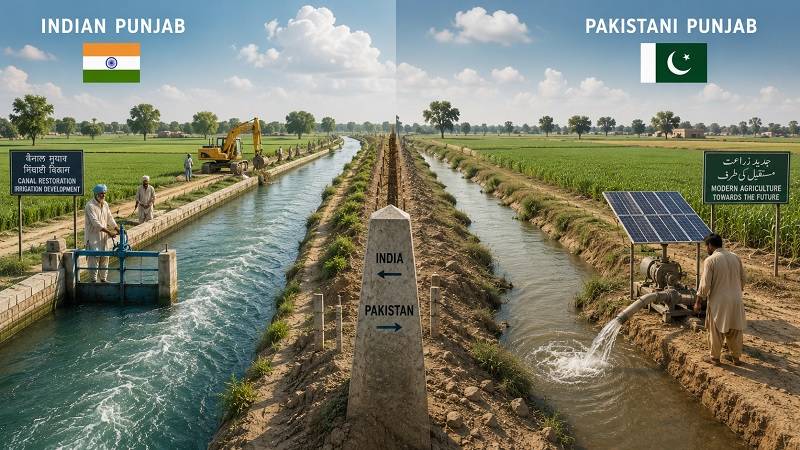
Indian Punjab has unintentionally conducted two experiments. One demonstrates that a neglected canal system can be restored to life. The other demonstrates the long-term consequences of allowing water to become effectively free. Pakistani Punjab should learn from both, but imitate only one.
Until March 2022, Indian Punjab was using little more than a quarter of the canal system it already owned. Against a designed potential of roughly 7.59 million acres, only 2.09 million acres were actually receiving canal water. The rest had quietly slipped onto tubewells while the canals meant to serve it silted up, breached, or simply fell out of use. If the Punjab government's reported figures are accepted, canal irrigation coverage has since risen to around 78 percent. Groundwater extraction has fallen from 164 percent of the annual extractable resource in 2023 to 156 percent in 2025, and over-exploited assessment units have declined from 117 to 111. This is not a state that has solved its water crisis: it is still extracting roughly one and a half times what is sustainable. But it has shown that restoring neglected canal infrastructure can slow the decline.
What is genuinely transferable is the method: restoration rather than construction. Since 2022, the Punjab government says it has invested about INR 67 billion (roughly PKR 196 billion) in canal modernisation, including nearly 13,000 kilometres of canals restored, over 15,500 canal reaches cleaned, nearly 18,350 watercourses revived, dormant lift schemes rehabilitated, and pipelines extended to fields that open channels no longer reached. It is framed not as routine maintenance but as groundwater policy, aimed at persuading farmers back from tubewells to canals.
Pakistani Punjab's problem was never that it lacked canals. It owns one of the largest contiguous irrigation systems on earth, serving a command area of around 21 million acres. The problem is that we built the system, then treated its upkeep as the least inauguration-worthy activity in government. Nobody cuts a ribbon for desilting. Nobody unveils a plaque for a corrected outlet. Nobody holds a ceremony because a tail-end farmer finally received his rightful turn. So the silt wins, the outlet distorts, the tail-ender gives up, and the tubewell becomes the rational choice. Once a farmer has sunk a well, no amount of canal rhetoric brings him back unless the water actually arrives.
Here Indian Punjab turns from model into warning. To pull farmers towards canal water, it is now abolishing its canal water cess (abiana) altogether. The chief minister's reasoning is simple: the state already subsidises tubewell electricity heavily, so charging for canal water while groundwater stays effectively free penalises the very behaviour it wants to encourage. There is logic in that, but it also reveals how completely canal pricing had stopped functioning as a demand-management tool or a source of maintenance finance. The cess being abolished was already a corpse: it was expected to raise about INR 3.6 billion (roughly PKR 10.5 billion) over four years and collected only INR 37.5 million (roughly PKR 110 million), barely one percent of target.
Which is exactly why Pakistani Punjab's recent abiana reform matters. India now has free farm electricity, roughly 1.4 million tubewells drawing large power subsidies, and no meaningful price on water anywhere in the system. It is a state that let water's price collapse to zero on every front. A flat PKR 1,650 per acre for kharif and PKR 850 for rabi under the Punjab Irrigation, Drainage and Rivers Act 2023 is the correct move, not a contradiction of India's cess abolition. We are not raising a charge India had the wisdom to abandon; we are restoring a functioning price where India allowed pricing to disappear. The direction is opposite because the starting point is opposite.
Once a farmer has sunk a well, no amount of canal rhetoric brings him back unless the water actually arrives.
There is another reason the comparison matters. India's metered-electricity incentives still give policymakers leverage over groundwater pumping; Pakistan's rapid shift to solar tubewells is eroding that option. A solar tubewell pumps at near-zero marginal cost and answers to no electricity price signal. Pakistan may already have some 650,000 of them, each one a farmer moving beyond the reach of future energy pricing. That lever is weakening, which means canal water pricing itself must do the work electricity pricing soon may not.
But the reform's success rests on one point: a price is only legitimate if the bargain behind it is honoured. The farmer pays, and the state delivers reliable water to the tail. Break that bargain and abiana stops being payment for a service; it becomes, in the farmer's eyes, simple extraction. On the current numbers, we risk breaking it. The Punjab Budget 2026–27 projects approximately PKR 43.6 billion in irrigation receipts, yet repairs and maintenance run to only about PKR 8.9 billion. The farmer is not asking whether every rupee is spent on his distributary; he is asking whether paying more has bought him better water. If the answer is no, the fiscal arithmetic becomes politically irrelevant. The revenue may balance in Lahore, but the bargain has already failed at the tail.
This is why the two lessons are really one: maintenance without a pricing mechanism leaves canals dependent on the annual budget's shifting priorities, and a price without visible maintenance becomes mere extraction. The reform that endures combines both: a price visibly returned to the canal command it came from, measured not in kilometres desilted but in water reaching the farmer at the tail.
The legal foundations for that reform already exist. The Punjab Irrigation, Drainage and Rivers Act 2023 vests groundwater in the state and requires monitoring of recharge and abstraction, a framework arguably more sophisticated than Indian Punjab's. What is missing is not legislation. It is the decision to maintain the canal before building another one, and to show farmers, command by command, what was collected, what was spent, and what came back in return. Transparency is what turns a tax into a bargain.
Pakistani Punjab can learn from both Indian experiments at once: restoring the canal system without abandoning the price signal that sustains it. Success won't be judged by the number printed on an abiana challan. It will be judged by a simpler test: whether the next increase in abiana is accompanied by water reaching the last farmer on the distributary.