

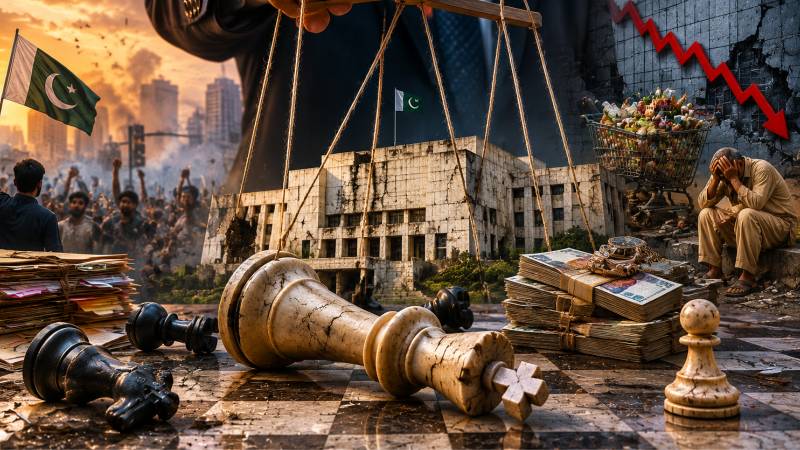
Mohsin Naqvi's declaration that Pakistan's governance system has collapsed was not a diagnosis. It was a confession. At the Pakistan Economic Summit on 30 July 2026, the Interior Minister said what millions of Pakistanis live daily: the state cannot solve its own basic problems. Shehbaz Sharif's marathon work schedule, in Naqvi's own words, is firefighting, not governance. His solution: new provinces, carved out by locking political parties in a room until they agree. He also warned that a generation denied merit and opportunity — his now-notorious "cockroaches" line — could one day overturn the whole order.
What matters is not what Naqvi said. It is who said it. He is not a critic outside the system. He is the Interior Minister, a central figure in the hybrid arrangement that has run Pakistan since April 2022. Najam Sethi has noted that even the DG ISPR now concedes governance has failed. The admission has moved from the op-ed pages into the power structure itself.
That is a serious contradiction. Naqvi is not observing state failure from a distance. His ministry sits at the centre of it. Balochistan remains a battlefield. Khyber Pakhtunkhwa continues to bleed from militant attacks and cross-border instability. The former tribal districts are still not integrated into the state. After decades of operations and billions spent, the state still cannot secure or administer these areas. If the model has failed, Naqvi cannot just diagnose it. He has to answer for it.
The responses from PPP and PML-N exposed the real problem: the parties that govern Pakistan depend on the very system that has failed it. The PPP treated the new-provinces idea as a threat to Sindh's political turf, not as a governance question. That is not an accident. Any honest reckoning with state failure threatens the patronage networks PPP has run in Sindh since 2008.
PML-N's response was quieter but just as evasive. Party leaders agreed with the diagnosis in principle, then insisted the debate stay inside parliament — safely procedural, safely contained. That is not an answer. If the system has collapsed, the people who have run it cannot claim to be bystanders. Shehbaz Sharif has spent decades building his reputation as the man who makes the state work — motorways, bureaucratic management, patronage run efficiently. Yet Pakistan's core governance failures sit exactly where they were a decade ago. The Bhutto-Zardari PPP speaks the language of federalism and empowerment, and after years of running Sindh has built one of the most entrenched patronage machines in the country. Two families, two vocabularies, one political economy: control the state, distribute the spoils, protect what you've captured.
Governments changed. Alliances shifted. The system remained. That is why the post-April 2022 hybrid arrangement deserves scrutiny, not applause. PML-N, PPP and their allies promised to save the economy and restore stability. What they delivered was managed decline. Inflation came down. Reserves stabilised. Poverty rose. Household incomes shrank. Young Pakistanis found fewer jobs and less reason to stay. The state got better at surviving its crises than solving them. Naqvi's comment forces a question Pakistan's ruling class has dodged for decades: after every combination of political and military power, what has actually changed? If the honest answer is nothing, the failure is not administrative. It is political.
Pakistan’s crisis is not a map problem. It is an incentive problem. Political families, the bureaucracy, business groups and powerful institutions compete for control of state resources, while citizens pay for it in bad services, high taxes, rising debt and shrinking opportunity.
New provinces will not fix that. Pakistan's crisis is not a map problem. It is an incentive problem. Political families, the bureaucracy, business groups and powerful institutions compete for control of state resources, while citizens pay for it in bad services, high taxes, rising debt and shrinking opportunity. More provinces means more assemblies, more ministries, more patronage seats. It does not touch the system that rewards capturing the state over building the economy. It is reform without reform. The real fault line in Pakistan is not civilians versus the establishment. That framing is convenient, and it is shallow. The real fault line is between a narrow elite that extracts from the state and a much larger population that depends on it and gets less of it every year.
Everyone responsible for this order now claims to be the solution to it. Politicians blame institutions. Institutions blame politicians. Bureaucrats blame political interference. Political leaders blame bureaucratic inertia. Ordinary Pakistanis are left holding weak governance, insecurity, stagnation, and no trust left to spend. Naqvi's remark stripped away one of the last pretences: the admission of failure no longer comes only from outside power. It now comes from inside it. But admitting failure is not the same as accepting responsibility.
A minister who calls the system broken while continuing to run it cannot also claim to be a bystander watching the wreckage. A government that admits failure while still drawing benefits from the arrangement cannot present itself as the agent of reform. So the question answers itself: why has the cabinet not resigned? Why has Naqvi not resigned?
Pakistan does not need another redrawing of administrative boundaries while the political economy underneath stays untouched. It needs a change in how power is won, used and made accountable. In February 2024, I wrote a three-part series for this paper, "Is There a Way Forward for Pakistan?" I wrote it out of frustration with the apathy of our ruling elites and the decline of serious debate in our media — including, at times, in opinion pages of otherwise respected DAWN. Anyone who thinks Pakistan can escape its predicament with recycled slogans and superficial analysis is mistaken. Both our political class and our commentary culture have grown shallower over the years.
The first step is not a truth and reconciliation commission. It is not new elections alone. It is not martial law. It is humility — the willingness of both the political class and the establishment to admit they have both failed. Only then can Pakistan address the real causes of its crisis instead of recycling superficial fixes.
If the establishment genuinely believes the system has collapsed, there are only two honest paths: take direct responsibility through martial law, or hand power back to voters through a real election. The current arrangement — hybrid, confused, directionless — cannot continue. But a hard state without a development strategy and institutional reform would be worse than an inefficient elected government. And even an elected government will fail unless it confronts the political economy that produced this crisis.
That is why new provinces are the wrong answer. They misdiagnose the disease. Pakistan's core problem is elite capture of state resources, in a system that rewards extraction over development. The civil-military framing misses this. The real divide is between the elite and everyone else — and the elite factions fighting over the state have every incentive to keep the system exactly as broken as it is.