

“The only thing we learn from history is that we learn nothing from history.”
(Anonymous.)
Less than 18 months after the US overthrew the Taliban from Kabul, it embarked on a mission to overthrow Saddam Hussein’s regime in Baghdad. In October 2001, Afghanistan was attacked because the Taliban had refused to turn over Osama bin Laden, the mastermind of the 9/11 attacks in the US.
The Taliban were removed from the seat of power in December 2001. Much of the world was united in its resolve to support that US mission.
However, there was almost no global support for the US decision to invade and occupy Iraq. Very few countries bought into the argument put forward by Colin Powell at the UN Security Council that Iraq possessed weapons of mass destruction that posed a threat to world peace. This was a very different attack from the one the US under President George H. W. Bush, the father of George W. Bush, had carried out in 1991 when it invaded Kuwait to evict Iraqi forces. Again, much of the world supported that intervention in what became known as the Gulf War. After evicting Iraqi forces from Kuwait, the US did not go into Iraq to dislodge Saddam Hussain.
However, just two months after 9/11, President George W. Bush, a Republican, working in close concert with Vice President Dick Cheney and Defense Secretary Donald Rumsfeld, and egged on by neoconservatives such as Paul Wolfowitz, began to devise a plan to dislodge the Baathist regime in Iraq. They claimed that Iraq possessed weapons of mass destruction (WMD) and had close ties with Al Qaeda. Thus, it posed an imminent threat to the US.
As the war plan took shape, and an all-out attack on Iraq appeared imminent, large-scale protests erupted throughout the US. A slogan often heard at these protests was “No blood for Oil.” Very few Americans bought the “imminent threat” argument.
Removing a leader like Saddam Hussein is a discrete military act, but failing to plan for the day after creates a dangerous power vacuum and fuels long-running insurgencies
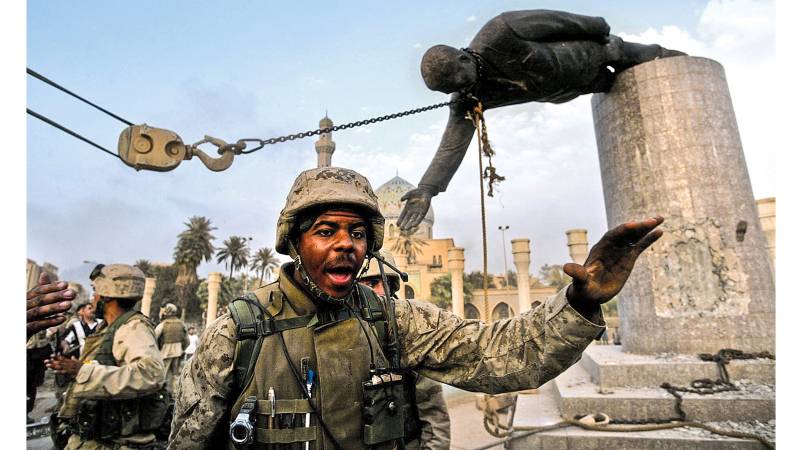
An all-out US assault on Iraq began on March 20, 2003. The US hit Iraq from the air and invaded it with 130,000 US troops. The invasion reached its climax on April 9, 2003, when Saddam’s statue was toppled at Firdaus Square in Baghdad.
In the ultimate display of machismo, President Bush flew onto the deck of the USS Abraham Lincoln, an aircraft carrier that was anchored off the coast of San Diego. Standing under a banner that read “Mission Accomplished,” Bush congratulated the US armed forces for deposing a tyrannical regime that posed an imminent threat to the people of the United States.
However, in just a few weeks, the US discovered that the job had just begun. The US disbanded the Baath Party and the Iraqi Army. That unleashed lawlessness throughout Iraq. The US had forgotten what happened in the post-1945 when it de-Nazified Germany. It also forgot how insurgencies in Vietnam and Afghanistan had derailed the US from achieving victory.
Soon enough, a deadly sectarian conflict broke out between the Sunni and Shia segments in Iraq. A terrorist group, ISIS, arose from the chaos that had enveloped the country. Iraq was racked with civil unrest not seen in decades. The US discovered to its regret that attacking Iraq had opened the gates of hell, which is what the head of the Arab League and the foreign minister of Egypt had warned against.
Saddam, despite his innumerable faults and tyrannical tendencies had kept Iraq together since he seized the reins of power on July 9, 1979.
To divert attention, the US decided to expand its mission to remake Iraq into a western-style democracy. As in the wars it had carried out in Vietnam and Afghanistan, it failed to understand Iraq’s culture. And it overestimated the power of technology over insurgencies.
What went wrong? Plenty, as argued in a book written by a senior member of the Iraqi administration, Ali Allawi, penned a 518-page book in 2007, The occupation of Iraq: winning the war, losing the peace.
Allawi was the defense and later the finance minister in successive post-Saddam governments and later an advisor to the prime minister. He was one of those who supported the invasion. But in retrospect, he concludes that the entire process of planning for a post-war Iraq “was mired in ineptitude, poor organisation and indifference.”
He faults Paul Bremer, the second American proconsul in Baghdad, for engaging in “blindly optimistic” group think. He says that Bremer refused to recognise the insurgency as a potent and lasting threat because he misread Iraq’s strategic culture and was ignorant of its troubled and tangled history. Allawi says the Americans naively believed that they could wave a magic wand and Iraq would become a secular, liberal democracy.
A similarly dismal picture was painted by George Tenet, a former director of the Central Intelligence Agency. In 2007, he published a memoir, At the Center of the Storm. Tenet blamed Dick Cheney for pressuring the agency into coming up with unsubstantiated evidence about Iraq’s military capabilities. He also blamed Paul Wolfowitz and Douglas Feith for claiming that there was a link between Saddam Hussein and al-Qaeda. He also stated that the CIA had warned the White House that Iraq could fall apart once the invasion was over, but that his advice had fallen on deaf ears in the White House. Bush was only listening to the neocons.
The Iraq War continued under President Barack Obama, a Democrat. Finally, eight years after the war had begun, the US withdrew its forces in 2011. The war ended up costing the US taxpayer upwards of $3 trillion, according to Joseph Stiglitz, winner of the Nobel Prize in Economics and former Chief Economist of the World Bank. Roughly 4,500 US military personnel were killed and more than 30,000 were wounded during the war. An even larger number of their relatives were traumatised. It was totally unclear what was gained from waging such a terrible war.
For Iraq, the devastation was beyond comprehension. Experts at Brown University estimate that more than 800,000 Iraqis died as a direct result of the war. Of those, more than 335,000 were civilians. Worse, “another 21 million people have been displaced due to violence.” Just about everyone in Iraq lost someone they knew due to the US invasion.
In 2017, I ran into an Iraqi man in Sydney. He was the guard at a government facility. I introduced myself to him and asked if he had been affected by the war. He burst into tears and said please don’t ask me about what it did to my family and my life. The calamity was beyond words.
In 2019, the US army released a two-volume report about the Iraq War. It ended with this damning conclusion: “In a way, it would be reassuring to believe that the mistakes the United States made in the Iraq War were the result of unintelligent leaders making poor decisions. If that were so, then the United States could be assured of avoiding similar mistakes in the future simply by selecting better, more intelligent leaders. However, this is not the case. The overwhelming majority of decisions in the Iraq War were made by highly intelligent, highly experienced leaders whose choices, often in consensus, seemed reasonable at the time they were made, but nonetheless added up over time to a failure to achieve our strategic objectives.”
The Iraq War stands out as a major blunder in US defense and foreign policy. It has been studied assiduously by several former military officers, intelligence officers, political scientists, historians, and economists and journalists. Eight lessons emerge from their writings:
One, regime change requires a realistic post-conflict plan: Removing a leader like Saddam Hussein is a discrete military act, but failing to plan for the day after creates a dangerous power vacuum and fuels long-running insurgencies.
Two, intelligence is often inaccurate. To be useful, it must be rigorously vetted: Decisions based on flawed, pressured, or unverified claims regarding weapons of mass destruction (WMDs) and terrorist links severely damage national credibility and strategic trust.
Three, disbanding state institutions is disastrous: Dissolving the national military and governing bureaucracy instantly alienated hundreds of thousands of armed and employed individuals, inadvertently laying the groundwork for sectarian civil war and leading to the birth of an extremist group like ISIS.
Four, local context and regional balance matter: Interventions can inadvertently shift regional power dynamics—such as empowering neighboring rivals like Iran—and cannot easily force a sustainable, centralised democracy onto a deeply divided society without organic local consent and reconciliation. The law of unintended consequences always kicks in.
Five, military tactics are no substitute for political strategy: Tactical and operational dominance on the battlefield cannot fix an unachievable or ill-defined political goal. Lasting security depends on legitimate governance, economic reconstruction, and institutional stability rather than force projection alone.
Six, democracy cannot be imposed from the outside. It must arise from within. Democracy is an alien concept in many countries, especially in the Arab world. Where it does exist, it only serves to legitimise authoritarianism. Corruption and nepotism are widespread. Institutions are weak.
Seven, the enemy’s reaction is mostly poorly estimated. The US assumed, as it had assumed in Vietnam and Afghanistan, that once Saddam was deposed, the Iraqi army disbanded and the Baath Party dissolved, that Iraqis would welcome the US troops as liberators. None of that happened. All the US did was open Pandora’s Box.
Eight, the costs of the war are underestimated more often than not. The US thought the war would be over in a few months and cost less than a hundred billion dollars, not the three thousand billion dollars it ended up costing.
It behooves the US defense and political establishment to digest these lessons to prevent a repeat of the debacles that occurred in Vietnam, Afghanistan and Iraq.