

Pakistan is home to one of the oldest civilisations in the world: the Indus Valley Civilisation. Over the centuries, many empires have ruled over what is now modern-day Pakistan, from the Mughal Empire in the 17th century to the British Empire in the 19th century. Its architectural heritage has absorbed influences from the ancient Gandharan civilisation and various Islamic dynasties, as well as the Mughals, Sikhs and British. Yet, walk through its major cities today, and that history is becoming increasingly difficult to recognise.
The country’s three major cities, Islamabad, Lahore and Karachi, have become concrete jungles, dominated by residential societies and underpasses, all presented as symbols of development. In the pursuit of modernisation, Pakistan is not merely neglecting its architectural heritage; it is gradually abandoning an architectural identity that took centuries to develop and was shaped by successive historical civilisations.
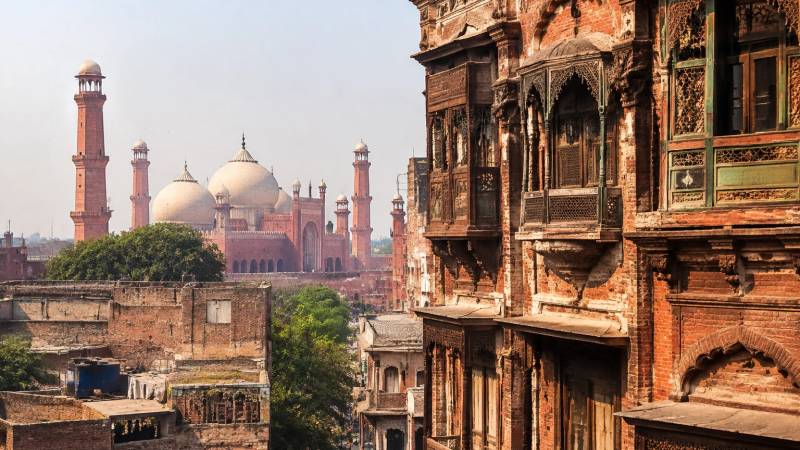
Lahore, the heart of Pakistan, was once known for its Mughal architecture and colonial past. However, over time, that identity has become increasingly obscured. Lahore’s historical legacy was not confined to the Badshahi Mosque, Shalimar Gardens or Lahore Fort. It extended into the narrow streets of the Walled City. It was visible in the intricate carvings on household doors and the red-brick façades that created a kaleidoscope of colours, reflecting the craftsmanship of past generations. However, much of this architectural heritage is now being sacrificed in the name of urban development. A prime example is the demolition of the historic Lakshmi Building, which was reduced to rubble to make way for commercial development. It was the very building where leaders of the Pakistan Movement once gathered.
Traditional Pakistani architecture was designed in harmony with the environment. Thick red-brick walls provided thermal mass and reduced heat transfer into building interiors. Large havelis encouraged air circulation, while jharokas provided shade and facilitated airflow. These were not merely decorative features; they were practical applications of architectural techniques developed over centuries through generations of adaptation and experimentation, taking the subcontinent’s climate and environment into account.
However, as Pakistan embraces modernisation, the very principles that guided the development of its cities are increasingly being replaced by designs that often neglect the climates to which they should be adapted. Architectural homogenisation is becoming increasingly prevalent in Pakistan’s major cities, where glass-fronted, Western-inspired buildings are gradually replacing the traditional architectural features that once made them unique. This trend can also result in higher indoor temperatures. A 2022 comparative study found that traditional Pakistani buildings maintained indoor temperatures approximately 4–5°C lower than those of contemporary-style buildings.
The increasing prevalence of concrete surfaces and the reduction of green spaces have contributed to the urban heat island effect, in which cities experience higher temperatures than their surrounding rural areas. This is particularly evident in Islamabad. A study published in Ecological Informatics showed that Islamabad’s daytime urban cool-island intensity shifted from -1.05°C in 2010 to an urban heat-island intensity of +1.02°C in 2022. Meanwhile, Peshawar’s intensity increased from 0.2°C to 2.51°C over the same period. Traditional urban planning incorporated shaded streets, courtyards and vegetation. Reintroducing these features would not only make cities more sustainable but also more liveable.
What was once achieved through architectural ingenuity and climate-responsive construction is now being compensated for through expensive electricity consumption. A study of five-marla houses in Rawalpindi found that homes featuring traditional-style courtyards and thick mud walls reduced energy consumption by 22%. This has significant implications for Pakistan’s energy consumption, particularly as households account for 45% of the country’s annual energy use. Energy-efficient buildings offer long-term financial benefits through lower operating costs and reduced expenditure on electricity.
Pakistan’s architectural future does not have to involve a choice between preserving history and embracing modernisation. The country can adopt modern building techniques while preserving its history and culture. Contemporary construction can incorporate traditional principles through large courtyards, naturally ventilated layouts and locally sourced materials. Government institutions can also contribute by strengthening heritage protection regulations and encouraging developers to adopt climate-responsive building techniques. The task is not to stop our cities from changing, but to ensure that, in the process of change, they do not lose the sense of identity that makes them unique.