

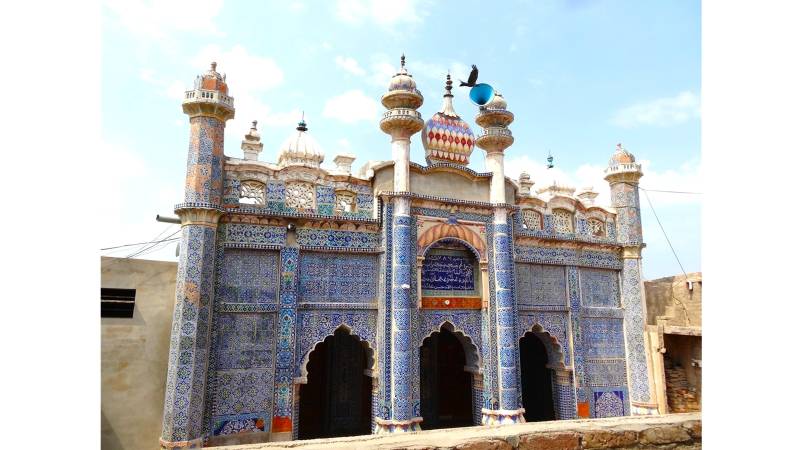
Bukera Sharif in Tando Allahyar district is not only noted for its impressive tombs of Sufi saints but also for the magnificent mosques built by these revered figures and landed elites. Walking through the cultural landscape of Bukera Sharif, one comes across several historical mosques. According to Murad Ali Shah Bukerai, a local historian from Bukera Sharif, the town has several historic mosques.
One such mosque is locally known as Charag Masjid, as it is in the Mohalla of the Dars community; hence, it is also called Darsan Wari Masjid. A dignitary from the Dars community built this mosque.
Before discussing the mosque, I will first explain who the Dars are. Dars was a prominent religious and honorific title associated with the Ghausi Ja'amt of Shaikh Bahauddin Zakariya (d. 1262). According to Dr Nabi Bakhsh Khan Baloch (2005), author of Rihan Hiran Kha’an Vol. 6, the word Dars literally means "lesson" or "teaching". The term, a respected faqiri (Sufi) title, gradually acquired a broader meaning within the Suhrawardiyya Sufi order. Pious and learned individuals associated with the order, particularly those entrusted with religious teaching and preaching, came to be known as Dars. The title was especially applied to scholars and religious teachers who were appointed to particular places to impart religious instruction and propagate the teachings of the order.
Over time, therefore, Dars developed from a term denoting religious instruction into an honorific title for preachers and learned representatives of the Ghausiyya Jama'at of the Suhrawardi order. In the beginning, prominent members of the Mangrio clan were among the first to bear the title Dars and became followers of Shaikh Bahauddin Zakariya. Since the earliest known Dars belonged to the Mangrio community, the title gradually came to be regarded as exclusively associated with the Mangrias. This, however, did not remain the case. As the Ghausi Jama'at expanded, prominent faqirs and khalifas (deputies) from other castes and communities also came to bear the title Dars, showing that it had developed into a broader religious title rather than remaining confined to a particular caste or lineage.
However, Dr Nabi Bakhsh Khan Baloch (2005) believes that many dignitaries from other castes—including Phulpota, Hingorja, Sameja, Banbhra, Keeriya, Halepota, Lanja, and many others—became Dars, and many eminent people from these castes preached the teachings of the spiritual masters in their respective regions.
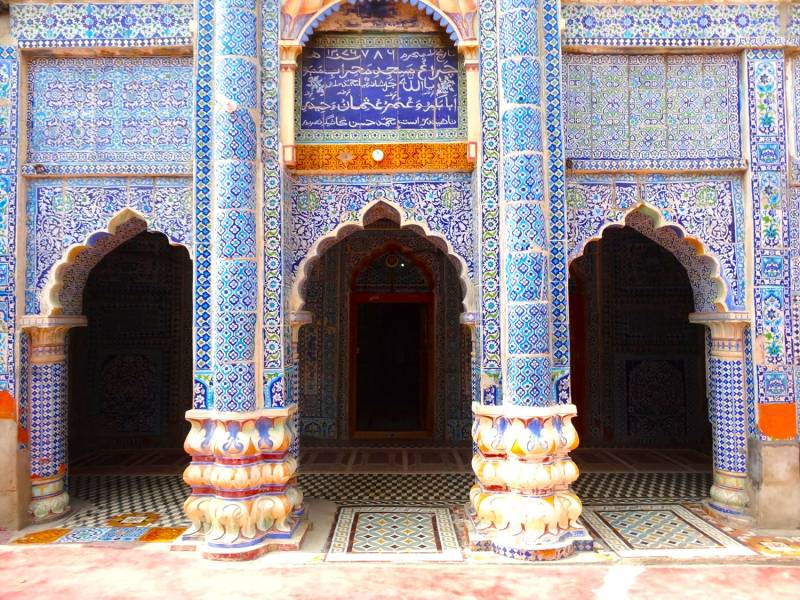
Mosques featuring such magnificent glazed tilework can be seen in many villages across Tando Allahyar, reflecting the widespread popularity of glazed tile decoration in the religious architecture of the district
In Bukera Sharif, two Dars families are spiritually connected to the Ghausi Jam’at of Shaikh Bahauddin Zakariya: the Banhepota Dars, descendants of Shaikh Banho, and the Nidhu Dars. The dignitaries of Nidhu Dars built the Charag mosque. It is not known which family member first built the mosque. During an interview with Muhammad Bachal Dars, son of Muhammad Achar Dars, I learned that Makhdoom Kahu Aali Faqir Dars was probably the first person to build the Charag mosque. He used to teach there. It was a simple and small mosque at that time.
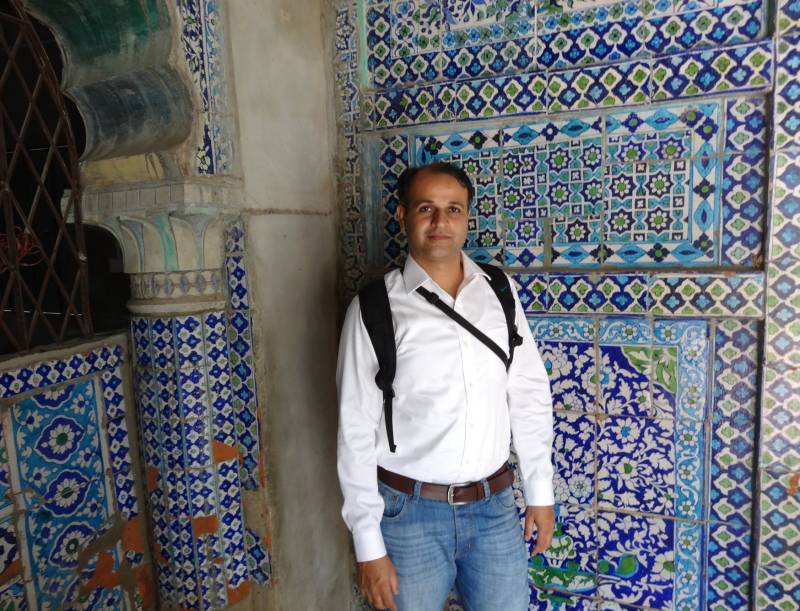
Later, Akhund Muhammad Bachal Dars rebuilt the mosque in the colonial era. In 1956, Muhammad Achar Dars (d. 1971), a close relative of Akhund Muhammad Bachal, commissioned plasterwork, tilework, and paintings for the Darsan Wari Masjid. He hired skilled masons from the town of Jhduo to carry out the mosque's decorative work. A father-and-son team undertook the tilework and paintings; Muhammad Hasan Shaikh handled the tilework, while his son painted the walls of the mosque's main prayer hall.
Architecture and Renovation
Darsan Wari Masjid is built in a rectangular plan with four minarets rising from the thickness of the walls. Two corner pillars are more massive, while two flanking the central arch are comparatively slender. All four are clad in distinctive blue tiles of Nasarpur and terminate in miniature domes. The mosque's parapet is adorned with three miniature domes and turrets, lending elegance to the façade. The central dome, however, is only a half-dome built on the front, cleverly creating the impression of a complete dome when viewed from the east. It appears that there used to be a full dome, but a half-dome was built later during a renovation.
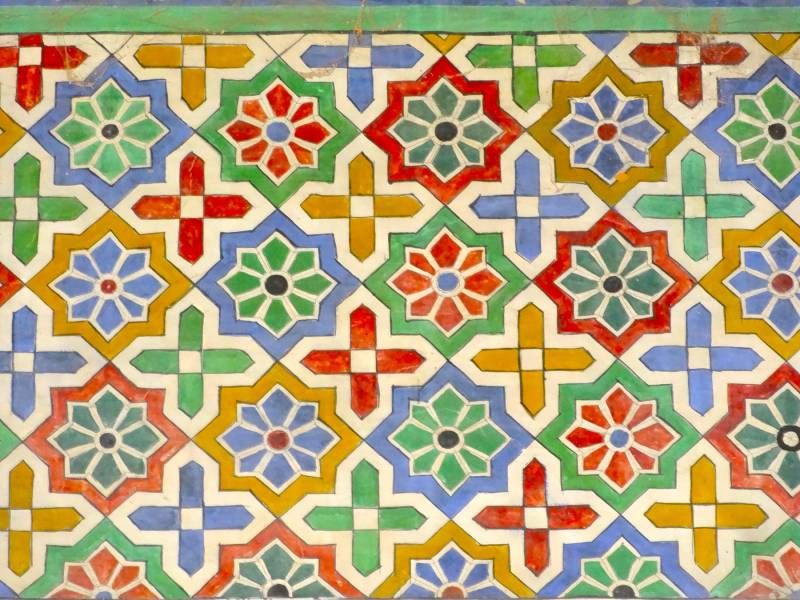
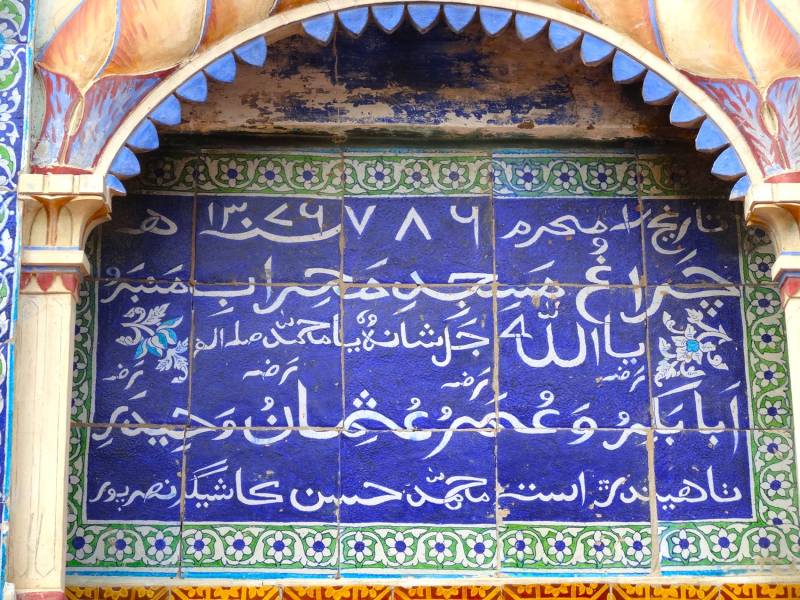
One enters from the courtyard through three arched entrances to a covered verandah, which leads to the mosque's main prayer hall. The mason remarkably makes the cusps of each arch. The spandrels of the arches are decorated with floral arabesque. The front of the mosque is decorated with enamelled Nasarpuri tiles. The inscription bears the name Kashigar Osto Muhammad Hasan. Moreover, one can also observe the date as the 7th of August 1956 (1st Muharram 1376 AH). This is most likely the date of renovation when the tiles were fixed on the mosque walls.
Another important point to consider is the similarity in the names of the artisans associated with the mosque. Two individuals named Muhammad Hasan were involved in its decoration: Osto Muhammad Hasan Kashigar of Nasarpur, a tile maker (kashigar) whose name appears in the inscription, and Muhammad Hasan Shaikh of Jhudo, who fixed the tiles on the mosque's walls. Although they shared the same name, they were two different craftsmen with distinct roles: one produced the tiles, while the other installed them.
Depictions of Holy Sites
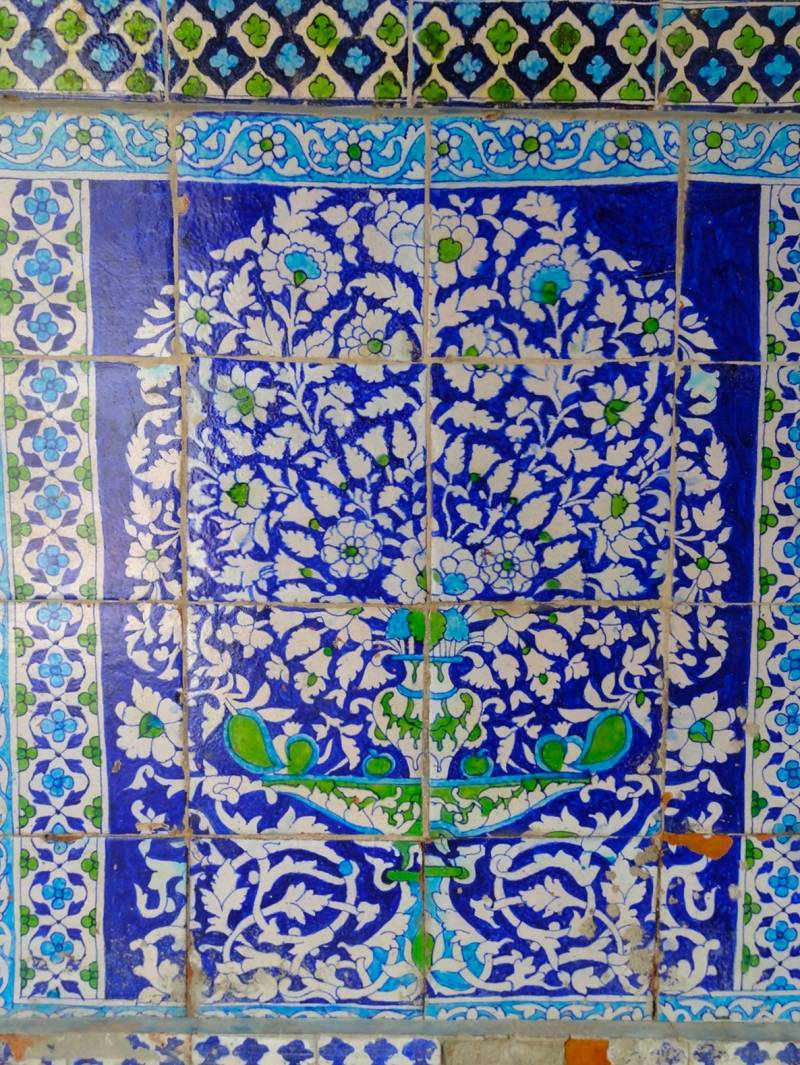
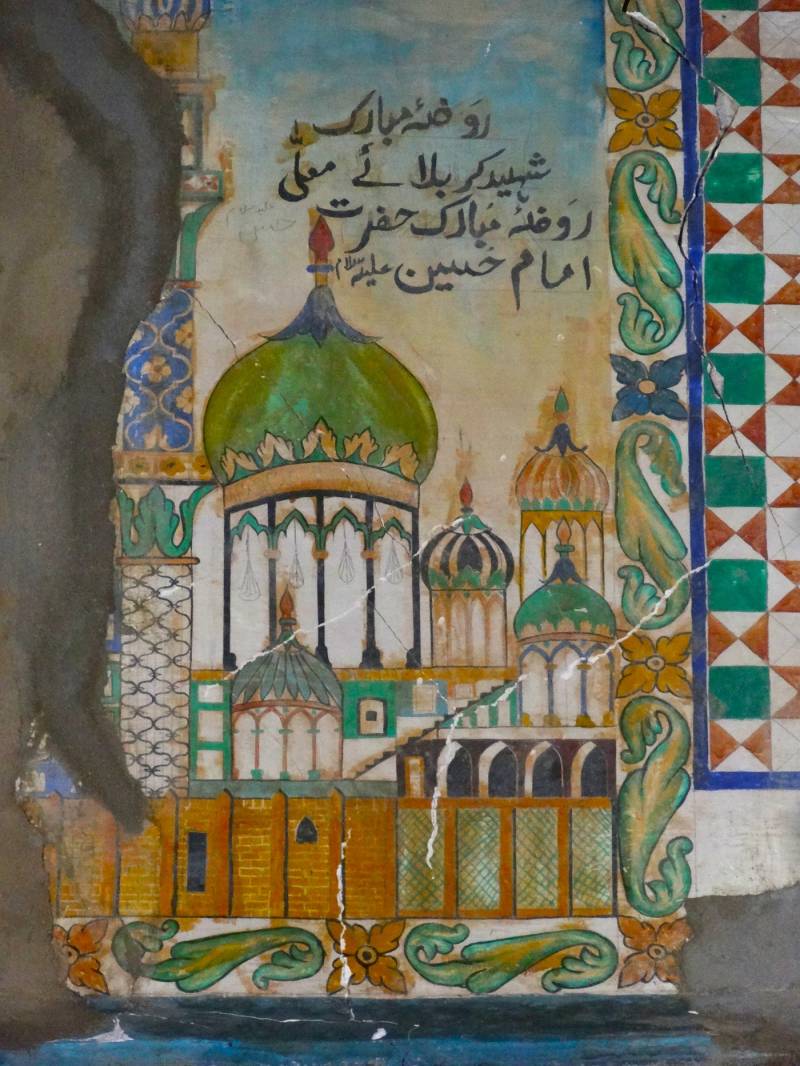
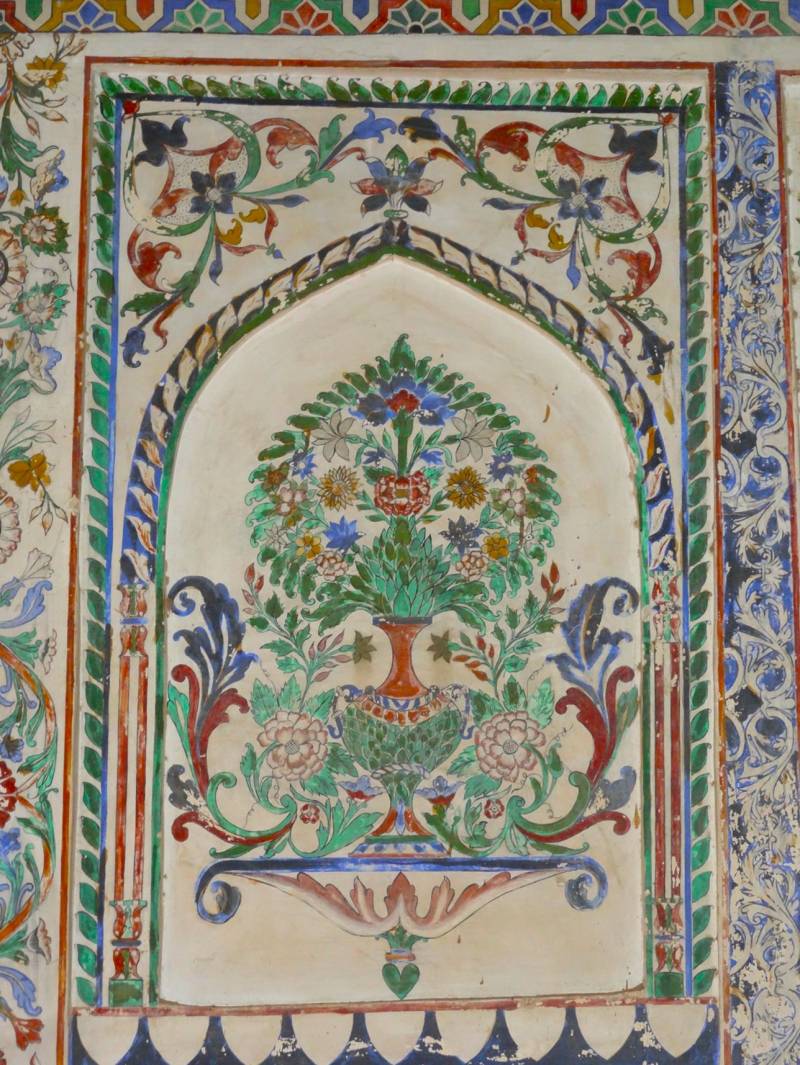
The verandah walls are adorned with glazed tiles. The main prayer hall of the mosque is adorned with both glazed tiles and mural paintings representing floral and geometric designs. Panels depict floral and stylised vases on the walls of the main prayer hall. The distinctive feature of the painting is two representations of a shrine and a mosque. Both are painted on the mosque's western wall. On the right of the mihrab is painted the shrine of Hazrat Imam Hussain (AS). The name of the shrine is written as ‘Roza-e-Mubarak Shaheed-e-Karbala Maula Roza-e-Mubarak Hazrat Imam Hussain Alayhi al-salam (The blessed shrine of Hazrat Imam Hussain (peace be upon him), the martyr of Karbala)’.
It is peculiar to see the representation of the shrine of Hazrat Imam Hussain in any mosque in Tando Allahyar district. In fact, I have not seen a depiction of the shrine of Hazrat Imam Hussain in any other mosque in Sindh. However, one can see its depiction in tombs, but not in mosques.
One can see representations of holy pilgrimage sites in both tombs and mosques in Sindh. The Ka'ba and the Masjid al-Haram that surrounds it, and the Mosque of the Holy Prophet Muhammad (Peace be upon Him) at Madinah, have been frequently depicted in Islamic art. Both Makkah and Madinah, the sites of pilgrimage, have been represented in tombs and mosques in Sindh.
Most tombs built during the Talpur and British periods are decorated with depictions of Makkah and Madinah. The earliest representation of Ka’aba is found in the mosque of Jam Nindo at Qubo Shahdad necropolis in Sanghar district. This mosque was built during the Kalhora period (1700-1783). Near the depiction of the Holy Ka’aba are paintings of shrines.
The most splendid tomb of Syed Hasan Ali, which was built in 1829 CE during the Talpur period (1783-1843), is decorated with paintings of the Holy Ka'aba and the Mosque of the Holy Prophet Muhammad (PBUH). The tomb of Syed Hasan Ali, locally known as Mahawali, is located near 70 Morri in Tando Muhammad Khan district. On the eastern wall of the tomb are two panels which depict the Holy Ka'aba and the Mosque of the Holy Prophet Muhammad (PBUH), respectively. It also depicts Jannat ul Baqi.
Two tombs at Sangharo Sharif in the district of Tando Allahyar belong to Pir Noor Muhammad Qadiri and Bachal Shah, respectively. Both tombs depict paintings of Makkah and Madinah. The tomb of Pir Noor Muhammad Qadiri has two panels that show the Holy Ka'aba and the Masjid al-Nabawi. The panel shows the Holy Ka'aba in the centre, depicting key annotated monuments.
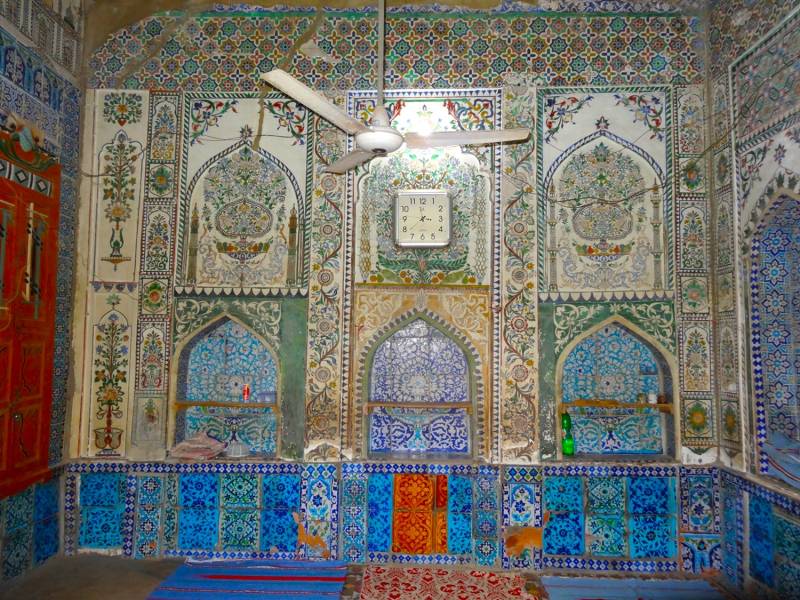
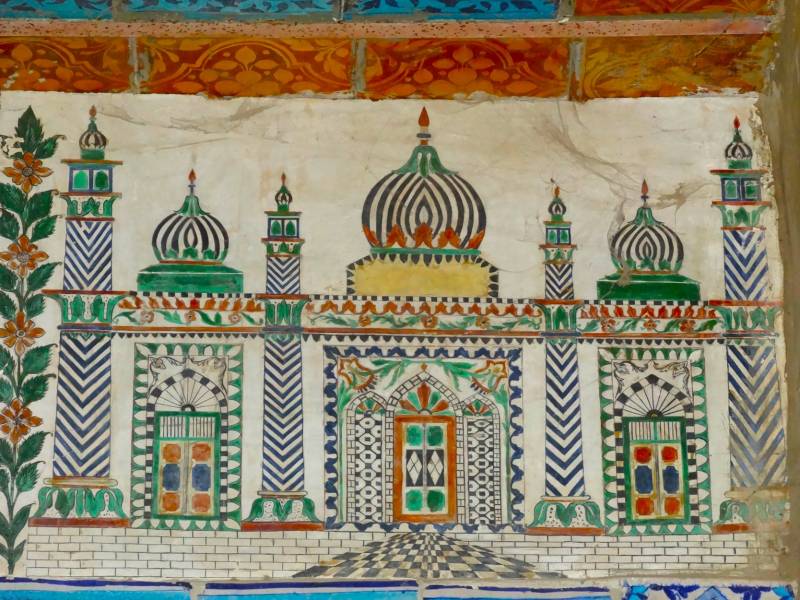
Another representation in the Darsan Wari Masjid in Bukera Sharif depicts the mosque itself, reflecting an interesting visual record of its architecture. Mistri Abdul Raheed, a painter from Jhudo, painted this representation on the western wall of the prayer hall to the right of the mihrab. The painting reproduces the mosque’s architectural form and decorative details. The artist also left his name and the date of his work on the wall. According to the inscription, Abdul Raheed painted the prayer hall in 1958, two years after his father, Muhammad Hasan Shaikh, had completed the installation of the enamelled Nasarpuri tiles on the mosque's walls and ceiling in 1956.
Mosques featuring such magnificent glazed tilework can be seen in many villages across Tando Allahyar. In Bukera Sharif, the mosque of Pir Wilayat Shah is another notable example, with its walls adorned with glazed tiles. Beyond Bukera Sharif, similarly decorated mosques can be found at Kamaro Sharif, Shadiyon Walhar, and several other places in the region, reflecting the widespread popularity of glazed tile decoration in the religious architecture of Tando Allahyar district.