

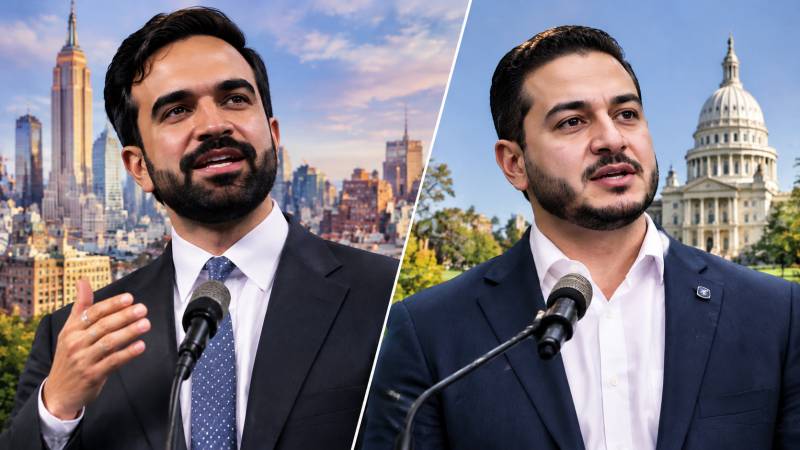
Politics occasionally produces moments in which a few ordinary words acquire extraordinary historical significance. On the night of November 3, 2026, as election results confirmed a remarkable victory in Michigan, Dr Abdulrahman Mohamed El-Sayed stood before a jubilant gathering and reflected upon two expressions that had accompanied his political journey: Inshallah, meaning God willing, and Alhamdulillah, meaning praise be to God. Throughout his campaign, he had invoked the first as an expression of hope. Now, with victory secured, he could replace uncertainty with gratitude. The audience responded enthusiastically, turning a personal expression of faith into a shared moment of political celebration. The significance extended beyond religious symbolism. For the first time in American history, a Muslim had been elected to the United States Senate.
Only a year earlier, another young Muslim politician, Zohran Mamdani, had captured the world's attention by winning the mayoralty of New York City. Mamdani assumed office on January 1, 2026, becoming the city's first Muslim mayor and one of the most prominent figures associated with democratic socialism in American politics. His campaign challenged familiar political assumptions about electability, identity, campaign financing and the issues that motivate ordinary voters. The victory of Abdul El-Sayed now invites comparisons with that earlier breakthrough. Are these merely two individual achievements, or do they suggest a wider transformation in American political life?
The answer requires looking beyond the religious identity of the candidates. Their successes cannot be understood simply as victories of Muslim representation, however historically significant that representation may be. Both emerged within a broader political environment shaped by economic insecurity, frustration with established institutions, dissatisfaction with political funding arrangements and a growing desire among sections of the electorate for candidates who speak directly about everyday difficulties. Their campaigns placed housing costs, healthcare, wages and corporate influence near the centre of political discussion. The underlying message was that democracy should address the material conditions of ordinary citizens rather than remain primarily an arena for wealthy donors and professional political organizations.
Mamdani's rise demonstrated how a candidate with limited conventional political backing could construct a formidable electoral campaign through neighbourhood organizing, volunteer participation, digital communication and a consistent economic message. His emphasis on affordable housing, public transport and childcare resonated with voters confronting the rising cost of urban life. Rather than presenting these concerns as isolated policy issues, he connected them through the larger question of whether a prosperous city could remain accessible to the people who worked in it. His political approach involved translating abstract economic arguments into familiar experiences. A bus fare, a rent increase or the expense of childcare became an entry point into a broader conversation about inequality and public responsibility. This ability to connect everyday problems with a coherent political narrative helped distinguish his campaign from conventional appeals organized mainly around party loyalty or personal reputation. His Senate campaign therefore represented neither an effortless political ascent nor an overnight success. It emerged from years of political engagement and the gradual development of a public profile centered on healthcare and economic reform.
The Senate campaign brought together a progressive economic program and a criticism of the influence of large financial interests in American elections. El-Sayed advocated Medicare for All, sought to reduce the role of corporate money in politics and argued that public policy should address the economic pressures experienced by working families. His campaign also took positions on American foreign policy, including opposition to continued US military assistance to Israel, that generated sharp disagreements within the Democratic Party and beyond. His nomination was not assured. The Democratic primary in Michigan became an expensive and contentious contest, with significant outside spending opposing his candidacy. His eventual success challenged the assumption, frequently advanced by party strategists, that a progressive candidate with outspoken positions on controversial issues would necessarily struggle to compete in a politically divided state.
The general election posed another challenge. Michigan is not New York City. Its electorate includes industrial communities, suburban voters, university towns, rural areas and politically diverse populations. The economic experiences of its residents differ considerably from those of New Yorkers. El-Sayed faced Republican Mike Rogers, an experienced former congressman supported by prominent national Republican figures. The contest unfolded amid arguments over inflation, healthcare, foreign policy, immigration and the future direction of American politics. El-Sayed's campaign sought to connect these diverse concerns through a message focused on reducing financial pressures and increasing the influence of ordinary voters. Its volunteer operation had expanded significantly during the primary campaign, demonstrating the continuing importance of direct political contact even in an era dominated by digital advertising. Door-to-door conversations, community meetings, small contributions and volunteer networks became integral elements of its organizational strategy.
This is perhaps the most interesting connection with Mamdani. The term Mamdani effect should not be interpreted as evidence that one politician personally created another's success. El-Sayed's public-health career, political ideas and electoral efforts existed independently of Mamdani's mayoral campaign. Nor do the two politicians share an identical ideological identity: Mamdani describes himself as a democratic socialist, while El-Sayed has not adopted that description. Their campaigns nevertheless illustrate a similar willingness to challenge established political structures while prioritizing the economic concerns of working people. The connection was recognized by Mamdani himself. After El-Sayed won the Michigan Democratic primary in August 2026, the New York mayor publicly welcomed the result and described both campaigns as part of a wider effort to place working-class Americans at the centre of political discussion. Their shared political themes suggest an emerging progressive electoral approach, but the relationship should not be exaggerated into a single centrally organized movement.
A candidate's religious identity need not define the boundaries of the constituency he seeks to represent. Winning a Senate election requires building support among citizens with different beliefs, experiences and political priorities.
El-Sayed responded by refusing to conceal his identity. His victory speech began with a deliberate declaration of his full name. It was followed by the now widely circulated transition from Inshallah to Alhamdulillah. For Muslim audiences, the expressions were familiar. For others, they offered a reminder that public expressions of faith can coexist with participation in a pluralist democracy. Yet the importance of that moment should not be reduced to religious triumphalism. El-Sayed did not win solely because he was Muslim, nor can the entire electorate's motivations be inferred from one memorable speech. His campaign advanced particular policies, mobilized volunteers and benefited from the wider political conditions of the 2026 midterm elections. Muslim representation formed one part of a more complex democratic outcome.
There is also a broader lesson concerning political communication. Both Mamdani and El-Sayed have demonstrated the value of making political language accessible. Their messages did not depend exclusively upon elaborate ideological formulations. They spoke about rent, food, transport, medical bills and the influence of money in government. These issues are not unique to progressive politics; candidates across ideological traditions respond to them in different ways. What distinguished these campaigns was the prominence given to such concerns and the effort to connect them with a critique of existing political arrangements. Digital communication amplified their messages, but online popularity alone cannot explain electoral success. Social media may introduce a candidate to millions, yet the transformation of attention into votes requires organisation, credibility and participation. El-Sayed's campaign involved extensive travel and community engagement. Mamdani's election similarly reflected the contribution of volunteers and neighbourhood-level mobilization. Both illustrate the continuing relationship between modern political communication and traditional democratic organisation.
For observers outside the United States, including those in Pakistan, these developments offer an opportunity for reflection rather than simple imitation. Pakistan's political institutions, electoral rules, party structures and social conditions differ greatly from those of the United States. A campaign strategy that succeeds in New York or Michigan cannot be transplanted mechanically into Karachi, Lahore or Islamabad. Nevertheless, certain broader questions have international relevance. How can political organizations encourage meaningful citizen participation? Can campaign financing become more transparent? How should candidates communicate complex policies without reducing them to slogans? What place should minority representation occupy within democratic institutions? And how can voters evaluate ambitious promises against practical administrative capacity?
These questions matter wherever citizens feel that political institutions have become distant from everyday concerns. They also remind us that democratic participation involves more than voting on election day. Public debate, community organisation, scrutiny of institutions and continued accountability are equally important. The emergence of Muslim politicians in prominent American offices is another development worthy of careful observation. Their success challenges stereotypes, but it should not create the expectation that politicians sharing a religious identity must hold identical views. Muslim Americans, like other citizens, possess diverse political beliefs, professional backgrounds and policy priorities. Their inclusion in public institutions is most meaningful when they are able to participate as full political actors rather than being viewed exclusively through the lens of religious representation.
El-Sayed's election is historically significant precisely because it combines several dimensions: a breakthrough in representation, a competitive statewide victory, a progressive economic campaign and a wider national debate about the future of the Democratic Party. Reducing it to any single element would diminish the complexity of the event. The phrase From Inshallah to Alhamdulillah has nevertheless captured public attention because it expresses something recognizably human. Before an uncertain outcome, people hope. After an achievement, they express gratitude. El-Sayed placed these ordinary sentiments within the extraordinary setting of a national political milestone. For many observers, the moment symbolized the possibility of belonging without surrendering identity. For others, its greater importance lay in the policies and organizational work that carried the campaign to victory. Both interpretations can coexist without requiring agreement about the candidate's political agenda. The comparison with Mamdani ultimately reveals an evolving political experiment rather than a completed revolution. It is an experiment in whether grassroots organisation can compete with established financial and political structures, whether economic concerns can bring together diverse voters, and whether candidates associated with minority communities can secure wider public confidence.
Whether these achievements mark a lasting political transformation will be determined by developments still to come. But they have already complicated familiar assumptions about identity, political organisation and the boundaries of electoral possibility. Mamdani's rise showed that an unconventional political campaign could reach City Hall. El-Sayed's victory has demonstrated that a related style of grassroots politics can also compete successfully in a closely contested statewide election. Neither result eliminates the challenges of government, but together they offer an important subject for democratic reflection. And somewhere between Inshallah and Alhamdulillah lies the most demanding word in politics: responsibility. Hope can win an election. Gratitude can celebrate it. Only accountable public service can justify the trust that made it possible.