

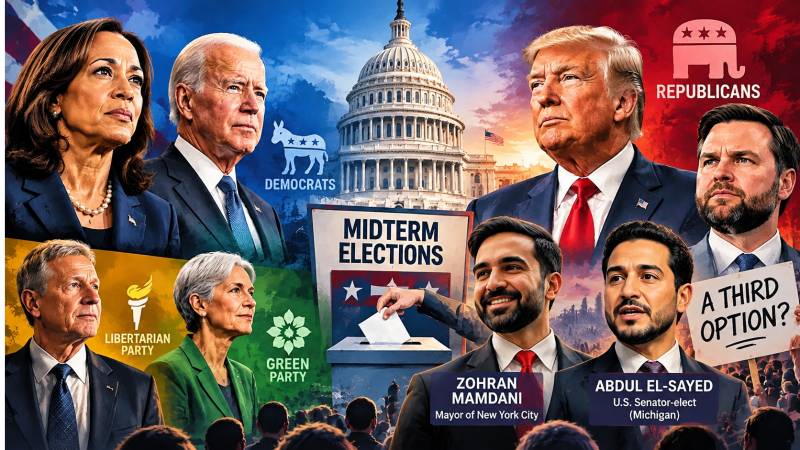
The American constitutional experiment, now almost 250 years old, has not only endured but also served as a model for numerous countries that gained independence or embraced democracy in the centuries that followed. Built around three branches of government, the executive, legislative and judiciary, its system of checks and balances ensures that no single institution enjoys unchecked authority. Its two-party system has further sustained competitive elections, with Democrats and Republicans taking turns making promises and occasionally explaining why the previous administration was responsible for their failure. The midterms, after all, offer voters an opportunity to remind the incumbent party that even two years is a long time to wait for promises to materialise. Yet, for all its democratic resilience there are still gaps to be filled.
For those who felt that neither party quite represented them, there have been attempts to offer an alternative. The Libertarian Party, with its emphasis on individual liberty and limited government, and the Green Party, with its focus on environmental reform, are two such examples. Yet neither has managed to make a significant breakthrough in a political system where Democrats and Republicans have spent generations establishing themselves. Breaking into American politics as a third force is rather easier said than done when the two existing players have practically made themselves at home. Today, however, there is a growing perception that the Democrats are moving further to the left, while parts of the Republican Party are embracing a more hardline form of conservatism. This leaves room for a couple of interesting questions, could there now be room for a centrist third party, one that offers voters something beyond choosing the lesser of two political frustrations? And, more importantly, what would such a party stand for?
American voters seem increasingly dissatisfied with the choices before them. Republicans swept the 2024 elections, winning the presidency and both chambers of Congress, only for Democrats to make gains in the 2026 midterms. This constant back and forth may suggest less loyalty to either party than frustration with both. A voter may want stricter border controls without supporting every ICE operation, just as they may want to prevent Iran from acquiring nuclear weapons without believing that another military confrontation is the answer. One can also support sensible gun regulations without wanting to abolish the constitutional right to bear arms. Yet these positions do not always sit comfortably within the two parties agendas. Perhaps there is room for a political middle that does not require voters to sign up to what now seems to be an either far left or far right ideology.
Repeated disappointment with campaign promises has left many Americans questioning what their vote delivers. If 2028 is to offer anything more than another round of familiar slogans and partisan finger-pointing, both parties will need to take that frustration seriously.
As a global superpower, America's foreign policy rarely stops at its own borders, which is why elections in Washington are watched so closely around the world. A third party could bring a slightly different approach to how America deals with the rest of the world. It could take a firm position against its adversaries without believing that every disagreement calls for a military response, giving diplomacy a fairer chance before reaching for the military option. On NATO, it could take a more conservative stance, question America's financial commitments and insisting that other members pay their fair share rather than leaving Washington to foot much of the bill. This would not mean abandoning America's global role, but being more careful about where it chooses to get involved. After all, being a superpower does not mean having to play policeman in every corner of the world.
Breaking into a two-party system that has never elected a third-party president will be no small task, although the political climate is changing. Figures such as Zohran Mamdani and Abdul El-Sayed have shown how candidates can build visibility and connect with voters through social media and with the help of algorithms, sometimes outside the conventional routes of party politics. But popularity online does not automatically translate into electoral success. Funding, ballot access, established party machinery and the limited time between elections remain formidable obstacles. The Electoral College presents another major hurdle. In America, winning millions of votes nationally does not necessarily translate into electoral success, as Ross Perot discovered in 1992 when he secured nearly 19 per cent of the popular vote but failed to win a single electoral vote. For a new party, building nationwide support is therefore not enough, it must also win support in the right states. A third party would have to build its presence well before the presidential race, rather than expect enthusiasm on social media to do all the heavy lifting.
Perhaps, however, the established parties have as much to consider as any potential newcomer. Rather than waiting for a third force to emerge, they could begin by reassessing the concerns of the voters they claim to represent. Repeated disappointment with campaign promises has left many Americans questioning what their vote delivers. If 2028 is to offer anything more than another round of familiar slogans and partisan finger-pointing, both parties will need to take that frustration seriously. Otherwise, the prospect of a third option may continue to grow. And the idea that voters should simply choose the lesser of two disappointments is, quite frankly, for the birds.