

Four decades ago, on August 14, 1983, the Movement for the Restoration of Democracy (MRD), an alliance of almost all major political parties in the country, formally launched its struggle to end General Zia-ul-Haq’s dictatorship and martial law.
In the first phase, leading political figures and workers began offering themselves for arrest at major intersections and public places in cities. The movement was launched in major cities including Karachi, Lahore, Quetta and Peshawar, as well as in other parts of the country. In Sindh, the movement began with extraordinary momentum and massive public participation. Thousands of people would gather whenever political leaders were arrested in Sindh. Every day, workers would come out onto the streets chanting slogans, while crowds of people welcomed them, put flower garlands around their necks, raised slogans with them and accompanied them towards police stations. Police and other law-enforcement personnel would arrest them on the way.
Within only a few days, thousands of workers in Sindh had courted arrest. Prisons and police stations across the province became overcrowded. It became difficult for the police and administration even to keep the arrested workers in custody overnight. In some places, workers who had offered themselves for arrest at police stations were sent home at night and returned to the stations the following morning to sit there again.
According to a cautious estimate, between 20,000 and 25,000 people were arrested in Sindh during the 1983 movement, including more than 100 women. Nearly 800 people lost their lives. At that time, newspapers, operating under strict censorship, were the only regular source of news. People in cities and villages would gather every day to listen to BBC London broadcasts for information about what was happening.
During the jail-filling campaign, very large rallies were also held across Sindh. Clashes with police, blocking of roads, baton charges, tear gas and acts of vandalism became routine. The number of people offering themselves for arrest increased to such an extent that, at times, police personnel disappeared from the stations and avoided making arrests. During the movement, several police officers refused to perform their duties and began removing their uniforms and police armbands. This created a situation resembling civil disobedience, particularly in Sindh. Several cities would shut down every day, while in many areas the situation resembled a curfew. In addition to political workers, journalists, writers, poets and intellectuals were also arrested. Some political workers, journalists and writers were publicly sentenced to flogging by military courts.
Nearly 800 people lost their lives. At that time, newspapers, operating under strict censorship, were the only regular source of news. People in cities and villages would gather every day to listen to BBC London broadcasts for information about what was happening.
In these circumstances, Ghulam Mustafa Jatoi, who was then president of the Sindh chapter of the Pakistan People’s Party and was leading the MRD movement, wrote a letter from the Karachi Jail Rest House asking party workers to end the movement. However, the people of Sindh rejected his appeal, and the movement continued in the province for several more months.
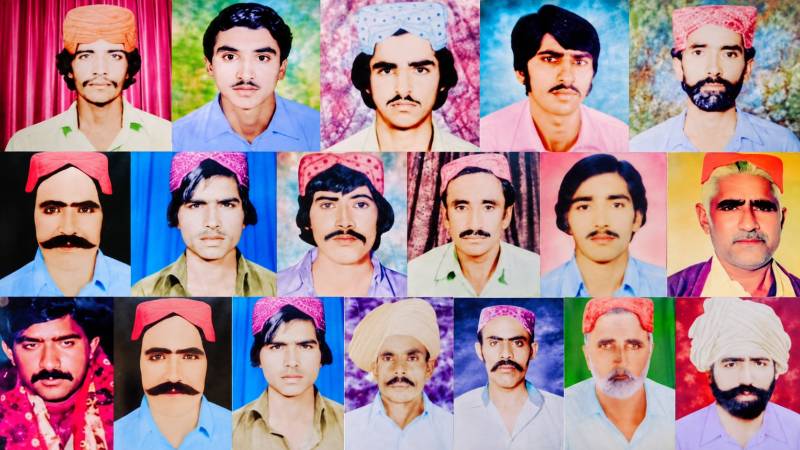
The biggest incident of the MRD movement took place 43 years ago, on September 29, 1983, near the town of Sakrand on the National Highway. Party workers and hundreds of villagers were protesting when law-enforcement personnel passing through the area opened fire on them. As a result, 16 people were killed and 51 others were injured and arrested. Seventy-year-old protest leader Panhal Khan Chandio and his son, Ghulam Abbas Chandio, were also arrested. They were tried by a military court in Khairpur and sentenced to rigorous imprisonment. Severely injured workers were being treated at the Civil Hospital in Nawabshah when they were taken away from the hospital and imprisoned.
Among the 16 people who were killed that day, nine were farmers. Two were students of Sakrand High School. One was a Manghanhar fakir who used to play the drum during celebrations and bring joy to people. Another worked as a daily wage laborer in Sakrand city; one ran a shop; another sold milk; and one was a goat herder. They were all ordinary workers belonging to the lower-income sections of society.
When I and a few journalist friends from Sakrand reached the scene in the evening, the blood of the dead and wounded had not yet dried on the National Highway. Their shoes, slippers and other belongings were scattered across the road. Eyewitnesses told us that the protesters were unarmed and were reciting the Holy Quran when indiscriminate firing was opened on them.
The brutal operation continued for nearly four hours. According to eyewitnesses, police trucks were driven over several wounded protesters, killing them. The following morning, we went with hundreds of people from Sakrand to the village of Panhal Khan Chandio, where the families of those killed were burying their loved ones. Besides the bereaved families, the then Member of the Sindh Assembly, Ghulam Qadir Chandio, was also present and receiving condolences from the people who had come to the village.
Ghulam Qadir Chandio is known as a representative of the working class who has continued to be elected for nearly 30 years. In 1995, Benazir Bhutto nominated him as a member of the Senate of Pakistan for a six-year term. He was subsequently elected to the Sindh Assembly for the fifth time. He has consistently played the role of a party worker and an ordinary political activist, both at public gatherings and on the floor of the provincial assembly.
The news of the September 29, 1983 incident was broadcast by the BBC as its leading news story. Radio Pakistan also reported the incident, stating that 16 people had been killed and 51 injured and arrested in firing between law-enforcement personnel and what it described as “miscreants” near Sakrand on the National Highway.
More than 43 years have now passed since the movement. The MRD struggle continued for a long period and was more active in Sindh than in other parts of the country. It is also important to recall that Sindh’s nationalist forces opposed the movement. Nationalist leader G.M. Syed described the MRD struggle as a “movement of grave robbers.”
Today, when there is renewed discussion about the creation of new provinces and administrative units in the country, opposition has emerged not only from nationalist parties but also from the Pakistan People’s Party, which has historically remained a major political force in Sindh and currently holds more than two-thirds of the seats in the Sindh Assembly. Along with its stated opposition to new provinces and a resolution adopted by the assembly, for the first time a day was observed on September 12 to pay tribute to the martyrs of MRD in Khairpur Nathan Shah.
Through this initiative, a message was conveyed to the powerful circles that any attempt to create new provinces could once again provoke a strong popular response from Sindh, similar to the MRD movement. Because of the historic struggle waged by the people of Sindh, they came to be recognized around the world as a democratic and anti-dictatorship people. The MRD movement remains, even today, an example of struggle and courage for those who believe in democracy across the region.