

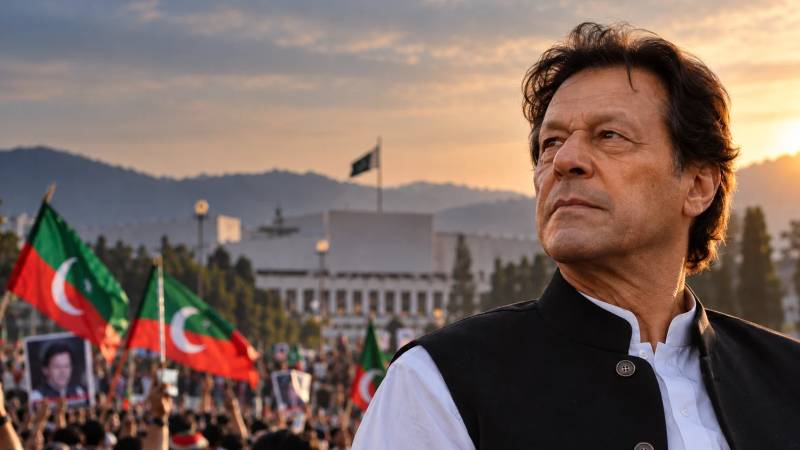
Pakistan's political opposition has something that movements elsewhere would envy: a leader with a substantial popular following, a governing establishment facing widespread economic discontent, and two principal civilian rivals whose credibility has been eroded by years of political compromise. Yet it has repeatedly failed to translate these advantages into sustained mass mobilisation. Imran Khan remains the most recognisable figure in opposition politics, but his popularity has not produced a comparable capacity for collective action. The contradiction deserves more serious examination than another round of accusations about weak party workers or failed protest marches.
The problem is not that Pakistanis are content with their circumstances. Households face heavy utility bills, inadequate public services, insecure livelihoods and limited opportunities for their children. Nor is it that Khan has ceased to matter politically. The performance of PTI-backed independents in the February 2024 elections, despite formidable restrictions, demonstrated the resilience of his electoral support. But voting for a popular leader, sympathising with his imprisonment and joining a sustained political struggle are three very different forms of political participation.
The current confrontation illustrates the distance between them. PTI's recent protest plans have involved changing dates, consultations among competing centres of leadership, disputes over negotiations and a renewed march from Khyber Pakhtunkhwa. The demand for Khan's release remains central. In September, Senate opposition leader Raja Nasir Abbas declared that only Khan himself could postpone the planned march. The assertion demonstrated loyalty, but also exposed the difficulty of operating a national political movement when decisive authority rests with a leader who is incarcerated.
Repression is a major part of the explanation. Restrictions on expression, intimidation of political activists and the erosion of judicial independence have raised the costs of political participation. But repression does not fully explain why the opposition has struggled to develop a coherent response to the country's economic crisis, or why its enormous political energy has remained so heavily concentrated on the fate of one man. Pakistan's history offers two revealing contrasts. Sheikh Mujibur Rahman and Zulfikar Ali Bhutto emerged as mass leaders during the 1960s because they connected struggles over political authority to the economic grievances of ordinary citizens. Their charisma mattered, but it was accompanied by programmes that gave those grievances political meaning.
Mujib's Six Points, presented in 1966, were ostensibly constitutional demands for provincial autonomy. Their political force, however, came from the economic argument developed by Bengali economists, including Rehman Sobhan, about the unequal distribution of public investment, foreign-exchange earnings and development opportunities between East and West Pakistan. Mujib made the relationship between political subordination and economic disadvantage intelligible to a mass audience. His programme identified the institutions through which resources were controlled and proposed a different distribution of authority.
Bhutto's political breakthrough rested on a different but equally powerful connection. Ayub Khan's decade of development had generated industrial growth alongside concentrations of wealth and privilege. Workers, students and sections of the peasantry increasingly questioned who benefited from the country's economic progress. Bhutto's promise of roti, kapra aur makan, supported by the PPP's original commitments to socialism and redistribution, gave these grievances an accessible political vocabulary. The struggle against Ayub was no longer merely about removing a military ruler; it was also about challenging an economic order.
Neither leader should be romanticised. Bhutto subsequently demonstrated authoritarian tendencies and pursued economic policies with serious adverse consequences. Mujib's post-independence record was also marked by increasing concentration of political authority. But their ability to mobilise large constituencies reflected something contemporary opposition politics has largely failed to reproduce: a connection between political change and the material interests of identifiable social groups.
PTI has not been entirely devoid of economic proposals. In June, its economic think tank, led by Taimur Jhagra, presented a 15-page budget alternative proposing relief for salaried taxpayers, a reduction in sales tax, limits on the petroleum levy and Rs500 billion in expenditure savings. It also addressed education, healthcare and energy-sector reform. These proposals merit examination, but they have not become the organising centre of the party's political activity.
The distinction is important. A collection of budget recommendations is not the same as a political programme that explains how the country's economic structure would be changed. Pakistan's difficulties arise not simply from high taxes or excessive government expenditure but from a system in which access to state resources, exemptions, subsidies, protected markets and public contracts has often depended on political influence. A programme for economic transformation would have to explain which privileges would be withdrawn, how the resulting resistance would be managed and how the benefits would reach ordinary households.
A political movement requires local leadership, relationships with communities and institutions capable of sustaining participation when demonstrations are prohibited or leaders arrested.
Khan's political language has remained more effective at identifying allegedly corrupt individuals than at explaining the institutions that reproduce economic privilege. His own government did not fundamentally alter those institutions. The argument that Pakistan needs honest leadership has considerable popular appeal, But honesty alone cannot put food on the table, create decent jobs, bring down electricity bills, improve schools and hospitals, or end a system in which the powerful enjoy privileges while ordinary Pakistanis struggle to make ends meet.
The opposition's second difficulty concerns the signals it sends to the public. At different moments, PTI leaders have demanded negotiations, rejected negotiations, announced confrontational marches, postponed them and returned to the possibility of accommodation. Some of these changes reflect genuine constraints imposed by the authorities. Others expose disagreements within the party and between PTI and its allies. The question is not whether political negotiations are legitimate. They are indispensable to democratic politics. The problem arises when the public cannot distinguish between negotiations intended to establish constitutional rules and negotiations intended to secure an arrangement for particular leaders.
The same ambiguity affects PTI's relationship with the establishment. The party condemns military interference in politics, yet its earlier rise to office was associated with an arrangement widely described as hybrid governance. Its present rhetoric has not always been accompanied by a sufficiently clear explanation of what would prevent a future repetition of that relationship under different political circumstances.
The wider opposition alliance faces a related problem. The Tehreek-i-Tahafuz Ayeen-i-Pakistan brings together figures with different political backgrounds and constituencies. Its demands for constitutional supremacy and civil liberties are legitimate. It has also attempted to broaden the debate. In June, a public discussion of an alternative budget, organised with the Haqooq-i-Khalq Party, connected economic hardship with questions of democratic accountability.
Yet such initiatives have remained peripheral to the opposition's public identity. The alliance is better known for its constitutional declarations, press conferences and participation in protest planning than for a common economic programme. Its political diversity could be an asset, but only if it produces agreement on substantive objectives rather than temporary coordination around immediate grievances.
The third weakness is organisational. Khan's personal authority has helped hold together a party subjected to extraordinary political pressure. Yet that same dependence complicates decision-making in his absence. PTI possesses experienced parliamentarians, lawyers, former ministers and provincial leaders, but their authority to determine political direction remains constrained by the need to obtain, interpret or invoke Khan's approval.
The September protest postponement was a revealing episode. Opposition leaders disagreed over whether the march should proceed on September 27, with Mahmood Khan Achakzai and Raja Nasir Abbas favouring the original date. PTI eventually postponed it until October 4, while its allies agreed to support the revised plan without endorsing the decision. This was more than a disagreement over scheduling. It exposed the difficulty of coordinating a political alliance in which the largest party's internal decisions determine the activities of its partners. The latest march has placed considerable responsibility on KP Chief Minister Sohail Afridi. A provincial chief minister, however energetic, cannot substitute for a functioning national leadership structure or organisations rooted in the country's diverse social constituencies.
PTI's strength on social media also presents a paradox. Digital communication has allowed the party to circumvent restrictions on conventional media and preserve its political identity. But online enthusiasm can exaggerate the depth of organisation. A political movement requires local leadership, relationships with communities and institutions capable of sustaining participation when demonstrations are prohibited or leaders arrested. The weakness of trade unions, student organisations and other representative associations across Pakistan compounds this problem.
The fourth weakness concerns strategy. PTI has repeatedly returned to the long march as its principal instrument of political pressure. The tactic has historical attractions. Its 2014 Islamabad sit-in helped establish Khan as a central figure in national opposition politics, and the party's subsequent confrontations contributed to its visibility before the 2018 elections. But the political conditions under which those tactics operated were different.
Today, the state has demonstrated a willingness to use extensive restrictions, arrests and force against protesters. The opposition cannot assume that demonstrations will produce concessions merely because they attract attention. Nor can it rely on divisions within powerful institutions to achieve what its own organisation cannot.
The fifth weakness is tactical. Announcing a march, postponing it, threatening confrontation and returning to negotiations may be unavoidable under certain circumstances. But repetition without visible progress can exhaust supporters and erode confidence in political leadership. The current march provides a striking example. A protest caravan has moved through eastern KP while both the government and opposition have left open the possibility of renewed negotiations. The immediate dispute centres on Khan's treatment and the provincial government's role in counterterrorism decisions. These are serious matters, but they illustrate how a national confrontation can become absorbed in negotiations over relatively narrow objectives.
The consequences extend beyond PTI. The repeated closure of roads, restrictions on movement and disruption of economic activity impose costs on citizens who are already under financial pressure. The authorities bear responsibility for disproportionate restrictions on peaceful assembly, but opposition parties must also consider how their tactics affect the people whose support they seek. An approach that repeatedly disrupts daily life without establishing a credible route towards political change risks alienating some of those citizens.
There is also a distinction between the capacity to assemble a large crowd and the capacity to sustain a political movement. Pakistan's opposition has demonstrated the former at different moments. The latter requires organisation, political education, leadership development and a programme that survives the cancellation of any particular protest.
All five weaknesses converge on the opposition's failure to give economic discontent a central place in its political identity. Pakistan's ruling arrangements have survived despite the widespread hardship associated with the country's economic model. The opposition has criticised rising prices, taxes and government expenditure, but it has not developed a sufficiently coherent account of how the system distributes economic privilege or what institutional changes would alter that distribution.
The established political parties have contributed to this failure. The PPP's historical commitment to redistribution has been weakened by its accommodation with entrenched interests. The PML-N's emphasis on infrastructure and investment has not overcome the country's dependence on debt-financed growth and repeated external assistance. Their participation in the present governing arrangement has made it difficult for either to present itself as an independent champion of democratic reform.
Khan's advantage is that he is not burdened by the same current association with the governing establishment. Yet his opposition has not translated that advantage into a sufficiently comprehensive economic argument. The promise of honest leadership is inadequate when the problem is an economic order in which privileges are embedded in taxation, regulation, public expenditure and access to state resources.
Pakistan's political history suggests that the relationship between democratic reform and economic justice cannot be treated as incidental. Mujib's programme made the distribution of economic authority central to the struggle for political representation. Bhutto's original movement linked opposition to Ayub Khan with demands for economic redistribution. Both demonstrated that political movements can acquire a social foundation when they connect struggles over power with the material interests of ordinary citizens.
The present opposition has the advantage of a popular leader and widespread dissatisfaction with established parties. It also faces formidable repression and institutional constraints. These realities explain much of its predicament, but they do not eliminate the need for a credible programme, consistent political signals, autonomous leadership, coherent strategy and tactics capable of sustaining public participation.
Pakistan's problem is not a shortage of political anger. It is the persistent failure of its political class to organise that anger around a programme capable of changing the distribution of economic and political power. The country's history contains examples of leaders who made that connection, although their subsequent records also warn against confusing mass mobilisation with democratic transformation.
Imran Khan's popularity gives the opposition a substantial political constituency. It does not, by itself, give that constituency a shared economic purpose or an institutional structure capable of enduring his absence. The unresolved question is whether Pakistan's opposition can develop a politics that speaks as forcefully to the struggles of ordinary households as it does to the fate of its imprisoned leader. Until it does, the distance between popular resentment and organised political action will remain one of the most consequential features of Pakistan's present crisis.