

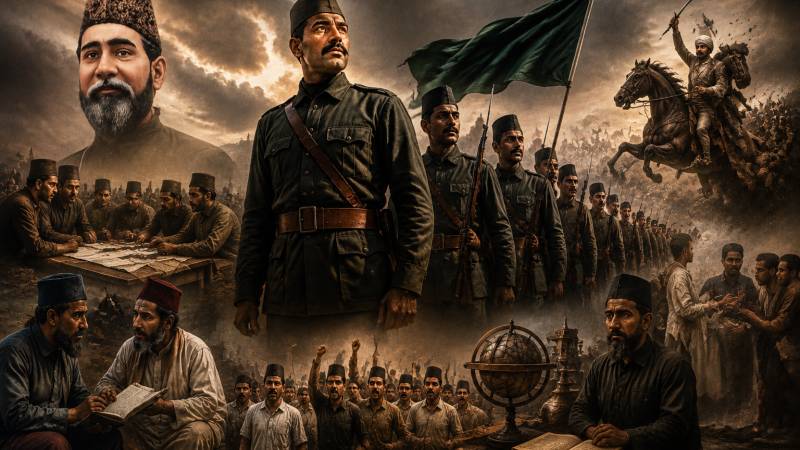
The Khaksar movement, founded by Allama Inayatullah Mashriqi in 1931, culminated in the creation of a paramilitary force. Mashriqi, a pan-Islamist scholar and a prolific writer, was heavily inspired by anti-colonialist figures. As it transpired, he had also influenced far too many revolutionaries and dictators: Adolf Hitler is said to have particularly enjoyed his writings and had even presented to him a luxurious six-seated Daimler Pullman car. Mashriqi had a brilliant academic career: he completed his Master’s degree from Punjab University and, by the age of 27, had become a college principal, passed four tripos degrees in five years during his time at Cambridge. He dedicated the rest of his life to the Education Service, serving in various capacities under the Empire. In 1930, he was denied a promotion which he considered ‘sheer act of injustice on the part of the British’ and resigned from his post. He then settled in Ichhra, a suburb of Lahore, and within a year founded the Khaksar movement and its associated weekly newspaper, al-Islah.
Khaksar literally means ‘of the earth’ (khak) and ‘like’ (sar): humble, or down to earth. In his pamphlets, Mashriqi elaborates on the underlying ethos of the movement: ‘to make the Khaksar bold and fearless, to wear down his fat soul, to strengthen his obstinate and proud self, and so to make his self the prize of the world by rendering it obedient.’ Membership was not limited by caste, religion, or creed; anyone could join, and the movement took pride in this non-exclusivist character. Spiritual upliftment was seen as the primary goal—breaking away from egotism and false sense of superiority were understood as universal failings addressed by the core teachings of all major world religions.
The rank of Janbaz was considered especially significant, reserved for those who pledged to serve the movement even at the cost of their lives.
The Khaksars had their way: leading a devotional life, imbibing an ascetic, almost Stoic spirit early on. They wore khaki dress and carried a belcha (spade), the spade symbolizing labour, and proudly wore a badge of ‘universal brotherhood.’ Drills and parades became central to the movement: Mashriqi argued that the decline of Muslims stemmed from a lack of martial spirit. This had put him in constant tension with the religious clergy, whom he regarded as unprogressive, lamenting the ‘maulvi’s dislike for the movement.’ He was influenced by a bunch of ecclectic iconoclasts: Mussolini, Ataturk, Stalin etc, and went on to blend their political ideals with his reading of Islam. Mashriqi’s emphasis on strength and domination as virtues also suggests the influence of Nietzsche, though the extent of this influence remains unknown.
In the weekly magazine al-Islah, Mashriqi laid out the movement’s primary objectives: to promote unity and affection through persuasion; to exalt the people by making them servants of God; to establish uniformity by requiring members to wear clothes of a single color; to eschew communal disputation; to collect taxes and discipline all villages under an Amir; and not to collect subscriptions. Anyone between the ages of sixteen and sixty could join. The officers were arranged in a hierarchy, with the Amir as the leader of the party and Khaksar as the lowest of the ranks. The rank of Janbaz was considered especially significant, reserved for those who pledged to serve the movement even at the cost of their lives. The oath ceremony of a Janbaz was a public occasion, celebrated by all and sundry.
The juxtaposition of devotional life against the obsession with power reveals a central tension underpinning the movement. On one hand, Mashriqi drew on Sufi teachings of solitary, ascetic life as the movement’s core. On the other, he championed martial values and domination and believed them to be instrumental to realizing a truly Islamic society. In his pamphlet, The Final Word, he wrote, ‘it is a movement for men, soldiers, and belligerents, and not for women, wives, eunuchs and boys.’
By 1938, the Khaksars had become an influential political force. They demanded that the British establish a radio station near Ichhra to disseminate Quranic teachings, and that government servants be given the discretion to join the party. The radio station request was considered but ultimately rejected. The Khaksars, in turn, rebuked the Empire through al-Islah and other publications, but the British took no action. They even managed to establish centres of learning in Egypt, Aden, and Bahrain, but the movement died out after the Partition, when Pakistan was carved out of British India, an outcome Mashriqi had long dreaded.