

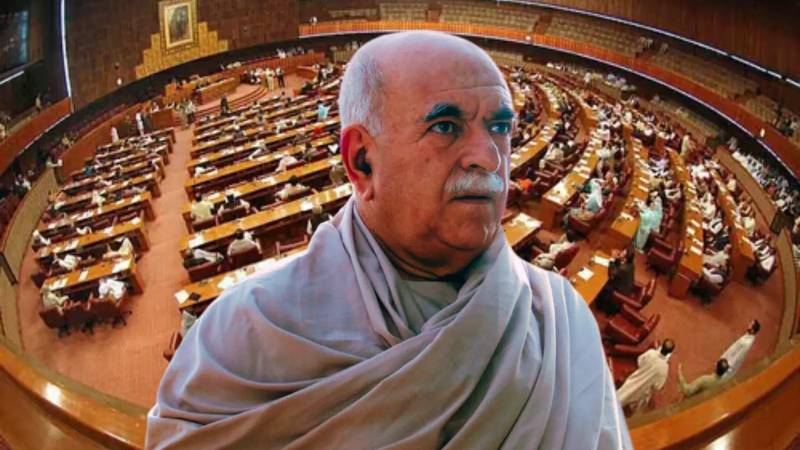
“Evil influence is like a nicotine patch; you cannot help but absorb what sticks to you.” E.A. Bucchianeri wrote these words in his novel Brushstrokes of a Gadfly. The observation resonates with Pakistan’s politics.
I was reminded of Bucchianeri’s words when Mahmood Khan Achakzai spoke to reporters at Parliament House recently. Expressing a willingness to meet “anywhere in Pakistan, even under a tree,” he said he would not enter the Prime Minister’s House, the Prime Minister’s Office or the Speaker’s House, and described the prime minister as illegitimate. He further said that any meeting with Prime Minister Shehbaz Sharif would take place only after a meeting with Imran Khan. For someone who has followed Achakzai’s political journey for three decades, this was more than routine parliamentary posturing. It marked a troubling departure from the politics that once defined much of his public life.
My engagement with Achakzai’s political thinking began in the National Assembly in 1993, when I was an undergraduate student of Political Science and History in Islamabad. He was an unusually compelling orator, with rhetorical precision, intellectual clarity and an ability to articulate the grievances of people of smaller provinces. His politics did not require me to embrace every aspect of his Pashtun nationalism. What attracted me was something broader: his commitment to parliamentary supremacy, federalism and the political rights of Pakistan’s federating units.
That is precisely why his recent position is difficult to reconcile with the Achakzai I have known as a parliamentarian. Political strategy inevitably evolves. Leaders have to respond to changing circumstances, alliances and parliamentary realities. But there is a difference between adapting political strategy and abandoning the principles that give political opposition its meaning.
Consider Achakzai’s own conduct only weeks before his latest remarks. In August, in his capacity as Leader of the Opposition in the National Assembly, he wrote formally to Prime Minister Shehbaz Sharif about the appointment of a new Chief Election Commissioner (CEC) and two members of the Election Commission of Pakistan (ECP). He invoked Articles 213(2A) and 218(2)(b), which require consultation between the prime minister and the leader of the opposition regarding ECP appointments, expressing a desire to meet and finalise the nominations.
The remedy for a disputed mandate is political and constitutional struggle, not institutional withdrawal; strengthening democratic institutions requires engagement even when political disagreements are profound.
That was the correct parliamentary approach. The issue itself is serious: the five-year terms of CEC Sikandar Sultan Raja and the ECP members Nasir Durrani and Shah Mohammad Jatoi, representing Sindh and Balochistan, respectively, expired on January 26, 2025. Although a proviso inserted through the 26th Constitutional Amendment allows them to continue until their successors are appointed, the constitutional process for replacing them has remained stalled for far too long.
By seeking consultation, Achakzai was demonstrating precisely how parliamentary opposition ought to function. He was challenging the government while simultaneously recognising the constitutional standing of the prime minister whose consultation was required to complete the appointment process. Yet, only weeks later, the same prime minister became, in Achakzai’s words, “illegitimate”, and the offices associated with him became places where the opposition leader would not sit for talks.
What changed in the interim? Shehbaz Sharif did not cease to be prime minister. The Constitution did not change. The constitutional provisions Achakzai invoked in August did not disappear. Nor did the office of Leader of the Opposition cease to require engagement with the government and other constitutional office-holders.
A political party or opposition alliance is perfectly entitled to dispute an election, challenge a government’s mandate or demand political reforms. But disputing a mandate is not the same as denying the constitutional existence of the office through which that mandate is exercised. This distinction is fundamental. Governments, parliamentary majorities, and political fortunes regularly cycle. Institutions, however, are built to endure through those transitions. If every disputed mandate makes a constitutional officeholder illegitimate, parliamentary democracy becomes little more than a struggle over who is entitled to occupy which chair.
The opposition is not expected to legitimise every government policy or accept every electoral result without question. Its constitutional role is to scrutinise, challenge, negotiate and, where necessary, mobilise public opinion against the government. None of these functions requires permanent non-engagement.
Indeed, Achakzai’s own conduct demonstrates that he understands this distinction. In August, his letter to the prime minister sought precisely the kind of constitutional consultation that his latest position appears to reject. The contradiction is therefore not between opposition and government. It is between two different approaches to the institutions of parliamentary democracy.
Achakzai became Leader of the Opposition in January 2026, a position that formally places him at the centre of parliamentary engagement with the government. His political alliance and close coordination with PTI are legitimate expressions of opposition politics. But alliances can shape political strategy without requiring a parliamentarian to surrender his own political principles.
This matters particularly in Achakzai’s case because his political stature was built over decades of defending constitutionalism, parliamentary authority and the rights of federating units. His influence has never depended merely on the number of seats held by his party. It has rested substantially on the credibility of his voice.
That credibility carries a responsibility. He can reject an electoral mandate without rejecting the constitutional institutions through which government operates. He can demand political change while still sitting across the table from those who currently hold public office. Above all, if the next election is to be free, fair and credible, the way forward lies in strengthening the Election Commission and ensuring meaningful consultation between the Prime Minister and the Leader of the Opposition, as required by the Constitution.
The remedy for a disputed mandate is political and constitutional struggle, not institutional withdrawal. If the “nicotine patch” of contemporary opposition rhetoric is beginning to alter the voice of one of Pakistan’s most distinctive parliamentarians, the question is ultimately a simple one: when political passions rise, does a statesman strengthen the institutions he spent a lifetime defending, or weaken them because he considers their current occupants illegitimate? That is the political paradox confronting Mahmood Khan Achakzai today. And how he resolves it may shape not only his present politics, but also the way history remembers his parliamentary legacy.