

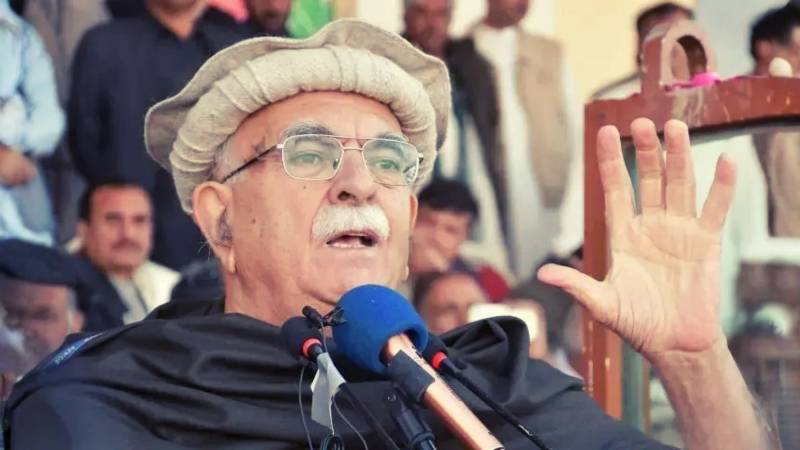
Quetta: Mahmood Khan Achakzai, Chairman of the Pashtunkhwa Milli Awami Party, Head of the Tehreek Tahafuz Aain Pakistan, and Leader of the Opposition in the National Assembly, said that the state must listen to the voice of the Pashtuns and address their legitimate constitutional, political, economic and national rights through democratic and constitutional means. “We should not be compelled to take our grievances to international forums. No state can be sustainably governed through force, nor can the political consciousness, constitutional rights and resources of its people be permanently controlled through coercion.”
He was addressing the opening session of the three-day Public Jirga of Southern Pashtunkhwa, held at the Grand Kababish Banquet Hall in Quetta under the chairmanship of Nawab Ayaz Khan Jogezai.
Mahmood Khan Achakzai said the Pashtuns were passing through an exceptionally difficult period marked by political uncertainty, economic hardship, insecurity and deprivation of their political and economic rights. The Public Jirga had therefore been convened as a representative forum where people from different walks of life and schools of thought could deliberate on their collective challenges and offer solutions through consultation and collective wisdom.
He said the jirga was an old Pashtun tradition through which collective problems had historically been addressed through consultation. The present circumstances, he added, demanded the revival of that spirit of political consciousness, mutual consultation and collective responsibility.
Referring to the history of Pakistan and the Pashtuns’ longstanding association with their homeland, he said that the prevailing political, economic and security crises could not be accepted as the permanent destiny of any nation. These conditions were the outcome of political, economic and administrative arrangements created by human beings and could therefore be changed through political struggle, sound judgment and better governance. At the same time, he acknowledged that the Pashtuns must also critically examine their own shortcomings and internal weaknesses.
Mahmood Khan Achakzai said that Pashtunkhwa was endowed with immense natural resources, minerals and strategic importance. Yet, instead of becoming a source of prosperity and development, these resources and the region’s geopolitical significance had too often become a source of hardship and insecurity for its people. He stressed that the resources and lands of local communities could not be transferred or occupied without their consent and constitutional protection.
He emphasized that the Jirga was not directed against any nation, ethnicity or religion. Pashtuns, he said, believed in equality, coexistence and respect for all human beings and rejected hatred or discrimination on the basis of race, colour, language or faith. At the same time, Pashtun land must not be used as a battleground for the wars, proxy conflicts or competing strategic interests of others.
He said Pashtun society had historically valued egalitarianism, consultation and collective responsibility. The Pashtuns had embraced Islam through their own free will and conviction, and coercion or imposition by force had never been consistent with their traditions.
Expressing grave concern over the deteriorating security situation in Southern Pashtunkhwa, he said that the lives and property of citizens were increasingly insecure. Referring particularly to the bombing of a police station in Saranan and the killing of innocent labourers, he said that such incidents required a clear determination of responsibility. The state’s foremost duty, he stressed, was to protect the lives, property and fundamental rights of its citizens; failure to discharge this responsibility would deepen insecurity, mistrust and alienation.
He further expressed concern over the allocation and transfer of lands belonging to local communities and tribes to non-local individuals, institutions and companies, saying that such matters must be addressed through constitutional safeguards, transparency and the consent of the concerned communities. Neither land nor resources could legitimately be taken through force, nor could political, civil and constitutional rights be suppressed through coercion.
Regarding relations between the Baloch and Pashtun peoples, Mahmood Khan Achakzai said that the Baloch were their brothers and that they sought a the province be governed on the principles of equality, justice, mutual respect and partnership between its constituent peoples. He added that Pashtoon are prepared to accommodated Hazara and other urban communities of Quetta in their fifty share in the province through a fair political and administrative framework based on equality and justice.
Turning to regional and international affairs, he expressed concern that Afghanistan continued to be discussed primarily as a security issue in regional forums, including the Shanghai Cooperation Organisation, without adequately incorporating the voice and genuine representation of the Afghan people. He said that attributing the region’s security and terrorism challenges solely to Afghanistan would overlook the historical context of the conflict.
He recalled that from the Cold War through the so-called War on Terror, Afghanistan and the wider region had suffered from the strategic policies, interventions, rivalries and proxy conflicts of major and regional powers. He therefore called upon the leadership of SCO member states and the Secretary-General of the United Nations to view Afghanistan not merely through the prism of security, but also as a humanitarian and political issue requiring a comprehensive regional approach.
Mahmood Khan Achakzai reiterated that the major powers and their respective proxies involved in the Cold War bore significant historical responsibility for the destruction and destabilization of Afghanistan. He said that it was now their civilizational responsibility to contribute to healing the wounds of the Afghan people and to support Afghanistan’s territorial integrity, political stability, peace and prosperity.
He reaffirmed that the people of Southern Pashtunkhwa would continue their peaceful and democratic struggle for their political, constitutional, economic and national rights. “We are not against anyone; we stand for our rights. We neither seek anyone else’s land or rights nor will we surrender our own land, resources, identity or constitutional rights.”
He said the time had come to strengthen a state order founded on the Constitution, Parliament, democracy, the people’s mandate and the principle of national equality rather than force and coercion. Sustainable peace, political stability and economic development, he maintained, could only be achieved by respecting the fundamental rights and democratic aspirations of the people.
Mahmood Khan Achakzai also expressed deep sorrow over the tragic incident at PIMS Islamabad and demanded a transparent, impartial and comprehensive investigation to establish the facts, identify those responsible and ensure that appropriate legal action was taken in accordance with law.
He further expressed solidarity with and sympathy for the people affected by the devastating floods in Nepal and Tibet and conveyed his heartfelt condolences to the victims and their bereaved families.