

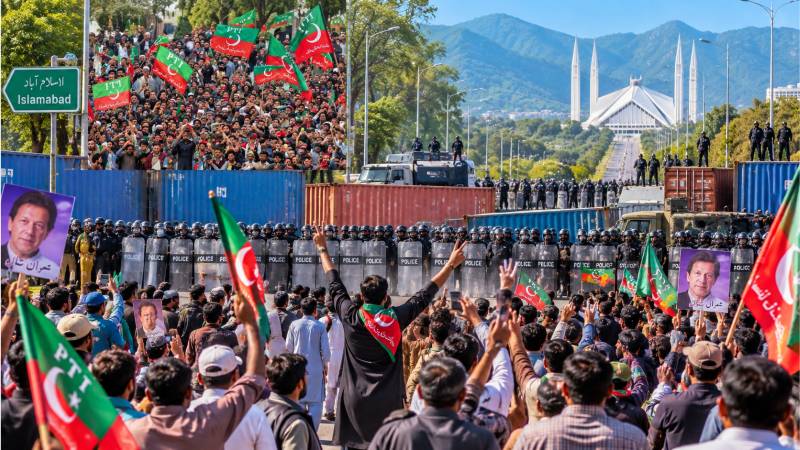
On September 27, the Pakistan Tehreek-e-Insaf (PTI) plans to march toward Islamabad, led by Khyber Pakhtunkhwa Chief Minister Sohail Afridi. PTI frames the protest as a struggle for Imran Khan’s release, constitutional rights, and political justice. Meanwhile, the federal government maintains that it will not allow the march to reach the capital, with Interior Minister Mohsin Naqvi warning PTI against entering a “dead-end street.” Both sides are right, it is a dead-end street. The fundamental problem is that both PTI and the establishment are trapped in it. September 27 is significant not because of how many people reach the capital or how many are stopped, but because it may demonstrate, once again, that neither side possesses an exit strategy.
Consider what has happened since 2023. Following the events of May 9, state crackdowns placed PTI under severe political and organizational pressure. Thousands were arrested and numerous cases were registered. Yet Imran Khan’s political influence has not disappeared. A similar attempt to reach Islamabad occurred on November 26, 2024. Despite blocked roads, heavy security, violent clashes, and casualties on both sides, the protest was eventually dispersed—leaving the political deadlock largely unchanged. That is the pattern. The state can win the day on the street, but it cannot settle the political argument. Conversely, PTI can survive a crackdown, but it cannot overturn the political order through street power alone.
Today, the systemic deadlock is sharper than ever. For PTI, politics without Imran Khan remains non-viable. The party retains governance in Khyber Pakhtunkhwa, a massive voting base demonstrated in the 2024 general election despite its candidates contesting as independents without the party’s electoral symbol, and a persistent leader-voter bond. But street power alone cannot reverse court orders or alter the broader political arrangement.
Pakistan does not need another demonstration of who can bring more people or who has more tear-gas shells. It needs a political off-ramp before the next confrontation turns into another march toward bloodshed.
For the establishment under Chief of Army Staff General Asim Munir, containing Khan politically has been possible, but eliminating his political influence has proved far more difficult. Administrative control can manage political space; it cannot by itself resolve the deeper questions of institutional trust, electoral legitimacy, and political representation. This dead end is dangerous for two additional reasons: federal stability and economic pressure.
First, this confrontation is no longer merely a political party competing against a ruling coalition. It involves a federating unit led by an elected chief minister directly confronting the federal government. That changes the stakes. Khyber Pakhtunkhwa is simultaneously facing a resurgence of terrorism and local insecurity. A permanent political war between the provincial leadership and the federal government risks diverting attention from security operations, weakening coordination, and leaving citizens to bear the consequences.
Second, ordinary Pakistanis are already under severe economic pressure. Headline inflation may have moderated, but lower inflation does not mean lower prices. The accumulated cost of food, transport, electricity, and fuel continues to weigh heavily on households. Petroleum prices and transport costs have an especially direct impact on daily life. When economic insecurity combines with political exclusion, unemployment, institutional distrust and repeated scenes of confrontation between citizens and the state, public frustration can quickly acquire a political and even confrontational character. This is where September 27 becomes more dangerous than another ordinary political demonstration. The greatest risk is not simply that PTI supporters and security forces clash. It is that another political dispute is converted into a confrontation between citizens and the state—and that every confrontation produces another cycle of arrests, resentment, retaliation and deeper distrust.
A street clash on September 27 will resolve nothing. PTI casualties will not force the federal government to fall, new arrests will not secure Imran Khan’s release, and blocking roads will not alter parliamentary majorities. On the other side, stopping the march will not eliminate PTI’s voter base, and securing the Red Zone will not restore public trust in elections. Force can stop a march, but it cannot end a political movement. A march can defy force, but it cannot become the state.
A viable exit strategy requires both sides to accept unpalatable realities. The establishment must accept that PTI cannot simply be governed out of existence. Its electoral base, provincial government, and leader remain permanent features of Pakistan’s political landscape. PTI, meanwhile, must accept that state institutions will not yield to street pressure alone; the path to political normalization and legal relief cannot be carved out through physical clashes on the Srinagar Highway.
There is another reality that both sides must confront: Pakistan cannot afford an endless political war while its economy remains fragile, its federation under strain, and its security environment deteriorating. Every confrontation consumes political capital that the country needs for governance. Every shutdown imposes a cost on people who have little influence over the political conflict. Every new arrest may close one political door while opening another.
If September 27 produces another confrontation, September 28 may look remarkably familiar: more cases, more bitterness, more accusations, more distrust and the same political question still standing. Whoever controls the road may win the confrontation of the day. Neither side, however, will have solved the crisis. Pakistan does not need another demonstration of who can bring more people or who has more tear-gas shells. It needs a political off-ramp before the next confrontation turns into another march toward bloodshed.