

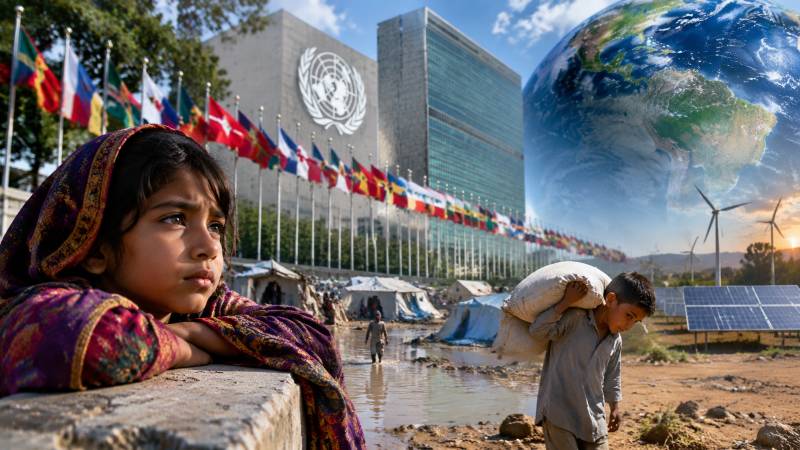
The world has never witnessed such an extraordinary concentration of international diplomacy as it does today. From the United Nations General Assembly and G20 to G7, BRICS, NATO and COP climate conferences, political leaders, economic powers and military alliances repeatedly assemble to negotiate the future of international relations. From Donald Trump, Xi Jinping and Vladimir Putin to António Guterres and European leaders, the world's political establishment remains preoccupied with strategic influence, nuclear deterrence, economic competition, energy security, artificial intelligence and territorial disputes. The historic Yalta Conference of February 1945, attended by Winston Churchill, Franklin D. Roosevelt and Joseph Stalin, symbolised the redistribution of global power after the Second World War. Eight decades later, the international landscape is again experiencing a profound transformation, with the United States, China and Russia representing competing yet interconnected centres of influence. However, amid this diplomatic activity, one fundamental question remains disturbingly neglected: where is humanity in the global agenda, and who is negotiating the future of civilisation?
The United Nations, established on 24 October 1945 after the signing of its Charter in San Francisco on 26 June 1945, was founded by 51 countries with the ambition of preventing another world war and promoting international cooperation. Today, it has 193 member states, yet its Security Council retains a structure reflecting the geopolitical realities of 1945, with five permanent members, China, France, Russia, the United Kingdom and the United States, holding veto powers. This institutional imbalance raises questions about representation, accountability and the ability of the international system to protect the interests of smaller nations. While major powers negotiate strategic arrangements, ordinary people remain concerned with much more fundamental questions: access to food, clean water, healthcare, education, employment, security and human dignity. A displaced family in Ukraine, a child in Gaza, a farmer in drought-stricken Africa or a vulnerable community in South Asia does not measure peace through military alliances or diplomatic declarations. For them, peace means survival, opportunity and freedom from fear.
The contradiction between extraordinary human progress and persistent inequality is perhaps the defining paradox of our century. Medical science, space exploration, biotechnology, robotics and artificial intelligence have expanded the boundaries of human knowledge, yet millions continue to experience hunger, poverty, illiteracy and inadequate healthcare. On 25 September 2015, world leaders adopted the United Nations Sustainable Development Goals, comprising 17 objectives intended to achieve a more equitable and sustainable world by 2030. These included eliminating poverty and hunger, ensuring quality education, achieving gender equality, providing clean water and promoting decent employment. More than a decade later, the distance between these commitments and the lived realities of vulnerable populations remains a serious challenge. Civilisation cannot be measured exclusively by GDP, military expenditure, billionaires or technological supremacy; its real character is also reflected in how societies treat their poorest and most vulnerable citizens.
Climate change represents an even greater challenge because it recognises neither national boundaries nor geopolitical alliances. On 12 December 2015, the Paris Agreement established an international framework to limit global warming, with the ambition of keeping the temperature rise well below 2°C and pursuing efforts towards 1.5°C above pre-industrial levels. Yet the World Meteorological Organization confirmed on 10 January 2025 that 2024 was the warmest year in the 175-year observational record, with global average temperatures approximately 1.55°C above the pre-industrial baseline. Although one exceptional year does not mean that the Paris Agreement's long-term temperature threshold has been permanently breached, the warning is unmistakable. Pakistan experienced this vulnerability dramatically during the floods of June to August 2022, when approximately 33 million people were affected, more than 1,700 lost their lives and nearly eight million were displaced. The joint Post-Disaster Needs Assessment, released on 28 October 2022 with the participation of the Government of Pakistan, World Bank, Asian Development Bank, European Union and United Nations agencies, estimated damages exceeding US$14.9 billion, economic losses of approximately US$15.2 billion and reconstruction requirements of at least US$16.3 billion. These figures demonstrate that climate insecurity is not merely an environmental concern; it is a direct threat to national economies, livelihoods, infrastructure and human survival.
The ultimate measure of a New World Order should not be who controls the world, but whether the world becomes a safer, fairer and more dignified place for humanity. The world has enough leaders negotiating the future of power; what it desperately needs is leadership committed to the future of humanity.
Meanwhile, the technological revolution is creating another defining question for humanity. Artificial intelligence, quantum computing, automation and biotechnology promise unprecedented improvements in medicine, agriculture, education and industrial productivity, but also raise concerns about unemployment, privacy, surveillance, cyberwarfare and the concentration of technological power. The international competition between Washington and Beijing is increasingly shaped by semiconductor production, digital infrastructure, advanced manufacturing and control over emerging technologies. However, the future of artificial intelligence cannot be determined exclusively by governments, investors and multinational corporations. Its benefits must reach ordinary citizens, developing countries and future generations. Technology should expand human capability rather than deepen inequality or diminish human dignity.
The humanitarian consequences of contemporary conflicts further expose the limitations of international diplomacy. Ukraine, Gaza, Sudan and Yemen illustrate how geopolitical rivalries and armed confrontations can devastate civilian populations across generations. International humanitarian law, including the Geneva Conventions of 12 August 1949, provides a framework for protecting civilians, prisoners of war and vulnerable populations during armed conflict. Yet the consistent implementation of these principles remains an enduring international challenge. Similarly, water scarcity, food insecurity, population displacement and environmental degradation demand collective responses beyond traditional military and economic calculations. The world must recognise that a nation's security is inseparable from the security of its people, natural resources and social institutions.
For Pakistan, the changing global order presents an opportunity to redefine national priorities. Its geographical position connecting South Asia, Central Asia, China and the Middle East, together with CPEC, Gwadar Port and its expanding transport infrastructure, offers considerable potential for regional economic integration. However, strategic partnerships with China, the United States, Russia, Europe and Gulf countries must ultimately translate into industrial development, employment, education, healthcare, water security and technological advancement. National progress should not be judged merely by highways, ports and investment agreements, but by the prosperity and opportunities they create for citizens. Pakistan's experience also demonstrates why climate-resilient infrastructure, sustainable agriculture, effective water management and environmental protection must become central components of development planning.
The world therefore needs a new international agenda in which human dignity, peace, climate justice, education, responsible technology, food and water security and economic equality receive the same importance as national security and strategic competition. The United Nations must evolve beyond the limitations of its post-war institutional structure, while international forums must translate declarations into measurable commitments, adequate financing and transparent implementation. Ultimately, the twenty-first century should not become another contest over which country dominates the world or which geopolitical bloc controls its future. Its greatest achievement would be a civilisation capable of combining scientific progress with moral responsibility, economic prosperity with social justice, and political power with compassion.
World leaders may continue meeting in Washington, Beijing, Moscow, Geneva, New York and other international capitals, negotiating the distribution of influence and the architecture of global power. Yet beyond those conference rooms, a farmer waits for rain, a child waits for a school, a patient waits for treatment, a displaced family waits to return home and an entire generation waits for a future free from fear and uncertainty. These are not peripheral concerns; they are the very substance of international peace and development. Perhaps humanity needs a different kind of summit, not to determine who will lead the world, but to decide how the world will protect its people and preserve civilisation. The ultimate measure of a New World Order should not be who controls the world, but whether the world becomes a safer, fairer and more dignified place for humanity. The world has enough leaders negotiating the future of power; what it desperately needs is leadership committed to the future of humanity.