

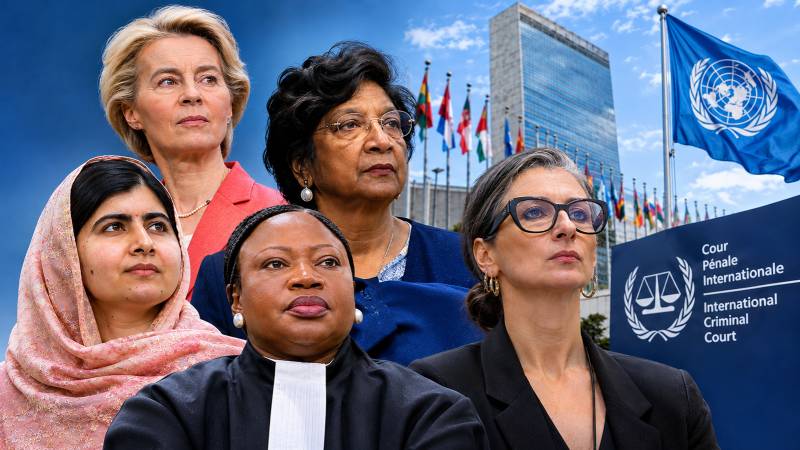
The importance of gender in the study of international politics emerged within the discipline of International Relations (IR) in the late 1980s and early 1990s, highlighting the importance of and need for women's participation in international politics. There has been a considerable increase in the number of women world leaders, including heads of state, heads of government and leaders of international institutions, such as European Commission President Ursula von der Leyen. However, according to data from the Inter-Parliamentary Union and the United Nations, the global share of women in parliaments has increased only gradually in recent years, rising from around 25 per cent in 2020 to 27 per cent in 2026.
Several countries, including Sweden, Canada, France, Mexico, Spain, Germany, Luxembourg, Chile, the Netherlands, Colombia, Libya, Liberia and Slovenia, have officially embraced Feminist Foreign Policy. Pakistan has been represented in international politics by capable women diplomats serving in various official capacities, including Sherry Rehman, Amna Baloch, Hina Rabbani Khar, Begum Ra'ana Liaquat Ali Khan, Begum Shaista Ikramullah, Tehmina Janjua, Maleeha Lodhi, Saima Saleem, Mumtaz Zahra Baloch, Tasnim Aslam and Naela Chohan. Unfortunately, Pakistan has yet to officially embrace a feminist foreign policy.
Highlighting the importance of women's participation at the level of representation, United Nations resolutions emphasise the need to increase women's representation in diplomacy, foreign policy and science. The United Nations Security Council adopted Resolution 1325, urging all actors to increase the participation of women and incorporate gender perspectives into all United Nations peace and security efforts. The United Nations General Assembly adopted Resolution A/RES/76/269, officially proclaiming 24 June of each year as the International Day of Women in Diplomacy. Women's equal participation and leadership in political and public life are essential to achieving the Sustainable Development Goals by 2030.
The gender perspective has also changed the discourse of international criminal law. In the aftermath of the Second World War, the Nuremberg Trials and Tokyo Trials largely ignored the question of gender. However, the International Criminal Tribunal for the former Yugoslavia (ICTY) and the International Criminal Tribunal for Rwanda (ICTR) subsequently prosecuted rape and other forms of sexual violence against women as war crimes, crimes against humanity and components of genocide. Thereafter, the Rome Statute of the International Criminal Court recognised rape, sexual slavery, enforced prostitution, forced pregnancy, enforced sterilisation and other forms of sexual violence of comparable gravity as international crimes.
The ongoing conflict in Darfur has witnessed mass rape of women, with rape being used as an instrument of war and genocide. This has not only attracted the attention of the international community but has also drawn condemnation from international legal institutions. Former Sudanese President Omar al-Bashir was the first sitting president to be sought by the International Criminal Court and the first person to be charged by the court with the crime of genocide. Sudan is not a State Party to the Rome Statute. However, since the United Nations Security Council referred the situation in Darfur to the International Criminal Court through Resolution 1593 on 31 March 2005, the Court may exercise its jurisdiction over crimes listed in the Rome Statute committed in Darfur, Sudan, from 1 July 2002 onwards.
The actions of women like Navi Pillay, Fatou Bensouda, Francesca Albanese and Malala Yousafzai demonstrate how women are influencing international law and challenging established power structures in global politics.
However, the discourse has now evolved to focus increasingly on the role of women as decision-makers. This change can be seen in the emergence of many powerful women in international politics and international law who have not only changed the course of history but have also challenged the imperialistic hegemony of powerful actors.
History was made when Rosalyn Cohen Higgins became the first woman judge of the International Court of Justice, serving from 1995 to 2009.
In 2026, Navi Pillay, a former International Criminal Court judge who oversaw a United Nations report that concluded Israel had committed genocide in Gaza, won the Nobel Peace Prize. However, just a few hours later, the President of the United States imposed sanctions on the International Criminal Court.
In 2020, the administration of United States President Donald Trump sanctioned Fatou Bensouda, the chief prosecutor of the International Criminal Court, over her investigation into whether US forces had committed war crimes in Afghanistan. In 2021, the administration of President Joe Biden lifted these sanctions.
In February 2026, the family of United Nations human rights rapporteur Francesca Albanese sued the administration of United States President Donald Trump over sanctions imposed on her the previous year. They argued that the sanctions were an attempt to punish her for bringing the human rights abuses committed by Israel against Palestinians into the limelight.
In 2025, Pakistani Nobel Peace Prize winner Malala Yousafzai urged Muslim leaders to support efforts to make gender apartheid a crime under international law in response to the atrocities faced by women in Afghanistan under Taliban rule.
In October 2026, the International Criminal Court unsealed arrest warrants for two Afghan Taliban education ministers accused of committing crimes against humanity through the Taliban government's restrictions on women and girls.
There is now a growing demand for the next United Nations Secretary-General to be a woman. This demand is being supported by various world leaders, as well as the current United Nations Secretary-General, António Guterres, whose term will conclude on 31 December 2026.
The discourse on gender in international criminal law and international relations has moved beyond focusing solely on violence committed against women and now increasingly examines the participation and role of women in shaping international criminal law and politics. The actions of women such as Navi Pillay, Fatou Bensouda, Francesca Albanese and Malala Yousafzai have not only influenced international politics but have also contributed significantly to the development of international criminal law. The very fact that the United States has imposed sanctions on some of these figures demonstrates that they are challenging and changing the narratives promoted by imperialistic and hegemonic actors in international politics.