

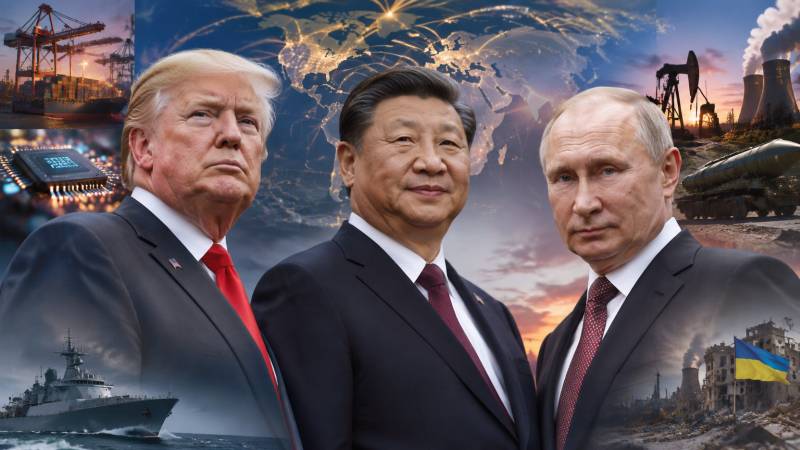
The trilateral meeting held in China on the sidelines of the APEC Summit has significant implications for global politics during these crucial times. Washington views the event as an opportunity to end the wars in Europe and West Asia, resolve the conflict in East Asia involving Pyongyang and Moscow, gain access to Chinese rare earth metals, and end the technological war between the major powers. It also presents an opportunity for Trump to restore his image as an influential global political leader. Meanwhile, Beijing views the meeting as an opportunity to project its power as a major global force with considerable influence over conflicts affecting global energy corridors, secure an end to US restrictions on advanced chips, and establish its technological edge over Western rivals. Putin, on the other hand, seeks to achieve Russia's objectives through a settlement with the US that would halt NATO's eastward expansion in Europe and secure the transfer of Donbas to Russia in exchange for ending the war in Ukraine.
The trilateral meeting scheduled for 19 November 2026 in Shenzhen, China, could become a new Yalta as the major powers seek to divide the world into their respective spheres of influence. The wars in Ukraine and Iran will play a key role in this division. Beijing is one of the world's major manufacturing hubs and controls significant global supply chains, while Washington maintains control over major energy choke points in West Asia. The conflicts in the South China Sea (SCS), China's national rejuvenation programme, which includes the reunification of territories it considers lost, particularly Taiwan, tensions on the Korean Peninsula, the Russia-Japan dispute over the Kuril Islands, and Beijing's conflict with India make this meeting particularly important. Prior to the meeting, President Trump held talks with his QUAD partners, India, Australia and Japan, in Manila on 17 November 2026. This engagement marked his commitment to regional allies and sought to reassure them of US policies aimed at protecting them from threats, including those posed by China and North Korea.
The trilateral meeting has been dubbed Yalta 2.0, drawing parallels with the Yalta Conference of 1945, which determined the future of the world at the end of the Second World War, when the two superpowers, the USSR and the US, divided the world into their respective spheres of influence. Hostility between these two superpowers over global dominance shaped international politics until 1991, when the Soviet Union disintegrated, resulting in the emergence of the US as the world's sole superpower. American influence remained dominant until the beginning of the Iran War, although signs of its declining strength had already become visible at the turn of the new millennium. This period witnessed the emergence of a multipolar world in which new actors, including China and Russia, became potential competitors.
The growth of regional economic partnerships, such as ASEAN and the European Union, coincided with a shift in US focus towards West Asia, including Afghanistan, where American forces remained engaged in a two-decade-long war against the Taliban until 2021. During this period, Washington's influence in the Asia-Pacific region declined as ASEAN developed a strategic partnership with China, Pakistan became a major economic partner in China's Belt and Road Initiative (BRI), and China's strategic partnerships with Russia and Iran further strengthened. Meanwhile, Beijing's strategic ally, North Korea, became a nuclear power in 2006, emerging as a potential threat to US allies South Korea and Japan. Despite repeated US assurances to its regional allies, Chinese influence continued to grow as Beijing emerged as the leading economic partner of several regional states and established considerable influence over North Korea, Russia, Iran and Pakistan.
Beijing's growing economic influence, control over critical rare earth minerals, military modernisation and strategic partnerships with Russia, Iran and North Korea have positioned China as a formidable challenger to American global dominance.
Beijing's continued economic assertiveness, reflected in its economic policies and flagship Belt and Road Initiative (BRI), which connects more than 50 countries, as well as its control over rare earth metals, military modernisation and claims over territories it considers lost, including the reunification of Taiwan with the mainland, have further strengthened its regional authority and strategic position. Its military and strategic partnerships with powerful regional states make China an increasingly formidable force in any potential conflict involving US partners in the region. China's technological superiority has been demonstrated in both the Iran War of 2026 and the Indo-Pakistan War of 2025, during which Pakistan used Chinese-made J-10C fighter jets and PL-15 missiles to shoot down Western-made Rafale jets. Even China's BeiDou satellite navigation system has emerged as a major contributor to its advancements in modern warfare technology.
Beijing's strategic partnerships with Russia and Iran are considered a major threat to US influence in global politics. Russia had expressed concerns over NATO's eastward expansion during the 1990s and 2000s and eventually decided to halt it through its invasion of Ukraine in 2022. This pushed the US and its European Union partners towards confronting a new security threat, resulting in a major war on Russia's eastern borders. Meanwhile, Tehran poses a different kind of threat, as it seeks to dictate its own terms in West Asia, end the US presence in the region and establish a mechanism to regulate traffic through the Strait of Hormuz to generate revenue. Iran's allied groups, collectively known as the Axis of Resistance (Hamas, Hezbollah and Ansarallah), continue to challenge US allies, including Israel and its Gulf partners in West Asia. The US and its allies need to halt their attacks on the energy and military infrastructure of the Gulf states. In both conflicts, Beijing's leverage continues to strengthen and expand as its strategic partners force US forces on the battlefield to reconsider their positions in the face of the economic and political costs of war. The political costs of Trump's party losing the US midterm elections in November, as well as the defeat of his ally Netanyahu in Israel's Knesset elections in October, demonstrate the wider political implications of these wars for the US and its allies.
During these turbulent times, when the West faces the threat of military attacks from Russia and Iran, cyberattacks on critical Western infrastructure, ranging from economic centres to basic healthcare and educational facilities, and political setbacks for those advocating continued warfare, the trilateral meeting assumes particular significance. The meeting between Putin, Trump and Xi could help the Western world ease tensions with China and address the threats facing the global community.
The meeting could witness a historic arrangement aimed at ending the wars in West Asia and Europe, as the three major powers, the US, China and Russia, seek to reshape the global political order. Such an arrangement could establish peace in the South China Sea (SCS), the Korean Peninsula and Europe, particularly on the Ukrainian front, while also providing the US with an off-ramp from its war with Iran. Russia is also expected to propose the Arctic shipping route as a potential alternative for global trade, allowing shipping to bypass the Malacca Strait, reduce travel distances and minimise security threats, including piracy, along global shipping routes.
The global semiconductor industry and the race for artificial intelligence (AI) supremacy will play a significant role in shaping the dialogue between China and the US, particularly as Washington has imposed restrictions on advanced chips supplied to China. These restrictions could be eased as part of an effort to end hostilities with Beijing and secure its support in resolving the Korean issue, given China's considerable influence over North Korean leader Kim Jong Un. The outcome of the trilateral meeting could determine the future direction of the global order, either through peaceful diplomatic arrangements or through further violent wars of aggression.