

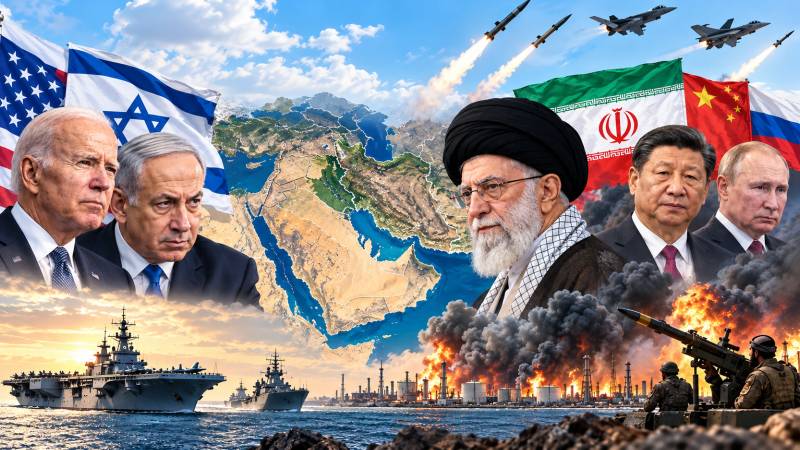
On the balance of probability, the next round of war looks inevitable. To see why, let us first consider the two possibilities: that the US–Israel duo chooses not to attack Iran, and that it does.
The first option would mean that the Straits of Hormuz and Bab el-Mandeb remain under the control of Iran and Ansar Allah (Houthis) for the foreseeable future. The US is pushed out of the Gulf once and for all. Iran is established as a regional hegemon, dictating terms to the rest of the Gulf, with its reach extending to the borders of Israel. All of Yemen comes under Ansar Allah's control, including the three provinces Saudi Arabia captured in 1934. This would mean the end of the petrodollar and of the Greater Israel project, and a total collapse of the American economy, turning the American dream into a nightmare. Anyone likes to think, US-led Middle East would choose this?
The second option means a massive air attack on Iran, and the possibility of sending ground troops to protect Kuwait and the UAE from a possible Iranian invasion, if not into the Iranian mainland itself. Once the US–Israel air campaign begins, one should not rule out the possibility of Iranian ground forces entering the UAE and Kuwait, as is also being discussed in some quarters. An attack on Iran's critical infrastructure would invite the same on Saudi, Emirati and Israeli infrastructure, along with massive attacks on major cities. A study conducted by an American professor Steven Starr reveals that 400–500 Iranian missiles would level Tel Aviv. Another 150–200 would do the same to Haifa. This would prompt an Israeli nuclear strike on Iran.
Now flip the situation. In Israel's calculations, Iran's devastating response can be avoided only by launching nuclear strikes on major Iranian cities and other military targets – some estimates suggest 12–16 such targets. In other words, both sides have their calculations on the table, along with reasons to strike first, which makes a pre-emptive strike the more probable course. Iran has made this very clear: if it sees a significant military build-up, it will not wait.
Chances of a China-led mediation? Extremely low. Oil and gas from Saudi and Emirati sources and their consumer markets might be important for the Chinese economy, but persuading Iran and Yemen to accept the demands of the US–Israel camp and the Gulf sheikhdoms would serve no Chinese interest. Meanwhile, China's oil and gas needs will be met by Iranian and Russian sources. Russia might not even be interested in playing an active diplomatic role in the Gulf – would the Americans and Israelis want it to? – as it is engaged in Europe, and the burning of Middle Eastern oil infrastructure would open doors for Russian oil and gas. And Pakistan, after the Mecca defence agreement, has lost its aura of neutrality in the region, so that option is off the table. So, what are we actually looking at? A politically and geographically redesigned Middle East, or a totally destroyed one? One of the two will inevitably happen, of which the latter looks more probable on balance. However, it may not begin in the Gulf itself.
Instead of consolidating our own fortress, we have chosen to step into the theatre of war itself, which could by all means be avoided.
The situation in Europe is deteriorating fast as Germany and Britain are getting embroiled in the war in Ukraine. Western media are rife with talk of an imminent Russian strike on any NATO country if things do not cool down soon – which looks unlikely. Of late, Germany has begun posturing more aggressively, as the recent surprise visit of the German chancellor, Friedrich Merz, to Kyiv on 4 October suggests. Three weeks ago, the head of Britain's Royal Navy, First Sea Lord General Sir Gwyn Jenkins, insisted on enhanced maritime capabilities: "The reason why we need this is simple: the greatest threat to our security today is Russia. That threat is felt most acutely in the maritime domain in the North Atlantic, in the High North." Today, 12 October, the British prime minister, Andy Burnham, blamed Russia for meddling in the result of the Brexit referendum. This kind of rhetoric brings two European nuclear powers – Britain and France – face to face with Russia, which many defence analysts believe could lead to a nuclear catastrophe. There is little doubt that Europe is facing its worst scenario since the end of the Second World War in 1945, and there seems to be no decent exit from it.
Beyond these calculations based on ground realities, when we begin to unravel why the US, Middle Eastern or European leaders would embroil themselves in a situation like this, data-based speculation enters the realm of a history-based theoretical framework, which some might label conspiracy theory. I would simply put it in the form of questions. Why couldn't strong trade relations between Germany, Britain, France and Russia prevent the First and Second World Wars? Why did the US enter the Second World War after going through a decade-long economic depression, from 1929 to 1939? If that is so, why would the same forces care about the US economy and the petrodollar today? Who benefited from the two great wars of Europe? When the First World War brought an end to the Russian and Ottoman empires, what came next? The Balfour Declaration of 1917! When the Second World War dismantled the British and French empires, what came afterwards? A world order based on the global financial system! Who controlled it? So, if history is repeated a third time, what happens? Who will benefit? Who will survive?
That is where it gets murky. If we allow ourselves to believe in this pattern of history, it becomes too imaginative to sound real, and many might ask whether invisible forces redesign the world map, and its system, every 80 to 100 years. However that may be, my immediate worry is this: while the situation, which is unfolding by the minute, inch by inch, might erupt into a massive fireball, we in Pakistan are grappling with frivolous matters and a frightfully bad economic situation. Instead of consolidating our own fortress, we have chosen to step into the theatre of war itself, which could by all means be avoided.