

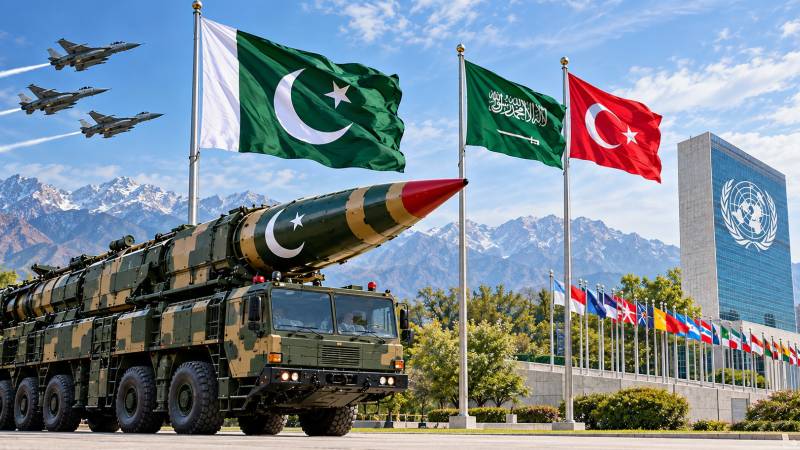
The post-1945 international order is not disappearing in one spectacular collapse. It is being hollowed out, crisis by crisis. Its institutions and treaties remain, and diplomats still speak the language of rules, sovereignty, and international law. Yet the political assumptions behind those rules are eroding. The wars in Ukraine and the Middle East, the return of great-power competition, proxy warfare, and the rapid militarisation of drones, artificial intelligence, cyber capabilities, and precision weapons have produced a world in which military power once again shapes the boundaries within which law operates. Nowhere is this more consequential than in the nuclear realm.
The nine nuclear-armed states do not share a common doctrine. China and India maintain declared no-first-use policies. The United States and Britain retain deliberate ambiguity. Russia’s revised doctrine has expanded the circumstances in which nuclear employment may be contemplated. France leaves the precise boundaries of its vital interests undefined. North Korea regards nuclear weapons as central to regime survival. Israel maintains nuclear opacity. Pakistan has never adopted no-first-use. SIPRI’s 2026 assessment found that all nine nuclear-armed states continued modernising their arsenals while the role of nuclear weapons in national security strategies was growing. The world’s nuclear order is not becoming simpler. It is becoming more fragmented.
Pakistan’s position must be understood in that reality rather than judged against an idealised model of nuclear behaviour. As the smaller nuclear power confronting a much larger conventional military neighbour, Islamabad has refused to renounce first use to prevent conventional superiority from inviting large-scale war. That calculation was tested dramatically in May 2025.
Following the April 22 false-flag Pahalgam attack, India launched strikes against targets inside Pakistan on May 7. Pakistan responded, and within days the confrontation escalated into intense air, missile, drone, and artillery exchanges before a ceasefire on May 10. What surprised outside observers was not that Pakistan responded, but how it responded. India possessed the larger defence budget, greater overall resources, and advanced Western-origin platforms. Pakistan nevertheless integrated combat aircraft, air-to-air missiles, air defence, drones, electronic warfare, and precision-strike capabilities into a coherent multi-domain response.
The precise number of Indian aircraft lost remains contested. Pakistan claimed several; India did not accept the tally. Yet US officials told Reuters that Pakistani J-10 aircraft had shot down at least two Indian aircraft, including at least one Rafale. India subsequently acknowledged losses without giving a number and admitted that tactics were changed after the initial phase. That was the strategic surprise. Pakistan had demonstrated an ability to contest the battlespace across multiple domains and impose costs on an adversary that entered the confrontation with considerable numerical and procurement advantages.
Platform superiority is not the same as operational superiority. Sensors, data links, command-and-control, electronic warfare, missile technology, training, doctrine, and the ability to integrate them under combat conditions can dramatically alter the balance. The May conflict therefore became an inadvertent advertisement for the maturity of Pakistan’s military relationship with China. Chinese-origin systems faced their most consequential combat test yet against sophisticated Western-designed aircraft, offering a rare real-world data point in the contest between Western and Chinese military technologies. Pakistan had become part of a much larger strategic story.
Nuclear deterrence is about preventing the war, not winning every conventional engagement. Islamabad’s nuclear capability exists to prevent an adversary from believing it can safely convert conventional superiority into decisive political coercion. The paradox of deterrence is that a credible nuclear capability can constrain conventional war precisely because both sides understand what lies beyond the conventional threshold. May 2025 illustrated the point. Two nuclear powers fought a serious conventional confrontation, yet neither crossed the nuclear threshold. Deterrence did not prevent violence; it helped define the ceiling beyond which violence became too dangerous.
Platform superiority is not the same as operational superiority. Sensors, data links, command-and-control, electronic warfare, missile technology, training, doctrine, and the ability to integrate them under combat conditions can dramatically alter the balance.
This distinction is frequently lost in Western discussions of Pakistan’s nuclear posture. A doctrine designed to deter existential conventional pressure is not automatically a doctrine designed to initiate nuclear war. Similar logic operates across the nuclear world: Russia has used nuclear signalling over Ukraine; North Korea links nuclear weapons to state survival; Israel’s opacity conceals its ultimate red lines; Washington, London, and France preserve strategic ambiguity. China remains different and increasingly important. Beijing continues to reaffirm an unconditional no-first-use policy even as its strategic capabilities expand, and its economic, technological, and diplomatic weight transforms the international balance. The China-Pakistan relationship therefore cannot be reduced to a bilateral defence partnership. It sits inside the larger movement of strategic gravity toward Asia.
That movement is now visible beyond Pakistan’s eastern frontier. On August 7, 2026, Saudi Arabia, Türkiye, and Pakistan signed the Makkah Joint Defence Agreement, declaring that an armed attack against any one of the three would be regarded as an attack against all three and committing them to deeper defence cooperation and collective deterrence. The three governments presented the arrangement as defensive and aimed at regional peace and stability. Its significance lies not in creating another military bloc, but in three strategically important Muslim-majority states seeking greater regional security capacity rather than assuming external powers will always provide it. Pakistan’s presence at the centre of that arrangement is not incidental.
Saudi Arabia brings economic weight, strategic geography, and regional influence. Türkiye brings a sophisticated, increasingly independent defence-industrial base, a major conventional military, and NATO experience. Pakistan brings a nuclear deterrent, decades of military cooperation with Saudi Arabia, extensive counterterrorism experience, and one of the world’s longest records of sustained participation in demanding military operations and UN peacekeeping. Its military relationship with Saudi Arabia dates to the 1960s and includes the training of thousands of Saudi personnel and decades of bilateral exercises. The Makkah agreement formalises an existing strategic relationship rather than creating one from scratch.
The nuclear dimension matters because collective deterrence ultimately depends on credibility. Pakistan’s nuclear status does not mean nuclear weapons are automatically part of every contingency under the agreement. Saudi Arabia has explicitly framed the arrangement as defensive and not a nuclear alliance. Yet the existence of a nuclear-armed member changes the strategic calculus. An aggressor must consider not merely the conventional capabilities of three states but the possibility that an attack could trigger a much broader strategic crisis. That is deterrence without nuclear employment, and that may be its most important function.
The deeper story is not Pakistan alone. It is the transition from a Western-dominated post-war system toward a more contested and plural international order. China stands at the centre of that transformation. The expanding influence of BRICS and the growing assertiveness of states across Asia, Africa, the Middle East, and Latin America show that the Global South is increasingly unwilling to accept a hierarchy in which strategic legitimacy is defined principally in Washington, London, Paris, or Brussels. China does not command this emerging world, nor do Global South states share identical interests. But the centre of gravity is unmistakably moving.
Pakistan occupies an unusually consequential position within that transition: nuclear power, major military actor, Chinese strategic partner, South Asian state, Indian Ocean country, and now a principal pillar of a trilateral security framework linking South Asia with the Gulf and Türkiye. That is a much larger strategic footprint than Pakistan possessed a decade ago. It also carries responsibilities. Pakistan must continue to demonstrate stringent nuclear stewardship, credible command and control, crisis communication, and restraint. China must balance strategic strength with its declared no-first-use policy. Saudi Arabia and Türkiye must ensure the Makkah framework remains defensive rather than allowing regional competition to turn it into another bloc confrontation.
The alternative is precisely what the collapsing post-war order cannot afford: a world in which every security dilemma becomes an arms race and every proxy conflict carries an uncontrolled escalation ladder. International law cannot solve that problem alone. The International Court of Justice’s 1996 advisory opinion left unresolved the most extreme scenario—whether nuclear use could be definitively judged lawful or unlawful where the very survival of a state was at stake. The continuing inability of the NPT process to produce consensus only reinforces the problem.
The answer is not to pretend that nuclear weapons do not exist. It is to ensure that credible deterrence, strategic restraint, and diplomacy operate together. May 2025 demonstrated that Pakistan can impose serious costs on a larger adversary without crossing the nuclear threshold. It demonstrated multi-domain competence that surprised many outside observers and showed the practical value of its defence relationship with China. The Makkah agreement has now extended that strategic relevance westward.
Pakistan’s nuclear capability is therefore best understood not as an invitation to war but as part of a wider architecture designed to make war more difficult to initiate. That is the central irony of the new age. The states increasingly shaping the emerging order are not necessarily those that inherited the old one. China is helping redraw the economic and strategic map. Pakistan is demonstrating that military weight cannot be measured by size alone. Türkiye is expanding its strategic autonomy. Saudi Arabia is investing in the capacity to shape its own security environment.
The post-1945 order is not simply being replaced. It is being contested. And in that contest, Pakistan is no longer merely a country others calculate against. It has become a country whose nuclear, conventional, diplomatic, and increasingly multi-domain capabilities must be calculated with.