

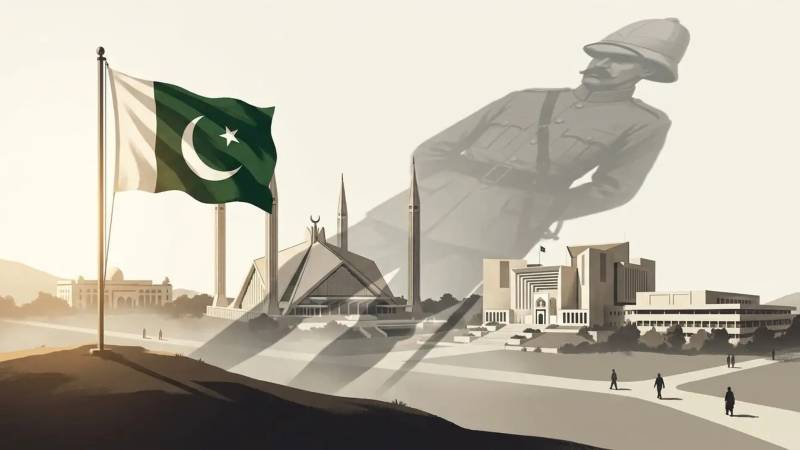
The essay makes four connected claims. First, the issue is not what the office was called, but the mindset it carried. Second, that mindset was professionalised by the ICS and then travelled differently through India, Pakistan and Bangladesh after 1947. Third, Pakistan’s version became especially damaging because it kept command authority while weakening professional discipline and accountability. Finally, real reform must reverse the relationship between state and citizen: through stronger local government, specialist institutions, predictable rules and taxation based on reciprocity rather than repeated extraction.
The Argument Is About Mindset
Huzaima Bukhari and Dr Ikramul Haq have responded thoughtfully to our account of South Asia’s district state, arguing that we draw too straight a line from the East India Company’s Collector to the ICS and, eventually, to Pakistan’s DMG/PAS. They are right to emphasise the major changes along the way: competitive examinations, professional training, language requirements, district experience, public works, famine relief and the emergence of the highly regarded ICS. That history matters. But it does not settle the deeper question. Our argument is not mainly about the service’s name, recruitment method, individual officers or formal functions. It is about the underlying idea of authority that the office carried forward.
That idea began in the eighteenth century, when the East India Company, a commercial corporation, acquired territorial and revenue authority over vast populations. It needed officials who could make territory legible to the centre, collect revenue, maintain order, enforce decisions and embody superior authority in the locality. From that requirement emerged a durable conception of administration: the officer represented the state to the people, not the people to the state. That distinction is the heart of the essay. The transitions from Company to Crown, Collector to District Magistrate and Collector, ICS to IAS, ICS to CSP and then DMG/PAS, and CSP to Bangladesh’s administrative machinery must all be read against it. The names, examinations, nationalities, constitutions and political masters changed. The administrative mindset proved much harder to dislodge.
The Eighteenth-Century Operating System
The Company’s district administration was constructed initially around remarkably simple imperatives: know the territory, secure revenue, maintain order and obey the centre. Authority travelled downward. Information and resources travelled upward. The subject stood at the bottom of the chain. The Collector became the interface between the centre and the locality. This was not just an entry on an organisational chart. Institutions teach habits. They transmit hierarchy, language, incentives, prestige and assumptions about who is entitled to decide.
Above all, they transmit an answer to a fundamental question: is the official the servant of the citizen, or is the citizen the administered object of the official? That is what we mean by institutional DNA. Institutions can change, of course. But they can also change their name, recruitment system, functions and personnel while preserving older assumptions about the relationship between ruler and ruled.
The ICS: Professionalisation Without Reversal
The nineteenth-century transformation of Company administration into the ICS was enormous. Competitive recruitment replaced patronage. Training improved. Administrative competence became a professional ideal. District knowledge, language proficiency and field experience mattered. The mature ICS took on responsibilities far beyond revenue, including famine relief, public health, irrigation, education, agriculture and infrastructure. We do not dispute this history. But our critics confuse professionalisation of the machinery with transformation of its governing philosophy.
The ICS made the machinery incomparably better. It did not reverse the direction in which authority flowed. The Collector remained the representative of superior government in the district. His authority came overwhelmingly from above. His population did not elect him. It could not remove him. His career depended upon the hierarchy above him rather than the citizens below him. A highly competent paternalistic state remains paternalistic. The ideal ICS officer may have known every canal, crop, notable family and village in his district. He may have been an exceptional administrator. But he still embodied the state: he coordinated, inspected, adjudicated, reported and decided. The population remained the administered.
1947: One Administrative Ancestor, Three Experiments
Partition provides an extraordinary comparative experiment. British India disappeared, but much of its administrative inheritance did not. India and Pakistan inherited variants of the ICS architecture; East Pakistan inherited Pakistan’s CSP structure and subsequently carried elements of that administrative tradition into independent Bangladesh. If our argument were that colonial origins mechanically determine outcomes, all three countries should have evolved identically. They did not. That is precisely why the comparison is useful. Institutional inheritance establishes the starting point. Political choices determine what societies subsequently do with it.
India: The Collector Entered a Democratic State
Independent India consciously retained much of the colonial administrative machinery. The ICS became the IAS. The district collector survived. The generalist survived. Elite competitive recruitment survived. The belief that a gifted generalist could move between radically different areas of government survived. There is therefore substantial continuity between the ICS and IAS. But India progressively surrounded this inheritance with counterweights: competitive democratic politics, powerful state governments, elected local institutions, a plural institutional landscape, a large private economy, a vigorous media and civil society, and multiple centres of political authority. The administrator consequently became one powerful actor among several. India did not eliminate the Collector mindset. It constrained it. India therefore demonstrates that colonial administrative inheritance is not destiny. A country can inherit the steel frame and progressively place democratic and institutional walls around it.
The test of reform is not whether the state can command more efficiently. It is whether citizens can control those who govern them: by electing them, questioning them, removing them and holding them responsible for results.
Bangladesh: The Second Inheritance
Bangladesh’s administrative genealogy is especially revealing because its inheritance came twice removed: from ICS to Pakistan’s CSP and, after 1971, into the civil service of independent Bangladesh. Again, the country changed. The flag changed. The constitution changed. The political leadership changed. The name of the service changed. Yet the prestige of the generalist administrative cadre, hierarchical culture and the recurring struggle between administrative generalists and professional cadres proved remarkably persistent.
If sovereignty alone automatically transformed administrative culture, 1947 should have ended the phenomenon in Pakistan and 1971 should have ended it in Bangladesh. Neither did. Bangladesh has developed its own institutions and administrative traditions and cannot be reduced to a colonial relic. But the persistence of administrative-cadre predominance illustrates the larger point: institutional cultures can outlive the political systems that created them. The sahib does not require a British passport. Sahib is a relationship with power.
Pakistan: We Preserved the Power and Lost the Discipline
Pakistan’s experience is the most troubling. We inherited the administrative architecture of the Raj through the CSP. The early CSP retained many characteristics associated with the ICS: competitive entry, elite status, strong esprit de corps, field experience, administrative continuity and considerable autonomy from day-to-day political pressure. It also inherited paternalism, hierarchy and the generalist conception of government. Then Pakistan began dismantling many of the features that had made the old system effective without dismantling the assumptions that made it authoritarian.
We weakened security of tenure. We politicised postings. We made transfers instruments of reward and punishment. We expanded patronage. We weakened institutional memory. We repeatedly failed to build durable local government. We did not give specialists institutional parity with administrative generalists. And yet we retained the belief that the generalist administrator possesses a special entitlement to govern. Pakistan therefore achieved the worst possible combination: we weakened the professionalism of the ICS tradition while preserving its command mentality. We lost much of the steel. We kept the frame.
From Administrative State to Extractive State
This is where the argument must go beyond bureaucratic history. The original Company state existed fundamentally to extract. It needed revenue to finance administration, military power and commercial activity. District machinery therefore developed around identifying resources, assessing obligations, collecting revenue, enforcing compliance and transmitting resources upward. Modern Pakistan is obviously not the East India Company. Its civil servants are not Company agents and its taxes do not finance shareholders in London. But look at the relationship between the Pakistani state and its productive citizens and businesses. Too often, the state approaches the economy not by asking how it can enable a citizen or enterprise to become more productive, but what it can collect, regulate, prohibit, license, surcharge or control.
Tax the already documented because widening the base is administratively harder. Increase electricity tariffs because reforming the power system is institutionally harder. Raise petroleum levies because restructuring expenditure is politically harder. Impose surcharges because eliminating inefficiency is harder. Create withholding taxes because building an effective tax administration is harder. Require another NOC because surrendering bureaucratic discretion is harder. The instruments are modern. The instinct is old: find the accessible economic surplus and extract it.
Extraction Without Reciprocity
Taxation itself is not extraction in the pejorative sense. Every functioning modern state taxes its citizens. The distinction is reciprocity. A developmental state taxes in order to provide public goods, expand productive capacity, protect rights and create the infrastructure through which citizens become more prosperous. An extractive state increasingly treats revenue collection as an end in itself while failing to provide corresponding services.
The citizen pays direct taxes, indirect taxes, withholding taxes, sales taxes, petroleum levies, electricity surcharges and innumerable fees. Then he privately purchases what the state inadequately provides: education, healthcare, security, water, electricity backup, transport and housing. The middle-class Pakistani therefore experiences the state twice: first as collector, and then through its absence as provider. That is not merely a fiscal problem. It is the continuation of a particular relationship between state and citizen.
The Formal Economy as the New Zamindar
Extractive systems naturally gravitate toward what they can see. The Company relied on identifiable revenue sources and intermediaries because they reduced the administrative cost of collection. Pakistan’s modern state exhibits a comparable preference for the visible. Salaried employees are visible. Registered companies are visible. Electricity consumers are visible. Telecommunications users are visible. Importers are visible. Banks are visible. Large-scale manufacturing is visible. So the state repeatedly returns to them. Meanwhile, large segments of property, retail, agriculture and the informal economy have historically been difficult or politically costly to tax effectively. The result is an administrative instinct: extract more from the compliant because confronting the powerful or finding the undocumented is harder. The modern spreadsheet has replaced the land register. The logic is disturbingly familiar.
Extraction Is Not Only About Tax
The extractive machinery extends beyond money. The state extracts time through delay, rent through discretionary approvals, compliance costs through overlapping jurisdictions, certainty through unpredictable policy and investment through regulatory risk. It also extracts dignity when a citizen entitled to a public service must approach an official as a supplicant. A bureaucracy can therefore be extractive even when no bribe is paid and no tax is collected. Every unnecessary permission creates a miniature relationship of ruler and ruled: the official possesses discretion; the citizen requests its favourable exercise. That is the Collector’s world in modern administrative clothing.
Why Local Government Matters So Much
This also explains Pakistan’s extraordinary resistance to genuine local government. Real devolution would do something much more radical than improve municipal services. It would reverse the direction of accountability. An empowered mayor does not represent Islamabad or Lahore to the citizen. The mayor represents citizens to the state. A locally accountable professional administration therefore challenges the deepest premise of the Collector model. Decentralisation cannot simply mean moving functions from Islamabad to provincial capitals. That merely shortens the distance over which authority travels downward. Real decentralisation transfers political authority, fiscal resources and accountability to institutions close enough for citizens to control. Pakistan has repeatedly avoided completing that transition.
Generalist Supremacy Is Another Form of the Same Mindset
The continuing institutional supremacy of generalist administrators over specialists is similarly revealing. The original Collector did not possess authority because he knew more about every technical subject than everyone around him. He possessed authority because he represented the sovereign. That distinction survived. The contemporary generalist can rotate from petroleum to health, from commerce to local government, from education to industry, and the system presumes that administrative seniority qualifies him to command the institution. This is not an argument against generalists. Good generalists are indispensable. It is an argument against generalist supremacy. The modern state requires administrators, economists, engineers, doctors, scientists, technologists, financial professionals and managers working within institutions where authority reflects function and competence. The Collector model instead presumes that administrative position itself confers competence to govern.
The Three Successor States Tell Us Something Important
India, Bangladesh and Pakistan therefore strengthen rather than weaken our argument. All three demonstrate continuity. All three also demonstrate change. India shows that an inherited bureaucracy can be constrained by democratic competition, institutional pluralism and economic transformation. Bangladesh shows how strongly administrative-cadre culture can persist even after two ruptures in sovereignty. Pakistan demonstrates something darker: an inherited command structure can combine with patronage, weak local democracy, generalist supremacy and elite capture to produce a state that is very capable of exercising authority, but repeatedly incapable of delivering corresponding public value. This is not because Pakistan is condemned by its colonial genes. It is because Pakistan repeatedly chose not to rewrite them.
Pakistan’s Extractive Equilibrium
The consequence is larger than the civil service. Pakistan has developed an equilibrium in which political elites, bureaucratic elites and other powerful groups can all benefit from a state whose discretionary machinery remains strong while its capacity to deliver universal public goods remains weak. The bureaucracy controls. Politics distributes. Protected interests capture. The documented economy pays. And the citizen navigates the resulting maze.
This is why administrative reform cannot be reduced to changing examinations, creating training programmes, renaming occupational groups or adjusting promotion rules. We have been doing that for decades. The real reform is philosophical: who is the sovereign? If the answer is the citizen, then the architecture must follow. The state must be judged not by the authority it exercises over society, but by the public value it creates for society.
The Collector Is Still With Us
The Collector survives not because his title endured, but because the relationship he embodied was never fully overturned. The question is whether the fundamental relationship between administrator and administered ever truly changed. From Company Collector to Crown Collector, from ICS to IAS, from ICS to CSP, from CSP to Bangladesh’s administrative cadre, from CSP to DMG and from DMG to PAS, the services metamorphosed. The mindset proved remarkably durable.
India placed more institutional constraints around it. Bangladesh continues to struggle with its legacy. Pakistan performed the most unfortunate mutation of all: we retained the Collector’s authority, weakened the Collector’s professionalism and adapted the Collector’s extractive instincts to a modern economy. The eighteenth-century Collector extracted land revenue. The twenty-first-century state has tariffs, levies, withholding taxes, surcharges, licences, regulatory approvals and an almost limitless capacity to create another form. The technology changed. The relationship did not change enough.
For many Pakistanis, the state is most visible not when it protects rights or delivers services, but when it manages, disciplines and suppresses legitimate dissent. In that lived experience, the district administration appears less as a civic institution than as the local face of coercive authority. That relationship must now be reversed deliberately and institutionally. Reform cannot mean another service name, another training programme or another rearrangement of occupational groups. It must move power from command offices to accountable institutions.
Above all, this points toward the empowerment of local government as the direction Pakistan must take. Power must be placed where citizens can see it, question it, discipline it and replace it. That means local governments with their own revenues, staff and authority; elected mayors answerable to residents; protected tenures, transparent appointments and safeguards against political interference; specialists leading specialised institutions; fewer permissions; more predictable rules; and a tax system that broadens the base instead of repeatedly burdening those already visible and compliant.
The test of reform is not whether the state can command more efficiently. It is whether citizens can control those who govern them: by electing them, questioning them, removing them and holding them responsible for results. The state should measure success not by the authority it exercises, but by the economic security, public trust and human capability it enables. Until that principle governs the machinery of the state, changing CSP to DMG, DMG to PAS or PAS into whatever acronym the next reform commission invents will change remarkably little. Pakistan does not need another name for the Collector. It needs to dismantle the order that keeps the citizen beneath him and build a state that finally answers to its people.