

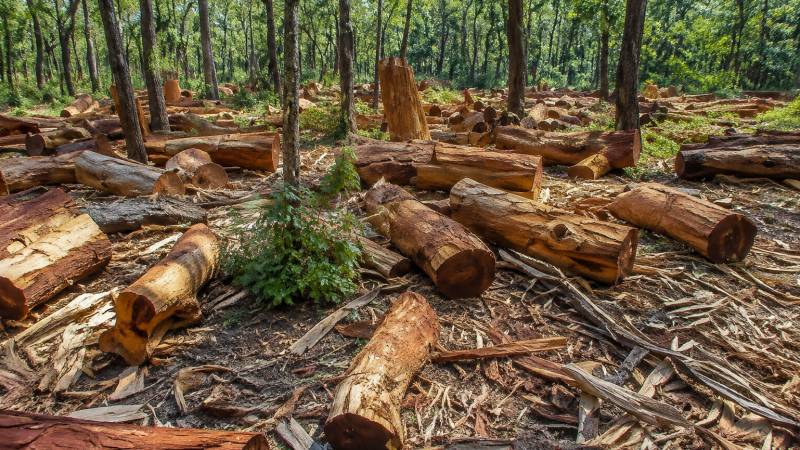
When Major James Abbott founded this city in the mid-nineteenth century, he was so moved by it that he wrote it a love poem, recalling “the sweet Abbottabad’s air” and “the trees and the ground covered with snow.” A plaque of those lines still stands in Lady Garden Park; the sentiment of a man bewitched by the pines, streams and trees of a valley in the Hazara hills. I was born in that valley and raised in it, and let me say plainly what is happening while we look away: the city Abbott loved for its trees is cutting them down. Abbottabad was once the valley of the chinars. These great trees that gave it shade that turned the hillsides copper each autumn that stood for a hundred years and more are being felled one after another. Where anything returns at all, it is self-seeded poplar in the damp margins, whose pollen chokes residents each summer. The city is quietly losing the very thing that made it beautiful.
This matters far beyond sentiment, because the whole country has a stake in this city. Abbottabad is the capital of Hazara and the gateway to Nathiagali, Ayubia and the Galiyat, one of Pakistan’s great tourist arteries; the Galiyat valley alone recorded over a million eco-tourists in 2024, nearly all passing through Abbottabad. It has long been known, too, as the City of Schools: Army Burn Hall College, Abbottabad Public School, Ayub Medical College, COMSATS and others have educated a remarkable share of the country’s officers, doctors, scholars and civil servants. Add the Pakistan Military Academy at Kakul, which trains the nation’s army, and almost every Pakistani institution and family has some quiet stake in this place. What is done to Abbottabad is not a local affair; it is done to a city the whole nation has, one way or another, passed through and whose entire worth, economic, cultural and ecological, is bound up in a natural beauty now being dismantled tree by tree. What is happening here is not a Hazara problem; it is the Pakistani problem in miniature, and my city is simply where I can show you the machinery up close.
The degradation is concentrated precisely where authority is fragmented where everyone can issue a challan and no one is responsible for the whole.
Drive through it now and the transformation is unmistakable. Hundred-year-old trees felled to raise apartment blocks and plazas. The nallahs built over. The shamilat and public commons land that belonged to everyone and therefore, in the end, to no one — encroached. The children of our villages have nowhere left to play. The Harno River, a picnic spot families once drove to on weekends, has been fouled by illegal construction and mining on its banks. Across the district, forests that hold our slopes and regulate our water are cleared for roads and plots, often without the environmental assessments the law requires. In 2022, when fire swept Khyber Pakhtunkhwa’s forests, no district recorded more incidents than Abbottabad.
None of this happened in a vacuum, and the turning point has a date. When the October 2005 earthquake devastated Balakot, Muzaffarabad and the surrounding hills, it displaced millions, and a great wave of them came to Abbottabad safe, settled, rich in the schools, hospitals and services people needed. The Orash Valley, the old lake-bed on which the city sits, absorbed a population surge it was never planned for. Researchers who study the city’s microclimate trace its abrupt urban sprawl directly to that moment: built-up land expanded, natural land shrank, and the pressure to concrete over every open space became relentless. No one planned the new neighbourhoods that rose to house the displaced; they simply appeared, absorbing farmland and open space wherever land could be found. The concrete now swallowing Abbottabad began, in large part, as an unmanaged response to a humanitarian emergency, growth that arrived faster than any authority was prepared to govern.
Here is the maddening thing: this city knows perfectly well how to protect green space. Walk into the Pakistan Military Academy at Kakul and you find lush, protected greenery, because someone with clear authority is accountable for keeping it so. Where a single institution both holds the mandate and answers for the outcome, the green survives. The degradation is concentrated precisely where authority is fragmented where everyone can issue a challan and no one is responsible for the whole.
That is the institutional heart of the matter. The Cantonment Board, by many residents’ experience, is diligent about collecting fees and far less visible in delivering the services those fees should fund; planned development, enforced building controls, protected commons. The city government, the cantonment, the forest department, the development authority and the provincial works department each hold a piece of Abbottabad, and not one is answerable for what the city becomes as a whole. When a chinar is felled to raise a plaza, the question “who allowed this?” has five possible answers and therefore, in practice, none. And what fills the gap is telling: the mega-projects delivered to these hills over the past decade have been overwhelmingly private — luxury towers marketed, without irony, against the very pine forests they replace while public investment in protected tree cover and enforced building lines is nowhere to be found. Fragmented authority is not a bureaucratic detail; it is the reason a beautiful city can be taken apart with no one ever quite deciding to take it apart.
Different cities, identical disease: authority everywhere and accountability nowhere, commons that vanish because protecting them wins no votes and blocks no deals.
Nowhere is this clearer today than in the forests of the Galiyat. Much of that hill country is Reserved Forest — a public and ecological heritage, not a commodity to be traded and it has been under pressure from timber interests and powerful local clans for decades. What makes the present moment graver is institutional rather than natural: as the Galiyat Development Authority is granted ever wider powers, it increasingly cuts across the mandate of the Forest Department, the very body created to protect these forests. When the regulator meant to guard a resource is sidelined by an authority whose reason for existing is development, the outcome is not in doubt. Development cannot mean handing protected forest to those with the power to commercialise it; the answer is not weaker forest institutions but stronger ones, with clear mandates and boundaries that are actually enforced.
This is not, in the end, a story about one city. It is the story of almost every Pakistani town where the politician’s incentive is the ribbon-cutting and the land deal, and no one’s is the patient stewardship that keeps a place worth living in. In Peshawar, the green belts of a two-thousand-year-old city give way to unplanned sprawl. In Quetta, an aquifer is pumped toward exhaustion with no single authority charged to save it. In Mardan, farmland is parcelled into housing schemes. In Hyderabad and Karachi, the natural drains meant to carry off the monsoon are built over, and the water takes its revenge a little more violently each year. Different cities, identical disease: authority everywhere and accountability nowhere, commons that vanish because protecting them wins no votes and blocks no deals. If you are reading this anywhere in Pakistan, you already know your own version of this story. You may be living in it.
I love this city. I was raised under its chinars, and I have spent two decades on the machinery that decides whether places like it flourish or decay. What Abbottabad is losing, what every such city is losing is not, at bottom, beauty. It is the institutions that once kept that beauty safe: serious enough, transparent enough and efficient enough to say no to the axe and mean it. A city can survive the loss of a few trees; it cannot survive the loss of the systems meant to stand between the trees and those who profit from cutting them. The founder of this city wrote it a poem because of its trees. We will owe our children an apology for their absence unless we decide, while something still remains, that the institutions meant to protect our cities are finally made to do their work.