

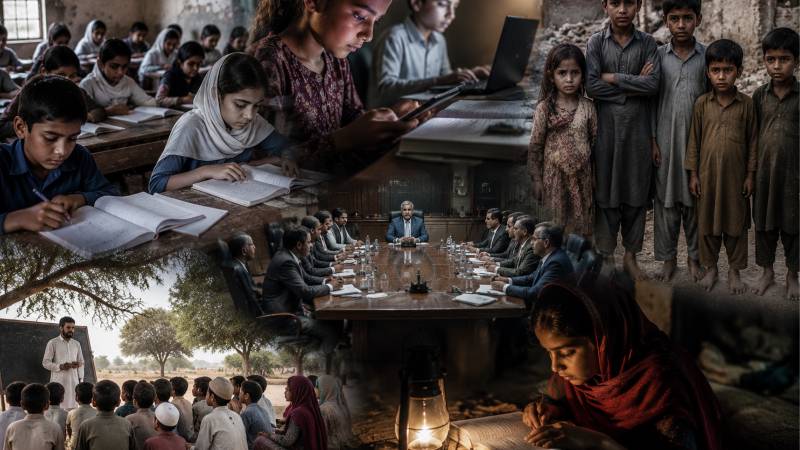
Two years ago, the Government of Pakistan declared an Education Emergency with much optimism and a fourteen-point agenda to tackle some of the country's most pressing educational challenges. The announcement raised hope that education had finally received the political attention it deserved. Last year, reviewing the first anniversary of the initiative, I argued that its success would depend not on the ambition of its promises but on the seriousness of their implementation. Another year has passed, and it's worth taking stock again.
Judged against these fourteen tasks, the picture remains disappointing. The Education Emergency still hasn't become the coordinated national programme it was meant to be. On the second anniversary of the Emergency, here is where each of the fourteen tasks stands.
Task 1 called for a National Action Plan to guide implementation, with clear priorities, timelines and targets. The plan, though, has been developed through consultation with the provinces and endorsed at the Inter-Provincial Education Ministers' Conference in January 2026, but it still hasn't been formally launched or rolled out, and that gap continues to hold up coordinated action between the federation and the provinces.
Task 2 promised an Education Challenge Fund to mobilise additional resources and support innovative partnerships. It still hasn't been established, and until it is, education financing will keep leaning almost entirely on conventional public allocations rather than the new, scalable sources the Emergency was supposed to unlock.
Task 3 envisioned an active Prime Minister's Task Force to provide leadership and review progress regularly. According to the latest status update, it has met only once since it was formed, and even that meeting was not chaired by the Prime Minister, the executive chair of the Task Force.
Task 4 committed to increasing public investment in education, on the premise that no serious reform happens without sustained financial backing. That commitment remains largely unmet: official figures show education expenditure falling from Rs 899.619 billion in July-March 2024-25 to Rs 356.499 billion in the same period of 2025-26, a drop of more than 60 percent in a single year. Fiscal constraints, and more recently the regional security situation, have squeezed the space available for education even further.
Task 5 called for a coordinated national implementation mechanism, with defined institutional responsibilities, annual targets, timelines and accountability for results. No real progress has been made here either, and its absence is part of why the other thirteen commitments keep drifting: without a mechanism to assign ownership and track delivery, good intentions rarely turn into results.
Task 6 aimed to expand school nutrition programmes, recognising how closely nutrition and learning are linked. Some encouraging initiatives have appeared at the provincial level and in Islamabad, often with donor support, but they remain limited in scale and disconnected from each other. Pakistan still has no nationally coordinated school meals framework with sustainable financing or defined coverage targets.
Task 7 proposed reviving community participation through the 'Each One Teach One' literacy campaign. NCHD has launched it, which is a genuine step forward, but its reach remains small next to the scale of adult illiteracy in Pakistan. Turning it into a real national literacy movement will mean bringing in universities, civil society, youth groups, the private sector and volunteers, not running it as a standalone government programme.
The Education Emergency has fallen short not because Pakistan lacked a diagnosis of its educational crisis, but because it lacked the political will to implement its own commitments.
Task 8 committed to bringing every child, especially girls, into school. No major nationwide initiative has been launched at the scale needed to accelerate enrolment of out-of-school children under the Emergency framework, and girls remain the group most affected by that gap.
Task 9 promised to expand Daanish Schools for disadvantaged children, and the federal budget for 2026-27 has backed this up with roughly Rs 21 billion for new construction. That's real money, but Daanish Schools remain primarily a residential, infrastructure-heavy model with limited reach compared to Pakistan's out-of-school children crisis. What matters now is whether that spending translates into cost-effective, wide-reaching enrolment gains, not simply how many new buildings go up.
Task 10 sought a comprehensive National Skills Programme linking technical and vocational education to the labour market. Various skills initiatives continue under different federal and provincial agencies, but nothing at the scale envisioned has emerged, and literacy, non-formal education, accelerated learning programmes, TVET, certification and apprenticeships still aren't working as a connected system.
Task 11 recognised the potential of digital learning, particularly for out-of-school children and marginalised youth. No significant nationwide progress has been made in building or scaling inclusive digital learning for this group specifically, which matters because these are the children hardest to reach through conventional schooling in the first place.
Task 12 promised continuous professional development for teachers, on the sound premise that no education system rises above the quality of its teaching force. No major nationwide initiative has been launched under the Emergency to address teacher shortages, capacity or continuous training at the scale required. Reform succeeds or fails inside the classroom, so this gap matters more than most.
Task 13 emphasised foundational literacy and numeracy in the early years of schooling. Despite a well-documented learning crisis, no coordinated national programme with measurable targets has emerged under the Emergency to address it. Weaknesses in the early years tend to follow children through their entire schooling, so delay here has a long tail.
Task 14 pledged a robust mechanism to monitor implementation and hold institutions accountable. No such mechanism has been established. There is still no regular public reporting on expenditure, outcomes or progress against the fourteen commitments, which makes it difficult for anyone outside government to tell genuine progress from scattered activity.
The evidence across all fourteen commitments points to one conclusion: The Education Emergency has fallen short not because Pakistan lacked a diagnosis of its educational crisis, but because it lacked the political will to implement its own commitments. Political will is the difference between policy and performance, between announcements and action. Education policies rarely fail for lack of good ideas; they fail because governments don't sustain the resolve to carry them out. Pakistan's education crisis is no longer primarily a crisis of policy. It is a crisis of political will. Unless education is elevated from a recurring political promise to a sustained national priority, backed by real financing, disciplined implementation and public accountability, future education policies are likely to meet the same fate as this one.