

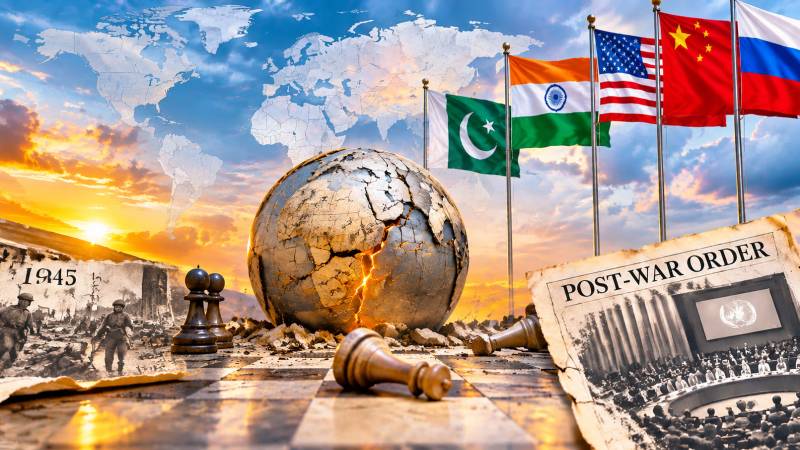
I have been insisting, with incessant reminders through my writings over the past three years, that the present world geopolitical crisis must be understood in the context of the post-war (since 1945) scenario. The prevalent political and economic models and philosophies came into existence in the post-war period, since the Yalta meeting was held in 1945 and the Marshall Plan was implemented subsequently.
My argument is that the world is increasingly facing a crisis of narratives, because the existing narratives were aligned with the post-war order. With that order crumbling in the wake of the Iran war and the subsequent decline of US power and influence, the old narratives are losing their relevance and currency. This change hits Pakistan’s Pan-Islamic narrative more strongly, which was concocted to suit its alignment with the West/US and, through it, with the Arab world.
The creation of Pakistan also came in this post-war period (1947). Shall we say it was a consequence of the Second World War, which dismantled the British Empire and hence divided British India? How and why Pakistan came to be aligned with the West, and thereafter joined the US bloc via the CENTO and SEATO alliances, needs to be understood within this particular context.
As part of the US bloc, it was natural for Pakistan to align itself more with the Arab world, as well as Iran prior to the Revolution, when Iran was closer to the West. Pan-Islamic ideals were to be built and promoted to suit this alignment. The first of which was the passing of the Objectives Resolution in 1949, which detached Pakistan from the notion of a united India under British rule and gave it a fresh, brand-new identity: more Middle East-leaning, Arab/Persian in character, and in the geopolitical context of the day it fit very well with the Western geopolitical priorities.
That political decision needed a narrative, which was further consolidated with the creation of “The Ideology of Pakistan” by Justice Javed Iqbal at the behest of General Ayub Khan – a book published by the state-owned Pakistan Times printing press in 1959. Pakistan became the Fortress of Islam, leading to its Pan-Islamic policy and making a perfect match with the self-assumed title of the Two Holy Mosques of the Saudi monarchs.The narrative was not merely adopted; it was funded and institutionalised. Under General Zia-ul-Haq, Islamisation at home and the Afghan jihad abroad were backed by both the United States and Saudi Arabia. Saudi money flowed to madrassas and to institutions such as the International Islamic University in Islamabad.
Inside Pakistan, this required a perpetual reminder to the people, via textbooks, religious sermons, political discourse, public debates and media, that Pakistan had a divine responsibility to protect the Holy Arab lands, while omitting how it actually served the strategic interests of the West, in particular the US, which has deep economic and geopolitical stakes in those lands.
The world is increasingly facing a crisis of narratives, because the existing narratives were aligned with the post-war order. With that order crumbling in the wake of the Iran war and the subsequent decline of US power and influence, the old narratives are losing their relevance and currency.
The West, under the tutelage of the United States, was building its own narrative in a more comfortable zone: liberal democracy, a capitalist/liberal economy, free speech, human rights, personal freedom, women’s rights and education, the promotion of democratic values and so on. Communism/socialism, and later Islam (or political Islam with Shariah laws): any system or ideology that opposed or potentially challenged Western ideas, systems or values was attacked, demonised and even destroyed. The West, too, built its narrative through funding and institutions, simultaneously: Fulbright scholarships from 1950, the National Endowment for Democracy from 1983, USAID’s rights projects.
The Indian case is rather more complex and interesting. India was founded as a secular country, and its apparently secular constitution helped it ward off the character of a Hindu majoritarian state, until Narendra Modi’s right-wing Hindu extremist government took over in 2014. India, from Nehru onwards, with its socialist thought and leanings, drifted close to the Soviet Union and declared itself a socialist state through the 42nd constitutional amendment in 1976, yet it never admitted to belonging to the Soviet bloc and claimed non-alignment instead. That non-alignment helped India change its story after the fall of the USSR in 1991, when it liberalised its economy, and by recognising Israel in 1992 it comfortably leaned to the West as the largest democracy of the world. Post-9/11, India took a ride on the tide of the terror narrative, used it against Pakistan, and to suppress the Kashmiri freedom movement. However, it fails to recognise that the narrative of terrorism has lost its potency as US priorities changed.
The narratives built by the West after the Second World War started to make a visible transition after President Trump assumed office on 20 January 2025. Trump’s withdrawal from the Paris Agreement came as the first blow. Weeks later, JD Vance told Europeans in Munich that the greatest threat to them came from within, and attacked European governments over free speech and migration. Elon Musk, amid the Los Angeles wildfires, blamed the city’s diversity, equity and inclusion (DEI) policies, a claim the fire chief rejected. USAID was formally closed on 1 July 2025. Each of these retired a piece of what the post-war order had carried: alliance solidarity, the language of human rights, development aid and multilateral commitments.
The Iran war accelerated this shift. The aura of US military might and ability has faded; Saudi status has diminished; and Iran’s regional status has risen after it withstood the US and Israel, along with its strategic control of the Strait of Hormuz. Consequently, the narratives built to align with the post-war order stand in disarray. India finds it hard to remind itself that Israel was declared fatherland hours before the attack was launched against Iran. As the Big Three – Trump, Putin and Xi – sit at the same table in Shenzhen, India watches from a distance, in growing irrelevance. The Vishwa-guru image built to counter China is a thing of the past. Trump, for his part, took office as president of a sole superpower and now shares that table with two other big powers on equal footing.
For Pakistan the consequence is direct. Its national stories were written for a particular arrangement: the US as senior partner, the Arab world as wealthy co-religionist, and Pakistan as the Fortress of Islam standing between them. That arrangement no longer holds. A narrative needs an order to belong to, and the order that will replace the post-war one has yet to emerge. It remains to be seen how fast these nations can recognise the new realities and adapt their stories to that change. The old narratives are a trap, which would cost them dearly.