

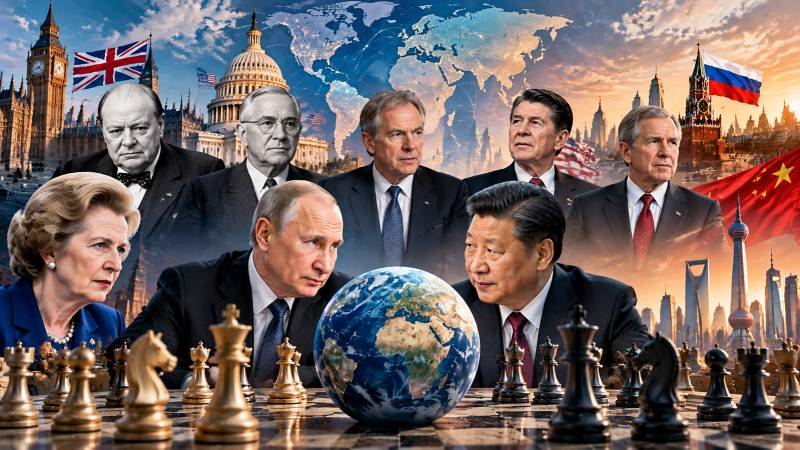
I have been writing about the emerging world order, or a revised version of the New World Order that came into existence after the fall of the Berlin Wall in 1989 – call it a neo-world order if you will. I have also insisted in my previous pieces that we must pay attention to the aftermath of 1945, the post-war period, and 1991, the post-Soviet period, as the context for the way conflicts are unfolding today. To get a sharper view of the current situation in the Middle East and Europe, I also draw attention to the speeches of President Putin and President Xi at forums like the SCO and BRICS since the Ukraine war started. These two leaders have repeatedly invoked terms which define the contours of this revised order, as we see it unfolding in real time. This time I end with a harder question: who wrote the story of how that order came to be, and what do we call those who question it?
Vladimir Putin and Xi Jinping both attack the old Western-led order, but from different places. Putin turns colonial language into an accusation: in a September 2013 New York Times op-ed on Syria he warned it is “extremely dangerous to encourage people to see themselves as exceptional”, and from Johannesburg in 2023 to New Delhi in 2026 he has condemned Western hegemony and neo-colonialism. Xi rarely says “colonialism” at BRICS or the SCO. He builds instead a doctrine of non-intervention, resting on sovereign equality and each country’s right to choose its own path, from his 2023 China-Central Asia speech to the Global Governance Initiative of September 2025, while Beijing pairs it with its own “core interests”.
Yet their agreement is closer than their tone suggests. Both say the world is moving from a unipolar to a multipolar order (Putin at BRICS in New Delhi, Xi at the Bishkek SCO summit, both in September 2026). Both invoke sovereign equality, non-interference and the UN Charter, demand rules without double standards, oppose economic coercion (Putin sanctions and tariff wars, Xi decoupling), reject bloc confrontation, and speak for the Global South.
Afghanistan tests those positions. Russia recognised the Taliban government in July 2025, a year after Lavrov cited women’s rights and inclusion as obstacles; experts call the move largely symbolic, driven by fear of ISIS-K. China accepted Taliban credentials in January 2024 but has not formally recognised the government, and its business has underdelivered: Mes Aynak is not producing and the Taliban cancelled the Amu Darya oil contract in 2025. Both signed the SCO’s call for an inclusive Afghan government, yet engage one that is not. Critics say non-interference works as a shield that bends with who is intervening. On Iran, both Russia and China speak with one voice, standing firm behind Tehran in its war against Western imperialism – the “axis of resistance”. Those are the arguments of the present, but every order rests on an older story, and that is where my question begins.
The result, they say, is a wider network of the Western establishment that shapes how we think, what we think and what counts as important, and anything outside that framework is dismissed as conspiracy theory.
When we examine the current situation in the context of British and European colonialism before the Second World War, and American colonialism in the post-war era through international organisations like the UN, the World Bank, the IMF, the WTO and others, one part is conspicuously overlooked. Did the British go to sleep after losing their empire? Have they enjoyed their diminished status after the Americans took over? The problem herein is that when we begin to dig deeper and connect the dots, the emerging picture is often labelled a conspiracy theory – something that doesn’t align neatly with the grand narrative of the current order. Western media, universities and other means of public engagement have spent decades building that grand narrative, and it is documented through the works of historians, academics and writers, and the memoirs of former US presidents and other Western leaders. Many in the developing world argue that the system perpetuates itself: scholars are invited, via scholarships, to learn that narrative and take it back home to teach. The result, they say, is a wider network of the Western establishment that shapes how we think, what we think and what counts as important, and anything outside that framework is dismissed as conspiracy theory. Even these very words, as I jot them down, may qualify as one. So did the British go to sleep? The archives say no, though what they show is less sinister than the conspiracy version.
At Fulton in 1946 Churchill called for an Anglo-American front against Moscow. In February 1947 the British embassy told Washington that London could no longer fund Greece and Turkey, and within weeks the Truman Doctrine followed. Ernest Bevin’s Brussels Treaty of 1948 was, in Britain’s own published papers, a prerequisite for securing American participation in what became NATO. In 1953 MI6 needed the CIA to carry out its plan against Mosaddeq in Iran, and declassified American files show an Eisenhower administration that was easily persuaded. Tony Blair pressed Clinton over Kosovo and promised Bush on Iraq, “I will be with you, whatever.” None of this is theory; it sits in the archives and in the Chilcot report. But no master plan emerges. Britain was often overruled: Eisenhower used financial pressure to break it at Suez, Chilcot found Blair “overestimated his ability to influence US decisions”, and Blair was briefed in 2000 to reassure Putin on NATO enlargement.
Consider what Thatcher did to her own country. Manufacturing collapsed in the early 1980s, leaving the North, Wales and Scotland as predominantly working class, while London and the South East boomed on finance. The model travelled. Reagan, her close ally, cut taxes, privatised and confronted organised labour, and others followed. Can we say that Thatcher’s economic model deindustrialised the US and Europe, something that now haunts both in the Ukraine and Iran war theatres? Meanwhile, three of Britain’s four nuclear-deterrent submarines are at sea together for the first time in five years, at least one of them armed with nuclear-tipped missiles, according to The Times. The defence secretary has urged the country to be ready for war within 1,000 days. There are no words and no signs from London of de-escalation, even as Putin says Russia is ready for war with Europe but does not want one, warning that “there will be no winners at all”. Britain and Brussels, though they parted ways in 2016, seem to be pushing harder against Russia, once again bringing major powers into a dangerous confrontation. The world holds its breath as the Great Game enters its next stage.