

Allama Iqbal described the Muslim-majority provinces as a potential bulwark of India and of the British Empire against the hungry generations of the Asiatic highlands. Iqbal never publicly demanded an independent state, used the word Pakistan only to disown it, and in 1931 and 1934 said so himself. His private letters of 1937 to Muhammad Ali Jinnah are the one place where the record becomes genuinely contested. The claim that Allama Muhammad Iqbal conceived Pakistan is embedded in Pakistan’s official history. In this familiar account, his December 1930 Allahabad address envisioned a separate Muslim state, Jinnah turned that vision into reality, and Pakistan fulfilled Iqbal’s prophecy.
What Allahabad actually said
On 29 December 1930, Sir Muhammad Iqbal delivered his presidential address to the All-India Muslim League at Allahabad. Every claim that he conceived Pakistan rests on one passage: I would like to see the Punjab, North-West Frontier Province, Sind and Baluchistan amalgamated into a single State. Self-government within the British Empire, or without the British Empire, the formation of a consolidated North-West Indian Muslim State appears to me to be the final destiny of the Muslims, at least of North-West India.
Read it slowly. It names four provinces. It does not name Bengal, whose Muslim-majority east later became East Pakistan. It does not mention the Muslim minorities of the United Provinces, Bihar or Bombay, the provinces that gave the Muslim League most of its early support. It does not use the word Pakistan, a word that first appeared in Choudhry Rahmat Ali’s pamphlet of 1933. And its most quoted clause, “within the British Empire, or without”, states two possibilities and prefers neither.
The question is not whether Iqbal proposed a major reorganisation of India; he plainly did. It is whether he demanded an independent, sovereign country outside India and British rule, corresponding to Pakistan’s eventual territorial and constitutional form. The address does not establish that conclusion. Iqbal proposed amalgamating north-western Muslim-majority provinces within a wider constitutional settlement; he supplied neither the boundaries nor the constitutional programme of the Pakistan created in 1947.
Supporters of the official story rely on more than that passage, and an honest account must say so. The address does use the word “state”: “I demand the formation of a consolidated Muslim state in the best interests of India and Islam.” But the same address calls the proposal “a Muslim India within India”. And Iqbal explained the passage himself, twice. In 1931 he told The Times that he meant Muslim provinces inside India. In 1934 he told Thompson that he meant one province inside an Indian federation.
The letter to The Times that complicates the official story
On 12 October 1931, The Times of London published Iqbal’s reply to Edward Thompson, who had quoted the Allahabad passage in the same newspaper on 3 October 1931 as evidence of “Pan-Islamic plotting”. Iqbal, in London for the Round Table Conference, wrote from St James’s Court on 10 October. Written after the Allahabad address, it is key evidence of how he explained his own position. Iqbal explicitly denied that he had made a practical demand for a Muslim state outside the British Empire. He described his suggestion as “only a guess at the possible outcome in the dim future of the mighty forces now shaping the destiny of the Indian sub-continent.” He added that he favoured redistributing India into provinces with effective majorities of one community or another, on lines advocated by both the Nehru and Simon reports, and that he would oppose “another cockpit of communal strife in the Central Punjab”.
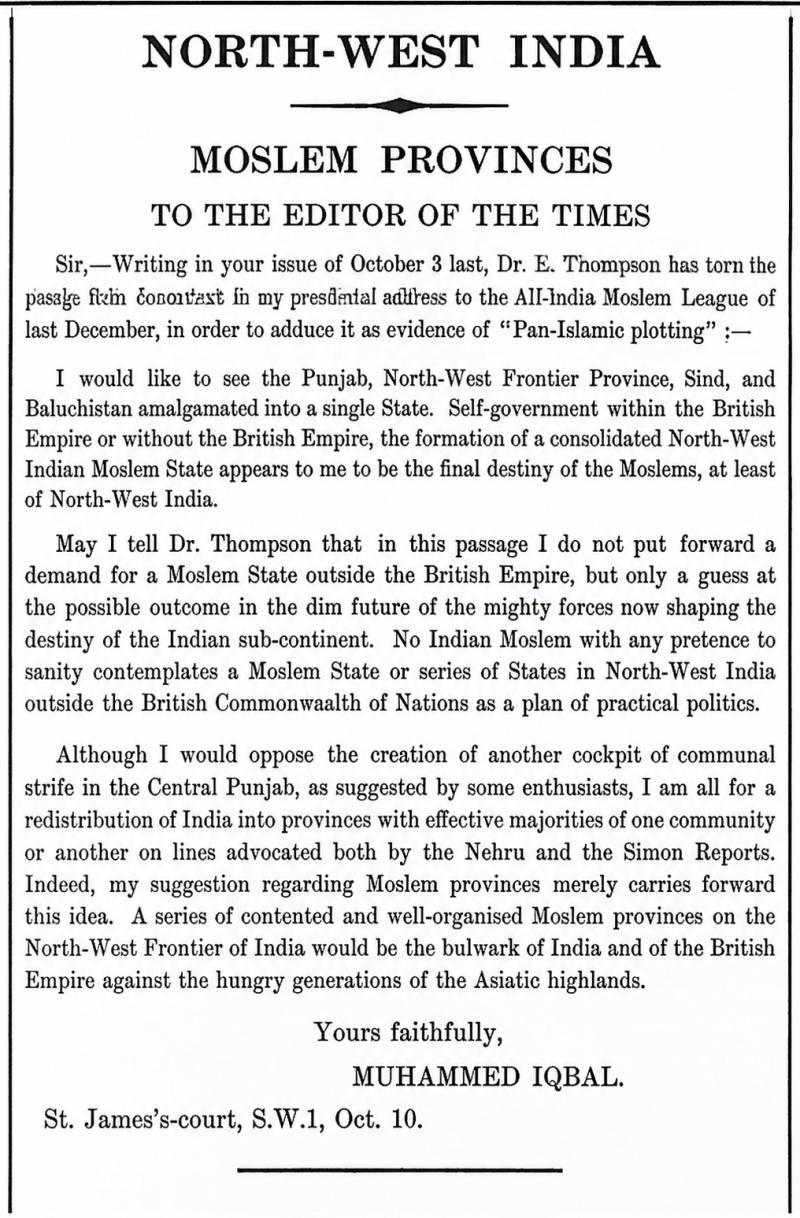
Image: Iqbal’s letter to the editor, “North-West India: Moslem Provinces”, The Times, 12 October 1931, p. 8. The text is also printed in Letters and Writings of Iqbal (Lahore: Iqbal Academy Pakistan, 1967), pp. 119–120. He was more categorical still: “No Indian Moslem with any pretence to sanity contemplates a Moslem state or series of States in North-West India outside the British commonwealth of Nations as a plan of practical politics.”
He also described the Muslim-majority provinces as a potential “bulwark of India and of the British Empire” against “the hungry generations of the Asiatic highlands”. That language sits uneasily with the portrayal of Iqbal as an uncompromising anti-colonial revolutionary seeking an independent Pakistan. One counterargument is that Iqbal was addressing a British audience and may have moderated his language. That possibility merits consideration, but it does not prove insincerity. Without independent evidence that he was concealing his intentions, his explicit clarification must be taken seriously.
The 1934 letter: “Pakistan is not my scheme”
A letter dated 4 March 1934, written by Iqbal in Lahore to the British historian and writer Edward John Thompson, directly addresses this question. Thompson had reviewed Iqbal’s The Reconstruction of Religious Thought in Islam and, according to Iqbal’s reply, described him as a protagonist of the scheme called Pakistan. Iqbal objected: “Now Pakistan is not my scheme.” He then specified what he had proposed at Allahabad in 1930: the creation of a Muslim-majority province in north-western India that would form part of a proposed Indian federation. He contrasted this with the Cambridge scheme, which envisaged “a separate federation of Muslim Provinces directly related to England as a separate dominion”. Iqbal added that the scheme “originated in Cambridge”. The letter is quoted in Iqbal Singh’s The Ardent Pilgrim: An Introduction to the Life and Work of Mohammad Iqbal (Delhi: Oxford University Press, 1997), p. xiii. S. Hasan Ahmad discusses it, with photographic reproductions of the original letters, in Iqbal: His Political Ideas at the Crossroads (Aligarh, 1979). The originals are in the Bodleian Library, Oxford. It provides explicit evidence that Iqbal distinguished his own constitutional proposal from the separate-federation scheme associated with the Cambridge group.
Justice Javed Iqbal’s direct testimony
A further and particularly relevant source is the recorded interview with Justice Javed Iqbal. Asked to consider the Allahabad Address and the origins of Pakistan, Javed Iqbal states that “Allahabad ke khutbe mein to alahdiggi ka tasavvur hi nahin hai”—that the Allahabad Address contains no conception of separation. He argues that his father proposed a Muslim-majority political unit with full autonomy within an Indian union, rather than the separate sovereign state that came into existence in 1947. This is not an inference attributed to him by another writer; it is the substance of Javed Iqbal’s recorded argument in the interview. His testimony is important, but not conclusive: being Iqbal’s son does not settle the historical question, and the comparison with the Cabinet Mission Plan is his interpretation.
Rahmat Ali and the difference between an idea and a programme
The distinction is clearer when Iqbal’s address is compared with Choudhry Rahmat Ali and fellow Cambridge students’ pamphlet Now or Never, published in January 1933. Rahmat Ali explicitly proposed a separate Muslim homeland and named it “Pakstan”, spelt without the “i” in the original pamphlet, dated 28 January 1933. It covered five northern units, Punjab, the Afghan (North-West Frontier) province, Kashmir, Sind and Baluchistan, as a state separate from the proposed Indian federation. Later pamphlets added “Bangistan” for Bengal and “Osmanistan” for Hyderabad. His scheme centred on Muslim-majority territories in the north-west, though it did not match the country created in 1947. Unlike Iqbal’s 1930 address, it stated a separatist programme directly.
Hasrat Mohani and the demand Iqbal did not make
The record of the 1920s shows who first demanded complete independence. Maulana Hasrat Mohani (1875–1951), a poet and journalist from Mohan in Unnao, was jailed for sedition in 1908 and served more than a year of rigorous imprisonment. In December 1921 the Khilafat Conference, the Indian National Congress and the Muslim League all met at Ahmedabad. Mohani, who presided over the League session, called in his address for complete independence from British rule (azadi-e-kamil). According to C. M. Naim, he moved a similar resolution in the Congress Subjects Committee, and Gandhi made sure it was defeated. Mohani was arrested after the Ahmedabad speeches and held in Yeravda jail, Pune, until March 1924. Congress did not adopt complete independence as its goal until the Lahore session of December 1929, and observed Independence Day on 26 January 1930. Mohani is also widely credited with the slogan “Inquilab Zindabad”, first raised in 1921.
A mature national history need not turn Iqbal into a prophet of an inevitable Pakistan to honour him. His thought—complex, evolving and shaped by colonial India—is more interesting than the simplified legend. Pakistan was not simply the execution of an Iqbal blueprint from 1930. It emerged from decades of political struggle involving many actors, conflicting objectives and decisions whose consequences were not predetermined.
The dates matter. Mohani’s demand came nine years before Allahabad, and ten years before Iqbal told The Times that no Indian Moslem “with any pretence to sanity” contemplated a state outside the British Commonwealth as practical politics. The comparison is not a verdict on Iqbal’s importance as a thinker. It shows that the demand for complete independence was made, and paid for, by others, and that the official story gives Iqbal a role he did not claim. Mohani’s later course adds an irony. He opposed Partition, resigned from the Muslim League after the plan of 3 June 1947, and stayed in India. He sat in its Constituent Assembly and died in Lucknow on 13 May 1951. The founding story of Pakistan credits Iqbal with the vision, yet the man who first called for complete independence on a Muslim platform rejected Pakistan.
Iqbal’s later thinking and the danger of a simplistic verdict
The 1937 letters must be read for what they are. They are two private letters to Jinnah, dated 28 May and 21 June 1937, the second marked “Private and Confidential”. The first, on Muslim poverty and the League’s programme, says that the enforcement and development of Islamic law “is impossible in this country without a free Muslim state or states”, and ends with a postscript saying he had thought of writing an open letter to the press but judged the moment unsuitable. The second, written after the riots of that spring, argues that the new constitution leaves Muslims dependent on non-Muslims even where they are the majority. On both occasions he kept the argument out of public view.
Neither letter uses the word Pakistan. The first speaks of “a free Muslim state or states”, plural, and the second of “a separate federation of Muslim provinces”, and in that letter he asks why the Muslims of “North-West India and Bengal” should not be considered nations entitled to self-determination. The phrase “a separate federation of Muslim provinces” is close to the one Iqbal had rejected in 1934 when describing the Cambridge scheme, “a separate federation of Muslim provinces directly related to England as a separate dominion”. Neither letter asks for dominion status. The first argues from Islamic law and Muslim poverty, with territory offered as the remedy; the second argues from the failure of the new constitution and from communal violence. They show his thinking moving. They do not show that he was working for the Pakistan that was created.
The strongest reading the other way deserves its full weight. In the second letter Iqbal asks why the Muslims of North-West India and Bengal should not be considered “nations entitled to self-determination just as other nations in India and outside India are”, calls the single Indian federation of the new constitution “completely hopeless”, and urges Jinnah to indicate in his coming address “at least the line of action that the Muslims of North-West India would be finally driven to take”. That is not a poet’s allusion. It is a politician proposing a territorial settlement to the League’s leader. It shows what Iqbal was prepared to say to Jinnah in 1937. But the same letter says the community was “not yet sufficiently organised and disciplined” for a North-West Indian Muslim Conference, and frames separation as the course Muslims might be “driven” to take, not as a programme he was then asking the League to adopt. It also adds Bengal, which his 1930 address left out. The ideas were moving; the demand had not been made.
Jinnah’s replies have not been found (C. M. Naim, who has studied the letters closely, notes that we do not have them), so we do not know how he answered at the time. What we do know is how the letters reached the public. Sh. Muhammad Ashraf of Lahore published thirteen of Iqbal’s letters to Jinnah in April 1943, with a foreword by Jinnah, five years after Iqbal’s death and when the Pakistan movement was at its peak. In that foreword Jinnah wrote that Iqbal’s views were “substantially in consonance with my own and had finally led me to the same conclusions”. That is Jinnah’s testimony about himself and Iqbal, written in 1943, not evidence of what Iqbal asked of him in 1937. A private exchange that Iqbal had held back from the press became part of the public case for Pakistan. A private letter is evidence of what a man thought. It is not evidence of what he did.
Iqbal died in April 1938, before the Lahore Resolution of 1940, the Muslim League’s electoral mobilisation of 1945–46 and the negotiations that produced Partition. The resolution called for independent states in Muslim-majority areas of north-western and eastern India, though its wording and implications were debated. Pakistan’s creation was shaped by political bargaining, provincial interests, British policy, Congress-League conflict and the contingencies of the final transfer of power. No single individual conceived all these elements in advance.
How a precursor became the founder
The conclusion is not that Iqbal played no role in Pakistan’s intellectual history, but that his role should be described accurately. He was a major advocate of Muslim political autonomy whose ideas influenced Muslim nationalism. He helped make the case for a political reorganisation that gave Muslim-majority provinces a distinctive status. The claim that he conceived the sovereign state created in 1947 goes beyond what the evidence can securely sustain. A mature national history need not turn Iqbal into a prophet of an inevitable Pakistan to honour him. His thought—complex, evolving and shaped by colonial India is more interesting than the simplified legend. Pakistan was not simply the execution of an Iqbal blueprint from 1930. It emerged from decades of political struggle involving many actors, conflicting objectives and decisions whose consequences were not predetermined. Recognising this history does not diminish Iqbal.