

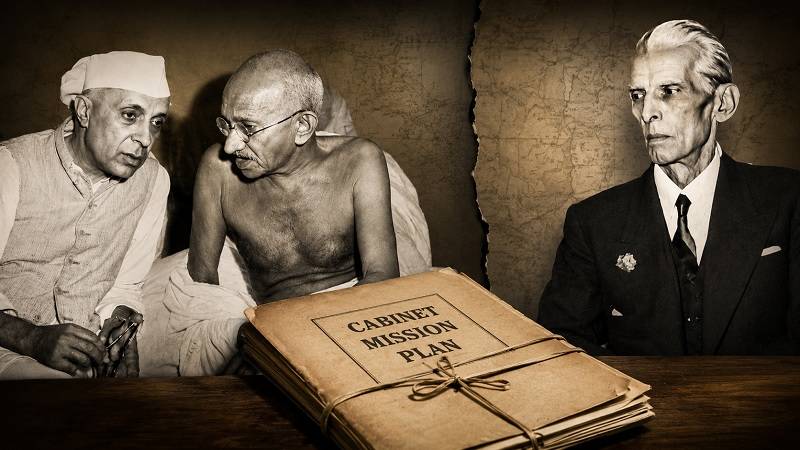
When it is argued that Mr Jinnah was ready to accept a limited union in form of the Cabinet Mission Plan, it was never a question of abandoning the Pakistan demand for Mr Jinnah but purely a question of constitutional law: what relationship Pakistan i.e. autonomous and sovereign Muslim majority areas would have with the rest of India. Would it be in a federation or a confederation or something else?
There are a few basic points that need to be made here. The existence of one united British India from Afghanistan to Burma was not the gospel truth. Sam Dalrymple’s Shattered Lands shows that the British Indian empire at its zenith contained within many other lands as well, including Aden, Burma etc. So it was never one country.
Pick up the map of the subcontinent before the advent of the British and you see that the subcontinent was not a single entity, except for a brief period – literally 2 or 3 years- under Aurangzeb. Even under Aurangzeb, the unity was achieved through brow beating of other powers like the Marathas etc. into becoming vassal states of the Mughal Empire.
So when the overlordship of the British was ending, the question was of the future of a deeply fractured subcontinent. Could united India have existed? Yes but it required a consociation-like solution and that is precisely what the Cabinet Mission Plan delivered.
But before we analyse the merits of that plan, let us look at Mr Jinnah and the Muslim League. Mr Jinnah had formally joined the Congress party in 1906 and that was the same year that Muslim League was formed. Ironically Mr Jinnah was amongst the earliest critics of the idea that Muslims should have a party of their own as well as the Simla Deputation. Jinnah’s politics from then to the 1930s at least was defined by his commitment to the somewhat ahistorical, anachronistic and emotional idea that British India was indeed one country. The separation of Burma in 1935 as well as the writings of visionaries like Chaudhry Rehmat Ali made Mr Jinnah radically reconsider his own erroneous Indian nationalist view. This change of approach in Jinnah is noted by none other than Jawaharlal Nehru in his book Discovery of India.
Yet, this did not mean that Jinnah had abandoned his dream of a united India. His idea of a united India was one of many mansions – a unity above Hindustan and Pakistan which would be the large constituent units of a grand federation. His acceptance of the Cabinet Mission Plan therefore was consistent with the Pakistan demand as he understood it and as it was expressed in the main foundational document of the country i.e. Lahore Resolution.
Maulana Azad was honest enough to admit it in his book India wins Freedom. H M Seervai, the great Indian jurist, concluded similarly in his Partition of India Legend and Reality. Azad and Seervai had no reason to absolve Jinnah of the blame of partition.
Much is made of how he sold the Cabinet Mission Plan to his working committee of the Muslim League. Here it is instructive to read Major Woodrow Wyatt’s account. Major Woodrow Wyatt was a liberal MP who had accompanied the Cabinet Mission in 1946. His second meeting with Jinnah on May 24, 1946 is significant. In it Mr Jinnah seems to be plain that he wants to accept the Cabinet Mission Plan but is in a difficult situation with the League and needs a face saving to do so. I quote the account of that meeting:
Excerpt from the Note by Major Wyatt of Conversation with Mr Jinnah, Friday, May 24th 1946 from The Transfer of Power 1942-7 Vol VII The Cabinet Mission.
“I asked him, in view of the foregoing, whether he thought that the Muslim League Working Committee might possibly pass a resolution on the following lines:
The British had exceeded their brief in pronouncing on the merits of Pakistan. They had no business to turn down what millions of people wanted. Their analysis of Pakistan was outrageous. But the Muslims had never expected the British to give them Pakistan. They had never expected anyone to give them Pakistan. They knew they had to get it by their own strong right arm.
The scheme outlined in the Cabinet Mission's Statement was impracticable and could not work. But nevertheless in order to show that they would give it a trial, although they knew that the machinery could not function, they would accept the Statement and would not go out of their way to sabotage the procedure-but they would accept the Statement as the first step on the road to Pakistan.
At this proposition he was delighted and said "That's it, you've got it", and I am completely convinced that that is what the Muslim League will do.
He will demand parity in the Interim Government if he decides to come into it.”
Even though Congress had initially accepted the plan, it is often argued by Congress circles, starting with Nehru and Gandhi themselves, that the plan provided for a too watered down a federation to viably exist. The only thing that the plan did was provide sovereignty to constituent units. There was no bar on these constituent units finally choosing out of their free will to establish a closer union. The United States of America started off as a confederation. Article II of the Articles of Confederation stated:
“Article II. Each state retains its sovereignty, freedom and independence, and every Power, Jurisdiction and right, which is not by this confederation expressly delegated to the United States, in Congress assembled”
It is precisely what the Muslim majority provinces were asking for starting with Mr Jinnah’s 14 points. It is a lazy argument to say that the question in the USA was not of a religious division. The demand by the Muslim League was couched in provincial rights and not strictly communal terms, in so much as the League asked for sovereign and autonomous units and not sovereign and autonomous communities. It was about Punjab, Sindh, Balochistan, NWFP and Bengal forming a federation of their own or coming into an all-India Federation on the principle that residuary powers lie with the provinces. Even Gandhi pointed this out to Jinnah when they debated the two nation theory i.e., the demand as embodied in the Lahore Resolution did not refer to the two nation theory. Was the demand that provinces be sovereign and autonomous with residuary provinces organised in groups so unreasonable and unworkable? To this I can only present the 10th Amendment to the current US Constitution:
“The powers not delegated to the United States by the Constitution, nor prohibited by it to the States, are reserved to the States respectively, or to the people.”
This is precisely the residuary powers principle that the Muslim majority provinces had been asking for since the 1920s. The underlying sentiment was the Muslim majority provinces escaping the tyranny of a Hindu dominated centre but it was also couched in constitutional language of provincial rights, right from Mr Jinnah’s 14 points. If it could be granted in an otherwise homogenous protestant Christian USA of 1789, it should have been granted in a multi-cultural, multi-religious, multi-ethnic and dare I say a multi-national India. Strangely, even today the Union of India vests residuary powers entirely in the centre and not the states, unlike Pakistan where residuary powers are vested in the provinces.
It is clear that India’s majoritarian Hindu rulers, be they of Congress or BJP persuasion, haven’t learnt anything from history. It is this Nehruvian hubris that caused the partition of India, not the Pakistan demand. The Pakistan demand i.e., sovereign and autonomous Muslim majority provinces was completely compatible with the idea of a United States of India and Sir Aga Khan III had called it precisely that. It was entirely possible that had Nehru did not sabotage the Cabinet Mission Plan with his mala fide interpretation of Clause 15 of the Cabinet Mission Plan, that a Union of India based on the Cabinet Mission Plan would have reconstituted itself as a closer union i.e., United States of India, with Pakistan, Hindustan, Bengal/Assam and Dravidistan as its constituent units. There was no explicit right to secede in the CMP. What was there was a provision for reconsideration of terms. It could have gone either way and if there had been a division later, at the very least it would have been peaceable and not the kind of violent tearing asunder that caused the deaths of 200,000 to 800,000 people in 1947.
The conflict over the provisions of the plan was an entirely manufactured one. Congress argued that the grouping clause of the plan was optional. League argued that it was the basic premise. The Cabinet Mission in its statement on the issue made it clear that the League’s position was the correct legal and constitutional position and the only way to resolve the deadlock.
It was utter lack of statesmanship and foresight on part of Congress leaders, especially Nehru but also Gandhi that caused partition. Jinnah had bent over backwards and taken immense political risk to ensure that India would stay united. There is no escaping the conclusion that the division of India and partition of Punjab and Bengal was the doing of the Congress leadership. Even Lord Wavell who admitted to having disliked Jinnah was forced to conclude that Nehru and Gandhi were not honest men interested in India’s future and that Jinnah had been right all along in his suspicions.
Maulana Azad was honest enough to admit it in his book India wins Freedom. H M Seervai, the great Indian jurist, concluded similarly in his Partition of India Legend and Reality. Azad and Seervai had no reason to absolve Jinnah of the blame of partition.
The responsibility therefore lies squarely with the Congress high command and not Jinnah or the Pakistan demand. Pakistan demand if taken in the context of the Lahore Resolution provided the precise consociational basis of an India above Pakistan and Hindustan. Unfortunately Gandhi and Nehru were too driven by their own political ideologies to keep India’s unity front and centre to their politics.
Jinnah’s Pakistan within an Indian union would have eroded both Gandhi’s majoritarian vision for India and Nehru’s centralising ambitions. A sovereign constituent Pakistan within a United States of India would have been a permanent check on the caste Hindu majority that was the political base of the two men. Hence they chose, and make no mistake about it - it was their choice, a Pakistan outside the Indian union to them was more palatable to their ambitions. So where does the blame lie for the violence and upheaval in 1947? It lies with the party that effectively sabotaged the one plan that could have given India its unity and the party that insisted on partitioning Punjab and Bengal. That party was the Congress which was despite its secular democratic protestations a representative of caste Hindu majority interests.