

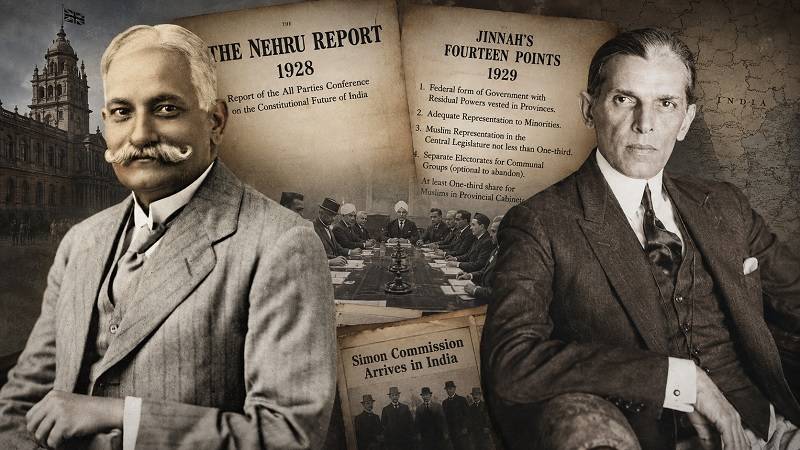
In continuation of Dan Qayyum’s article, Jinnah’s Last Offer, of 14 August 2026, I now examine his contention that the 1928 Motilal Nehru Report was a case of Hindu majoritarianism which compelled Jinnah to react to it in the form of a 14-point counter demand alternative to safeguard the rights of the Muslim minority.
It may be of some interests for readers to understand what the term majoritarianism means. One can define majoritarianism as a form of politics which privileges the biggest group of people to make the rules, virtually exclusively. Such a group can be based on number, religion, language, or class. Its worse manifestation can be majoritarian tyranny. To prevent that, modern democracies institute rules and procedures whereby minority rights are secured constitutionally and legally.
Also read: Did Jinnah Abandon The Demand For Pakistan?
In the light of this definition we can examine if the Motilal Nehru Report represented Hindu majoritarianism. To begin with, the Indian National Congress invited all existing political, religious and ethnic parties and groups to brainstorm a response to the Simon Commission’s all-white constitutional hearings. A constitutional formula which would represent the collective will of all shades of Indian opinion was to be devised. The invitation was sent in the name of Dr Ansari a leading Muslim intellectual and Congress leader. Mohammad Ali Jinnah did not attend its discussions although Muslim Leaguers Syed Ali Imam and Mohammad Shoaib did. A committee was set up to recommend constitutional provisions for India. Among the main recommendations were:
- India was to be dominion on a par with other British dominions.
- There was to be no state religion.
- Men and women would enjoy equal rights based on universal adult franchise.
- Hindustani was to be the national language with two official scripts: devnagari and Persian-Urdu.
- India was to be federation with an effective centre with 47 items given to the centre and 69 to the provinces. There was to be a concurrent list of subjects as well (Mr Qayyum’s assertion that residuary powers were vested in the provinces is not correct).
- There was to be neither separate electorates for minorities nor weightage adopted for any province. However, Muslims could have seats reserved strictly in proportion to their numbers in the provinces.
- Sindh was to be created as separate province provided it was found to be financially viable.
- Reforms were to be introduced in NWFP on a par with those in the other provinces.
The main thrust of the Motilal Nehru Report was that separate electorates prevented the formation of a nation based on equal rights of individuals. Weightage to minorities created unfair representation. The Muslims of Punjab and Bengal opposed their majorities being reduced to give greater representation to minorities such as the Sikhs in Punjab who were overrepresented at the expense of the Muslims.
Chaudhry Khaliquzzaman writes on page 101 in his book, Pathway to Pakistan, that in 1929 a meeting of the Muslim League was held in Delhi where a section of the party was in favour of accepting the Motilal Nehru Report but goondas stormed the meeting and threw out the supporters and then arrived Jinnah and the Report was rejected.
But more important was that by basing the right to vote on a universal adult basis and conferring equal rights on men and women the Report essentially undermined Hindu theology according to which a Brahmin could be given unlimited votes but a Dalit was not fit to have any right to vote. It was also argued that only miniscule minorities could possibly need separate representation but not communities like Muslims who were one-fourth of the total population and in a majority in north-western and north-eastern zones of India.
The final Report was signed by Motilal Nehru, Tej Bahadur Sapru, S. Ali Imam, Madan Mohan Malaviya, Annie Besant, M. A. Ansari, M. R. Jayakar, Abul Kalam Azad, Mangal Singh, M. S. Aney, Subhash Chandra Bose, Vijayaraghavchariar and Abdul Kadir Kasuri (grandfather of former Pakistan foreign minister Khurshid Mahmud Kasuri).
Jinnah’s 14 points included:
- Federal form of government with residual powers vested in the provinces.
- Adequate representation to minorities in every legislature without reducing the majority in any province to a minority.
- Muslim representation in the central legislature should not be less than one-third.
- Separate electorates for communal groups which any community can abandon in favour of joint electorates.
- At least one-third share for the Muslims in the provincial cabinets.
The main bone of contention between the Motilal Nehru Report and Jinnah’s 14 points was over one-third representation to Muslims in the national legislature and one-third representation to them in all provincial cabinets.
It needs to be underscored that the Report had effectively done away with the distinction between a Brahmin and a Dalit and a man and a woman with each individual being given one vote. How could the Muslims who were less than 25% of the total population in the 1920s be privileged to over-representation in the national legislature but even more significantly in provincial cabinets when in provinces such as Madras, CP, UP, Bihar and so on their percentage of the population varied between 7 and 14%?
Chaudhry Khaliquzzaman writes on page 101 in his book, Pathway to Pakistan, that in 1929 a meeting of the Muslim League was held in Delhi where a section of the party was in favour of accepting the Motilal Nehru Report but goondas stormed the meeting and threw out the supporters and then arrived Jinnah and the Report was rejected. He mentions that even Raja Sahib Mahmudabad was in favour of accepting the Nehru Report.
Obviously the attack on the supporters of the Report by goondas in Delhi where the Viceroy of India resided could not have taken place without the connivance of the authorities.
In short, the Motilal Nehru Report did not invest residual powers in the centre but divided them in the proportion of 47 – 69 items, and by conferring one vote on one individual political equality of all was acknowledged which Hindu theology had no place for. Also, the same principle applied to elections and representation in legislatures and provincial governments. The allegation that the Indian National Congress represented majoritarianism is not borne out by objective facts.
One can add that in 1931, the Congress Party passed a resolution that minorities will have the right to apply their religious rulings on personal matters such as marriage, divorce and inheritance. Later, in the 1980s this became a major argument of the Hindu Right that the Congress Party appeased Muslims because while in the 1950s the Hindu Personal Law was reformed, the Sharia-based Muslim Personal Law was left intact.
For details my book, Jinnah: His Successes, Failures and Role in History, can be consulted.